
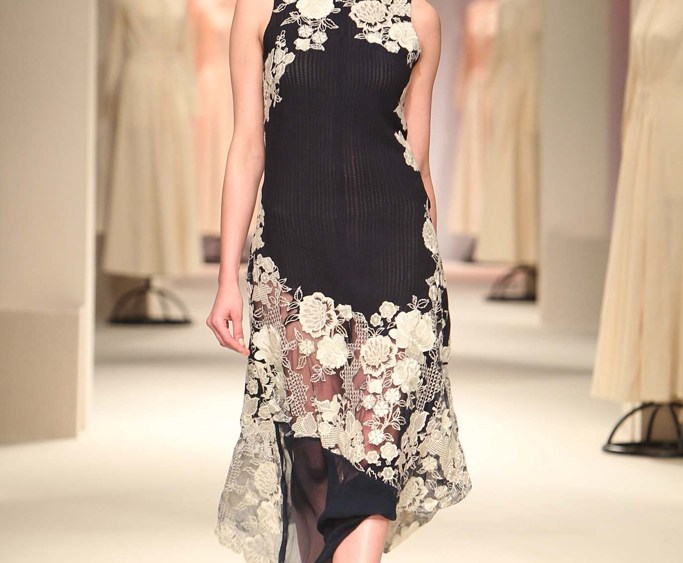
NEW DELHI — Amazon India Fashion Week opened Wednesday at Pragati Maidan here with five days of shows of designers’ fall collections.
The inaugural year of Amazon India, which replaces Wills Lifestyle India Fashion Week, is expected to be highly watched. Several designers said the collaboration means more opportunity for sales and growth, especially in times where buyers are not knocking heavily on every door.
“It really means a wider sales platform,” said Pratima Pandey, a designer who has an exhibition booth and will show Saturday.
The first show Wednesday was by Rajesh Pratap Singh, who’s known for his work with wool and spoke about the way the fashion week itself has evolved, as it marks its 25th season.
Related Articles
“I think the fashion week has come a long way. I’ve been part of it from the start. I think it’s going to grow much more in coming years,” he said. As for his own show, Singh said, “One has to do what you normally do — you can’t get carried away. We do things out of India that can be worn in any part of the world.”
You May Also Like
His show marked a morbid, if innovative, opening.
With hospital beds lining the runway, models completed the imagery as did his designs — which were clinical but structured, with wool weaves — and the Indian ikat textiles. The collection was made up of handwoven fabrics in merino wool in bold black-and-white or ikat checks and stripes, with models wearing black eyeglasses and bright lips marching up the runway, weaving through the beds in some cases; dancing at others. “It’s a simple, wearable collection, with a lot of textiles involved,” Singh said.
The fashion week, which is organized by the Fashion Design Council of India, will showcase 100 designers, but with a scaled down 25 shows over the five days. Some of the top designers who will participate include JJ Valaya, Rina Dhaka and Malini Ramani.
Vikas Purohit, head of fashion for Amazon India, said the 40 days between signing on as sponsor and the event itself had been extremely busy and focused on the new synergies that could result.
“For us, the biggest thing will be to jump-start the ecosystem here, of manufacturers, designers, sellers and a platform like Amazon working together. It’s just the start,” he said.
“The fashion and design industry is quite primed to do business now,” said Narendra Kumar, creative head at Amazon India, and a well-known designer himself. “They understand that this is a moment in history and they have an opportunity for moving — from a designer to a brand. They have realized the importance of e-commerce and how this is going to fuel their growth in the future. A lot of their growth was stunted because of retail costs. Today, e-commerce does not have those retail costs, but it has the reach that retail could never give them. There’s a lot of positives in the design community with this collaboration.”
A point of contention has been the high prices of the designer collections shown at fashion week. In addition, most Indian fashion e-tailing focuses on the lower end of the market. Purohit said part of the effort was geared toward growing the consumer shopping basket.
“Today we sell saris for 35,000 rupees [$560 at current exchange] on our platform,” he said. “They don’t sell as well as the 400 rupees [$6.40] sari, but it is how many new customers we are able to reach out to and how many more this is than a store can reach. It is a myth that higher price points don’t sell on e-commerce sites.”
Purohit said the business for higher price points was “fantastic” in other segments, like shoes. “We launched the Reebok Pump. It’s a 15,000 rupee [$240] shoe, more expensive than Nike. They’ve seen a sellout at Amazon in three days and they have launched exclusively at Amazon. Titan did a seven-day campaign with us for Titan Dicati campaign for watches, which were 25,000 rupees [$400]. It was a sellout. Out of their 200 stores, they did not sell as much as they sold on Amazon. There are many such examples,” he said.
The designers themselves see the shows as a chance to grow their businesses.
“I will say the fashion week in Delhi is a serious one,” said designer Tarun Tahiliani, known for his draping. “But it has stayed stagnant as well as parochial and hasn’t moved on. Now they will take fashion to a new customer and take pret to a true pret customer at prices Indians can afford.”
The finale on Sunday will showcase traditional Indian craft creations by 25 designers, including khadi, a hand-loom fabric.