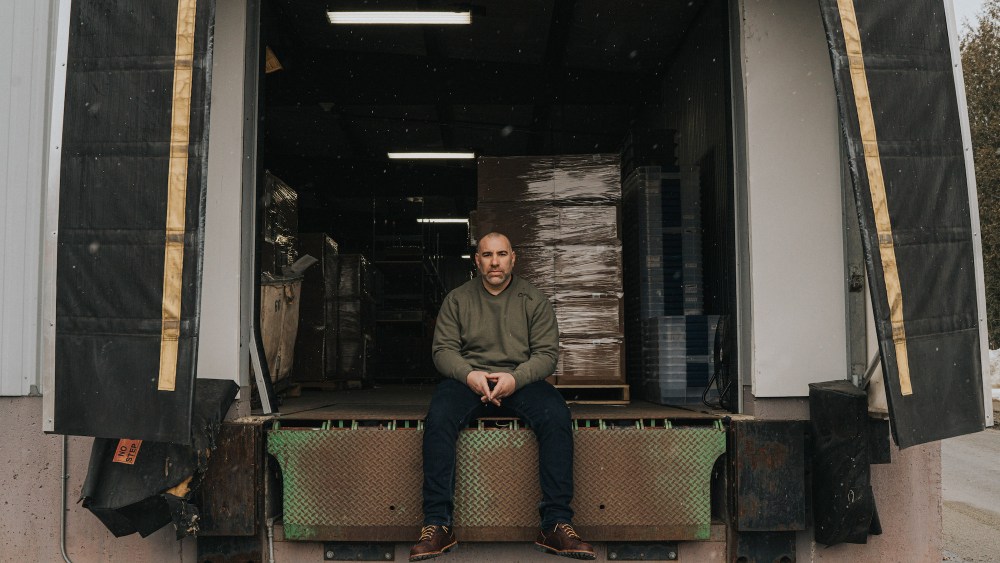
In a time when globalization and fast fashion dominate the apparel industry, one New England manufacturer is rewriting the script. Since launching Origin USA in 2011, Pete Roberts has made it his mission to bring denim manufacturing back to American soil — not as a niche craft, but at scale, and with purpose. Rooted in the belief that manufacturing can provide both economic vitality and personal fulfillment, Roberts and his business partner Jocko Willink are building an apparel and footwear brand that prioritizes local supply chains, environmental impact and quality craftsmanship.
Related Articles
Origin employs more than 300 people across three factories in Maine and North Carolina. The brand produces T-shirts, outerwear, technical bottoms, performance apparel, jiu-jitsu gear, footwear, accessories and more. In 2019, Origin launched its first jean. Denim now accounts for a quarter of the company’s business. On Black Friday 2024, Origin generated $6 million in sales and shipped 30,000 pairs of jeans — more than the brand’s total annual sales in 2019.
You May Also Like
“It’s been a real process, because we’ve done everything from scratch with no funding,” Roberts said. “But it’s been a fun journey.”
In this interview, Roberts discusses the challenges and rewards of producing domestically, the knowledge gaps his team has worked to close, and the long-term vision for creating an enduring, “built by freedom” legacy.
From a business perspective, what advantages have you seen from keeping manufacturing domestic?
Pete Roberts: I think there are multiple advantages to keeping it domestic. Number one is purpose. Jobs are important, especially in my community. In New England there are towns that were built around factories and now a lot are empty. It’s giving people purpose if they decide that they don’t want to go to college to become accountants and programmers. I look at manufacturing as a trade and there are a lot of people who want to do it. We have an obligation to support our communities. Additionally, keeping everything on a local supply chain is [sustainable]. There’s also so much economic prosperity throughout the supply chain that can be had. For me, localization is a very big thing. It’s important to know you’re having a positive impact on the environment and people. And you can better control manufacturing when you know where things are coming from. I know the people I’m working with; we’re friends. I can control the product and the quality product well and I can be anywhere in a few hours if I need to be. That’s also important.

Has manufacturing denim in the U.S. become easier or more difficult since you started in 2011?
P.R.: It’s become easier because there’s more knowledge. When I started, especially in my part of New England, there was no knowledge left. There were a couple of old-timers who had a little bit of knowledge and helped me. But as we’ve grown, we’ve rediscovered the knowledge and have passed it on to our team. There’s redundancy in our knowledge base. When you have one person with all the knowledge, you have a single point of failure. When you have 300 people with a shared consciousness, a shared knowledge, you can be craftier, and things don’t take as long as they used to. It used to take forever to do something, because we were figuring it out. Now we can develop things and do new things, and we have the skills to make them happen.
Is training a workforce difficult?
P.R.: You’d think it would be hard to train people, but we have a lot of young people. I look at it as a trade and a skill set. I’m not just training somebody on one thing. They’re not just pressing a button and pulling a levee. They’re crafting, they’re moving between machines, and they got to know how to do this and that and the other thing…as they learn and get better, it becomes more fulfilling for them. People intrinsically want to do a good job.
What have been the biggest challenges in producing denim domestically? How have you overcome this challenge?
P.R.: The hardest part was making the garment again. I wanted to bring [denim manufacturing] back but not in a bespoke way. I didn’t want to cut one pair of jeans. I wanted to bring it back in a scalable way. But trying to jump into scale immediately was difficult. We had to learn about leg twist and shrinkage on different batches and quality. There was just so much that we couldn’t see at face value until we got to the garment. It’s not just being able to create the garment one time — it’s being able to create it a million times and make sure it’s consistent every time. That was hard. There was a huge knowledge gap in being able to make that happen.
How did you overcome that challenge?
P.R.: We made a lot of tuition payments. We couldn’t sell the first 500 pairs of jeans. We donated a lot of them. Then I met a couple of patternmakers from Wrangler, and they went through the whole process. They learned from old-timers who used to work for Wrangler and filled in the knowledge gaps we were missing. They reengineered our patterns, created processes around what happens when the fabric comes in like inspection points and tolerances. I needed skilled people to help us on that part of the business.
Do you find U.S. denim production to be limited in terms of capabilities or variety?
P.R.: It’s all very challenging. We make a super-stretch denim. We’re making a 100 percent cotton heavyweight denim this fall and then next year we’re going to start selvedge denim. Making selvedge denim at scale in American is obviously hard. Each one is a challenge, but we’ve built a process around being able to do it. We don’t skip steps. If you skip steps, it’s disastrous.…But once you got it and you have talented people, and the knowledge is shared, you can make any style, whether it’s a relaxed or tapered or boot cut.
Does the U.S. government play a meaningful role in supporting domestic production for apparel? Is there enough incentivization for small businesses to produce Made in USA jeans?
P.R.: No, not even close. The U.S. government, historically, is concerned about national security and manufacturing. When you’re talking about footwear and apparel manufacturing, the original purpose was to outfit America’s military and that is the reason we still have the remaining fabric mills and factories. For the most part, they are supporting the federal government. They are maintaining the knowledge needed to make garments and footwear that fit the U.S. military’s needs. That’s the focus of the U.S. government. The focus has not been on that manufacturing in America is the right thing to do. It’s the right thing to do from a fossil fuel perspective. It’s the right thing to do from an economic perspective.
How do you anticipate current or future trade policies impacting your business operations and supply chain?
P.R.: It’s a good question, because it’s not what you would think, right? I would say, for the most part, no. But the one caveat to that is, if there’s more demand for U.S. apparel manufacturing, prices will go up because more people want to make it here. We saw it during COVID-19 with lumber — when demand increased, lumber prices soared. It won’t affect us tremendously, because we weave some of our own fabric. We cut and sew in our own factories. Raw materials might go up in price if there’s more demand, but I don’t think too much.
Do you work with any garment factories outside of your own?
P.R.: We make everything. We have overflow shops that help us on hoodies and T-shirts, but when it comes to things like blue jeans, jiu-jitsu gis and footwear, we don’t subcontract that stuff. We have a footwear factory in Maine where we make shoes from scratch with U.S.-sourced components. Those hard to make goods, we do it all in house.
What are your long-term goals for growing or evolving your domestic production?
P.R.: To build America’s next big brand, but 100 percent on American supply chain. That’s the 100-year plan. People think I’m crazy because I call it a 100-year plan, but it will transcend me. I’ll be gone by the time it’s realized. We’re going to go slow to speed up. We don’t need to go eat tons of market share tomorrow, because we’re never going to go public and we’re never going to sell the private equity or venture capital. We’ll maintain the business structure the way it is.
Origin produces a lot more than jeans. What categories do you see the most growth potential in?
P.R.: I think it’s less about growth potential and more about market size. The market will always grow, especially in blue jeans. People are always buying apparel. When I look at what has happened in footwear and apparel with Shein and Temu — all these cheap and cheerful goods coming across the ocean — it’s really disheartening, because the American consumer continues to be convinced that this is the way to buy more. And what we’re trying to say is, you need to buy less. You just need to buy quality, whether it’s from us or somebody else. The American consumer is consuming more than they ever have. The market is there; now it’s convincing consumers to spend money on the right things. If they’re looking for dopamine from a $12 flannel from Temu, that’s one thing. But if they’re looking for long-term fulfillment that’s where we can pull on their heartstrings a little bit. That’s the goal.
Do consumers actively seek out “Made in USA” products? Is that what draws them to the brand?
P.R.: Those early adopters just wanted to support Made in USA. But then they saw we offer a variety of product and we’re transparent about where things are made. We’ve showed them soup to nuts everything we’re doing, and customers want to become part of the revival of U.S. manufacturing. But in the beginning, we didn’t have best-in-class product, right? So, to appeal to customers who want best-in-class product, good fits and fabrics and function, we had to get better. We had to get better at building product. Now customers see it’s a great product, made in USA, dollars are going back to the community, and they love it. We’re diversifying product categories — that’s the phase we’re in now. We have our heritage goods, training goods, casual goods and the next step is professional.
What do you have planned for the rest of the year?
P.R.: We’re releasing our 100 percent cotton jeans in the fall and our first women’s jean, which we’re really excited about. Fiber, labor, rivets, zippers, buttons — 100 percent American made. We’ve trademarked the term “built by freedom.” That’s our way of saying “American made” because American made can mean a part of it was made in South America and then it was assembled in the U.S. “Built by freedom” means that every component came from a U.S. supply chain. We’re also expanding our footwear offering. We’re making a really cool bison boat shoe and some sneakers, and more casual goods professional goods. So really excited about this year.
In the current climate, is it challenging to not politicize “Made in USA”?
P.R.: Yes, it’s very difficult, because we’ve been standing on the rooftop for almost a decade and a half now, trying to tell the world what happened to my community and how we’re going to try to fix it. It was very people-centric, and purpose-driven. It’s like, we need to do this, because if we don’t save this, it will be gone forever. We’ve always been politically agnostic, but now suddenly there is this big Made in USA push, which I would say has become a little bit weaponized, depending on what side of the aisle you stand. But for me, it’s just the right thing to do.
It has been politicized, and maybe that’s OK because it’s getting everybody talking about it. I’d rather everybody be talking about it than not. During COVID-19, everyone wanted to make stuff here and the moment that ended, boom, everything back to foreign countries. Well, now people must talk about it so that’s a good thing. We’ve received less than a handful of comments like, oh, you know, I love Origin, but you guys are getting all political. And I’m like, whoa, what do you mean? We literally haven’t changed our message, but the noise from the outside has convinced you of this. Being 100 percent Made in America isn’t a political statement. That’s who we are. That’s our soul.
This article was published in SJ Denim’s “Made in America” issue. Click here to read more.