The activewear game is getting more competitive — especially online.
With ath-leisure continuing to boom — NPD data show sales in the category rose 8 percent in the year ending in October to $35.1 billion, or 17 percent of the overall apparel market, even as other sectors lagged — more and more companies are entering the fray. While the industry continues to be dominated by major players such as Nike, Adidas, Under Armour and Puma, these firms are only halfheartedly competing online, leaving a huge hole for new entrants.
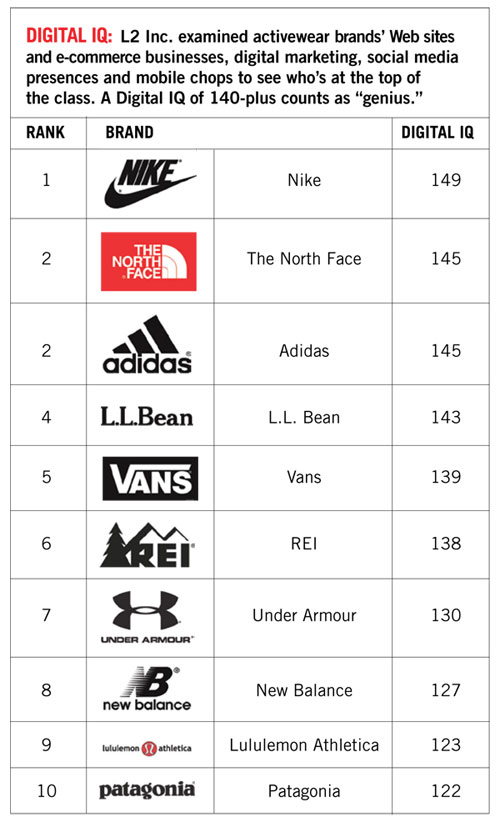
Even those who get marketing right — Nike last year spent $3 billion on advertising overall, or what it calls “demand creation” — don’t always see those efforts translate directly into e-commerce sales, according to L2’s Digital IQ Index for Sportswear. Still, Nike’s “Risk Everything” campaign — with its “Winner Stays” and “The Last Game” videos garnering 105 million and 76 million views, respectively — as well as a Nike+ Training Club app that has more than 17 million members, helped the company become one of four “genius” brands in the index.
Related Articles
Nike topped the L2 study, which ranked 59 athletic brands by their digital savvy and was released late last month. Adidas and The North Face tied for second, while L.L. Bean was fourth and Vans was fifth. REI, Under Armour, New Balance, Lululemon Athletica and Patagonia rounded out the top 10.
You May Also Like
But Nike as a brand still has plenty of room to grow when it comes to sales online.
“Nike is lagging in terms of e-commerce investments despite the fact that they grew over 50 percent in terms of e-commerce [last year],” said Sam Lee, research lead at L2 Inc.
Of Nike’s nearly $28 billion in revenues last year, just 3 percent, or about $800 million, came from e-commerce, he said. That’s well below the overall market, where e-commerce comprises slightly less than 10 percent of total retail sales.
Lee attributed at least part of this to the fact that only 20 percent of Nike’s sales are direct to the consumer, while the other 80 percent come from third-party sellers. Because Lululemon, which came in ninth place in the study, is a direct-to-consumer brand and controls its retail distribution, a much higher percentage of sales come from e-commerce. Lululemon’s e-commerce sales made up about 17 percent of its revenue last year — almost six times that of the more wholesale-oriented Nike.
“All the investments they’re [sports brands overall] making in digital don’t always translate into digital sales. It’s all about digital influence,” Lee said, estimating that digital influences up to half of all retail sales, with many of these purchases executed in-store.
Lee said: “The big brands [such as] Nike, Adidas, Under Armour and Puma are lagging [compared to] the rest of their retail peers in terms of digital because they are not sizing their digital investments appropriately. They’re allocating their digital advertising budget and sizing based on the size of their e-commerce business when in actuality they should be sizing it based on the full business because it’s affecting all of their sales, not just online sales.”
For instance, Under Armour increased its marketing budget by 34 percent last year to $333 million, or 11 percent of total revenues. Digital investments still aren’t as large as they should be, though — Lee said most of Under Armour’s marketing budget went toward securing high-profile sponsorships like Gisele Bündchen.
The relative underinvestment in digital by larger brands is providing an opening for smaller, nimbler players to break into the market.
Nick Brown, a partner at venture capital firm 14W — whose portfolio of brands include Everlane, Moda Operandi, Reformation, Glossier and eight-month-old men’s running apparel brand Tracksmith — said that the overarching question in terms of innovation online is whether this will be driven by a company that no one has ever heard of, one that is just specializing in the space or from a pre-existing lifestyle brand that doubles down on activewear as a category.
“Why most people suggest it will be a stand-alone business is that Nike and Lululemon are the most obvious winners in this category and they don’t actually do anything else [besides activewear],” Brown said. “There is something to be said about this not being a category of a larger lifestyle brand and being the core competency of the business.”
Net-a-porter unveiled its activewear portal Net-a-sporter last July, and Carbon38, an e-commerce site that strictly sells activewear, relaunched in the fall. Foot Locker’s younger, more stylish retail concept, Six:02, launched in 2012 and is banking on a strong Web presence to grow the brand, which has only a few doors across the U.S. so far.
The most recent to join the fray is Sweatstyle, which launched in February. Founded by Helena Cawley, the site sends members a box of activewear styles based on a detailed survey they fill out upon sign-up at Mysweatstyle.com. There is no membership fee, and customers have five days to decide if they want to return anything from the assortment, which includes brands like Alala, Koral, Zara Terez and Pheel.
Members get a 15 percent discount on the total purchase. It’s not a program for those on a budget. Prices on pants, for instance, reach up to $140.
Heather Kaminetsky, Net-a-porter’s vice president of marketing for the Americas, said that the sport category and men’s personal care and grooming were standouts in terms of growth drivers for the company in the past year. “We launched sport last year and within one day almost everything sold out — ballet, sailing products, equestrienne, even ski boots in July sold out instantly,” Kaminetsky said at Harvard Business School’s recent annual Retail and Luxury Goods Club conference. “Customers were telling us they needed more sources for sport product.”
Selling activewear online, though, requires a certain touch.
When Carbon38 originally launched in November 2013, founders Katie Warner Johnson and Caroline Gogolak said they built a standard, “cut and dry” e-commerce experience, where they photographed product and put it on their site, Carbon38.com. The two soon realized that activewear had “low hanger appeal” and if they wanted to grow the business in a significant way, they would have to change the look and feel of the site.
“We took a hard look at imagery, brought a photographer and the shoots in-house. All of our models are fitness professionals — they aren’t models. They are the living representation of this whole market,” Warner Johnson said.
The venture, which has raised about $2 million to date, maintains 12 full-time and six part-time employees. Sales for 2014 were $1.5 million and Warner Johnson and Gogolak project sales to hit close to $10 million by year’s end.
There is also a seemingly endless supply of up-and-coming active brands that are looking to grab share with a good deal of digital know-how, including Zara Terez, Tracksmith, Qor, JustFab’s Fabletics and Outdoor Voices.
New York-based brand Zara Terez, which is carried at both Carbon38 and Sweatstyle, as well as powerhouses like Amazon and Shopbop, is seeing meaningful growth online — both from a wholesale and retail standpoint. The company began as a wholesale business — first selling handbags in 2008 and then expanding into girls and adult ath-leisure apparel in 2012 — and has since established a strong direct-to-consumer presence online and large social media following. The brand’s vibrantly printed leggings, which retail for about $78, on average, have developed a cult following of women of all ages, solidifying the need for a strong digital flagship at Zaraterez.com, as well as a performance collection, which rolled out last year with the relaunch of the women’s line.
The brand is carried at more than 350 doors worldwide, including Nordstrom, Saks Fifth Avenue and, next month, Bloomingdale’s.
Tracksmith, the men’s performance apparel site that launched last year and specializes in running gear, is getting set to introduce a women’s collection in the spring. Founders Matt Taylor and Luke Scheybeler said that like their men’s pieces, women’s will focus on fit and function, embracing the same Ivy League inspired aesthetic. Then there is Qor, another vertical men’s e-tail brand that launched last year with a site at Qorkit.com and a catalogue. Qor is going after the ath-leisure trend in the men’s market, offering pieces that can take its customers from the gym to the office, including a $398 thermal cashmere hoodie and a $118 plaid tech shirt.
Fabletics, the direct-to-consumer activewear e-commerce site that was cofounded by Kate Hudson in 2013, sells complete outfits that start at $49. Members can browse personalized monthly activewear picks and elect to buy or skip at any given time. The activewear site is only a part of JustFab’s online empire of footwear, kid’s clothing and apparel, which raised $85 million in funding seven months ago and is expected to reach $500 million in sales this year.
Geraldine Martin-Coppola, general manager of Fabletics, said the brand will be profitable by the third quarter of this year, right before the company turns two years old.
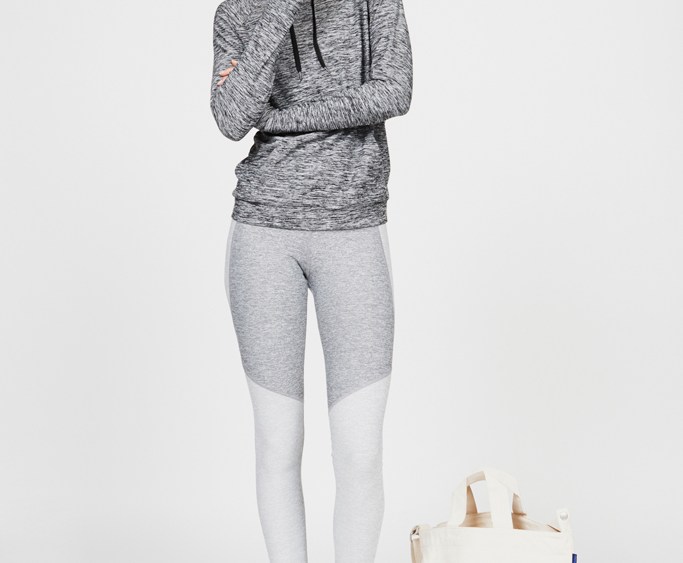
Outdoor Voices debuted at the end of 2013 with the launch of outdoorvoices.com and opened a freestanding door a year later. Items from the Austin, Tex.-based brand, like the $100 “Warmup Leggings” — paneled compression pants that come in color-blocked black and navy or light and dark grey options — are as functional as they are fashion forward.
According to Andrew Parietti, president of Outdoor Voices, 95 percent of the company’s sales come from its Web site and “all efforts continue to focus on direct online growth for the next few years.”
“We are the next generation of activewear, and being able to speak directly to our customer is everything for us,” Parietti said. “We don’t sponsor professional athletes — our brand is our community and we are in dialogue with them on a daily basis.”
And that next generation will no doubt do everything they can to keep the big names on their toes, online and off.