“To put it bluntly, Jane Fonda is one bad b—h,” exclaimed RuPaul after listing the 83-year-old actress and activist’s long list of accomplishments.
It was onstage inside the newly opened Academy Museum of Motion Pictures at Women in Film’s annual celebratory dinner, held to honor industry trailblazers. Founded in 1973, the Los Angeles-based nonprofit advocates for women working in television and film. Fonda was presented with the inaugural award named after her — the Jane Fonda Humanitarian Award.
“I became mesmerized a little over 50 years ago, when she showed up in my mailbox on the cover of Life magazine,” continued RuPaul. “I studied that cover as if my life depended on it. I remember thinking, ‘What is Barbarella?’ That body, that hair, that pose. Today, I understand why I was so mesmerized. It’s a combination of strength and vulnerability, intellect and beauty.”
Related Articles
When Fonda took the mic, she used the opportunity to spotlight a few of today’s most pressing issues, climate change and equal rights, urging women to continue to unite to create, collaborate and fight for change.
You May Also Like
“We’ve reached a moment in the history of humankind when all the things that once held us together and sustained us are unraveling, not just the ecosystems upon which we depend for life, but the idea of the collective of community, the common good,” Fonda said. “In our lifetimes, these things have become bad words, and individualism has been exalted and put on a pedestal.…That’s where women come in. For evolutionary reasons, women tend to be less prone to the disease of individualism, less ego-identified, more empathic, more welcoming to the idea of the public good and to collective action in support of the public good. We’re more able to embrace the holistic approach that’s needed. We see the connections between things. We understand interdependence. It’s what feminism does. As Gloria Steinem says, ‘It’s not that we’re morally better than men. We just don’t have our masculinity to prove.’”
Activism “isn’t a sprint or a marathon,” she added. “It’s a relay race, and I see this award — this award, I think, is a torch that will be handed off year after year to new generations of activists who will, I hope, do a better job than my generation did.”

The night, hosted by comedian, writer and actress Jenny Yang, also honored actress Zazie Beetz. Though not present, she was given the WIF Max Mara Face of the Future Award. (The Italian house is a longtime sponsor of the event, also supported by ShivHans Pictures and Lexus.) And as Women in Film does every year, the organization presented its Crystal Award, awarded to six women this year who have helped to expand the role of women within the entertainment industry: actress and deaf activist Marlee Matlin alongside writer and filmmaker Siân Heder, who worked together on Apple TV+ film “CODA”; actors Jean Smart and Hannah Einbinder of HBO Max series “Hacks” — twinning in matching black Max Mara suits — and actress Zendaya with producer Ashley Levinson, who most recently collaborated on Netflix’s “Malcolm & Marie” during the pandemic. The pairs — introduced by presenters Lauren Ridloff, Carl Clemons-Hopkins and John David Washington, respectively — sat for a few minutes onstage to converse throughout the evening.
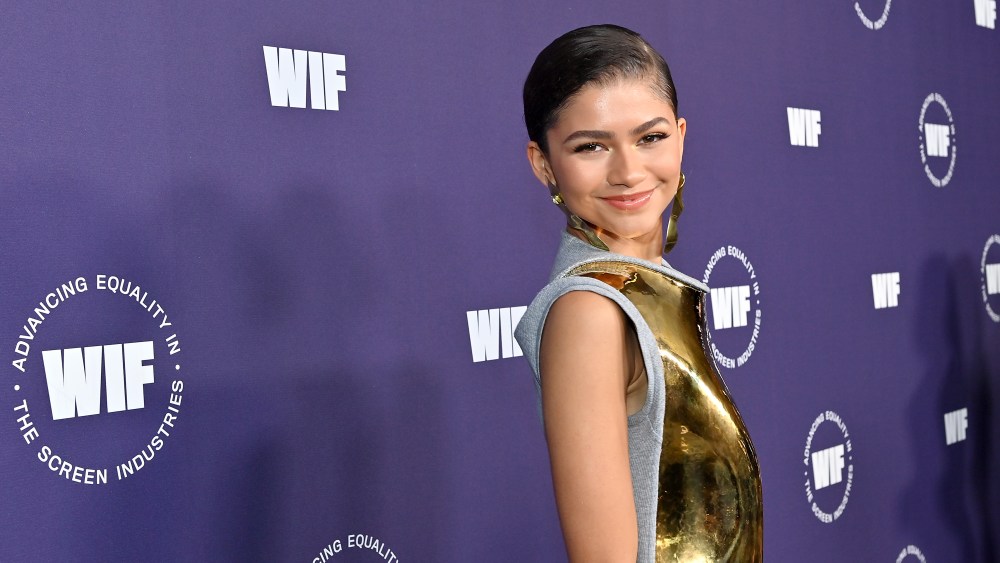
“The film came through basically just me being at home, like, can you please write me something to shoot in the house?” explained Zendaya with a laugh. She wore a straight-off-the runway, body-hugging Loewe dress adorned with a gold breastplate.
“Malcolm & Marie” had a shared equity model, allowing the crew to have an equity stake in the making of the film — which is far from the industry norm.
“We were doing it from our own pockets,” said Zendaya, explaining the decision. “I mean, there was a world where we hoped that one day we’d be able to sell it and maybe make some money. But we felt that if we did that, the people who were there every day with us, who took the risk of coming out there and making this art with us, should partake in that. It just felt fair.”
“What do you see as the biggest changes that are needed to help with inclusivity?” asked Yang.
“This room is a testament to some of that work, and the work that has been done, but we all know that there’s a lot of work left to be done,” Zendaya replied. “Any of us who have ever been in the meetings or been in the rooms behind the scenes, you can see it every day if you feel like you’re the only person there that looks like you. So, in my opinion, it’s not a lack of talent. It’s lack of opportunity, right? And many people who feel like they got the opportunity, there’s always this idea that there can only be one. And I oppose that idea. When you open the door, your job is to open the door and jam it open for other people to come in.”
“Hacks” costars Smart and Einbinder, who have undeniable chemistry, brought the biggest laughs of the night as they discussed their hit show. (“It was like the island where Wonder Woman is from,” joked Einbinder, a comedian and acting newbie, of working with a crew of women.) Meanwhile, Matlin, Heder and Ridloff had a powerful conversation about representation.
Heder said she felt a responsibility as a hearing person to surround herself with deaf collaborators and actors while making “CODA,” 40 percent of which is in American Sign Language.
“As a new actor in this industry, I have learned that myself, I feel like we’re at a point where the industry is starting to realize the importance of having authentic representation,” said Ridloff, who played Sarah Norman in Broadway’s “Children of a Lesser God” — the same character embodied by Matlin in the 1986 film.
“We’re not costumes that you can put on and take off at the end of the day,” added Matlin.