
“I wish I could have danced tonight,” said Paris Opera Ballet étoile dancer Hugo Marchand on Thursday evening at the gala celebrating the opening of the 2023 ballet season.
After the traditional procession of the ballet corps, he joined a glamorous audience that included Charlotte Casiraghi, Golshifteh Farahani, Clémence Poésy and Emma Mackey for an evening honoring contemporary female choreographers.
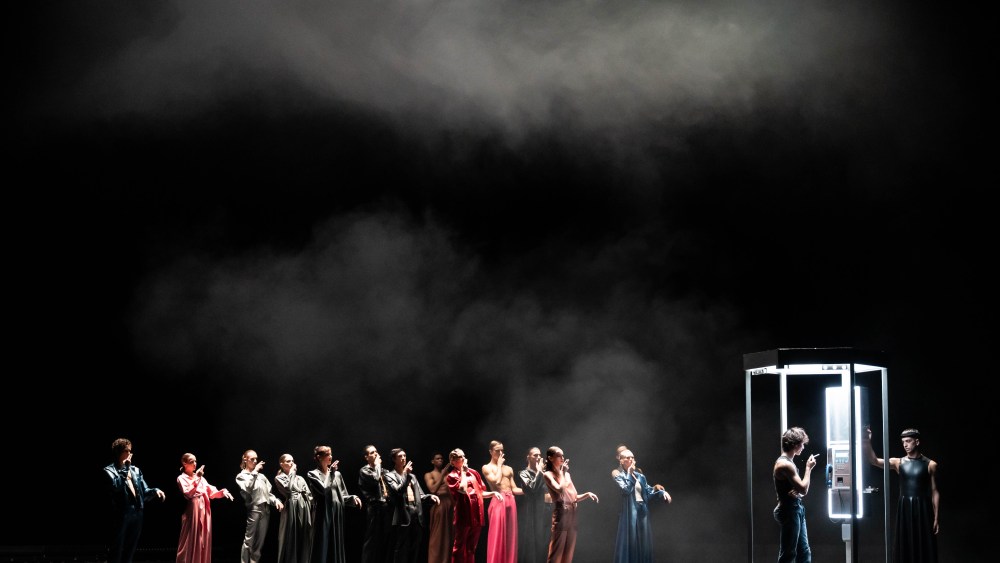
The three ballets presented during this fundraising evening supported by Chanel and Rolex were “The Last Call,” by French choreographer Marion Motin; “Horizon” by China’s Xie Xin, and “The Seasons’ Canon,” created by Crystal Pite in 2016. Conductor Stephanie Childress led the orchestra’s performance.
Related Articles
As is tradition, the program started with the procession of the ballet corps, from the youngest students enrolled in the institution’s dance school up to its prima ballerinas crowned with Chanel-created tutus and tiaras, including Émilie Cozette, who was retiring from the stage.
You May Also Like
Her final appearance was marked by lengthy applause from the public, embraces from her colleagues, a shower of golden confetti — and the dedication of the “Singularités Plurielles” piece that followed, a work by her husband, the French choreographer Nicolas Paul.
During the first intermission, chatter alternated between admiring the double-breasted Chanel tweed satin-lapeled trouser suits in Paul’s piece and discussing the opera house’s facade, whose classical features were turned into a gigantic grotto, the first of two monumental trompe-l’oeil tableaux imagined by artist JR to dress the scaffolding of the historic building.
A new chapter of the installation, set to be unveiled in November, is being created at 19M. Its design, a large-scale stage curtain depicting the inside of the cavern, will include handprints embroidered by members of the public who registered for initiation classes at the Chanel-owned hub of specialty workshops.
Motin’s “The Last Call” and Xin’s “Horizon” formed the second part of the ballet opening evening’s performance and brought conversations to female power and expression.
Even with her long-standing interest in dance, Casiraghi was particularly struck by the Chinese choreographer’s work, an ethereal evocation of cycles of life and nature.
“I discovered an aesthetic of movement very different from what I had been accustomed to seeing in ballet,” she said at the second intermission.
Changing tack to keep ideas vibrant was also on her mind for the bimonthly Les Rendezvous Littéraires Rue Cambon (literary gatherings at Rue Cambon, in English) events she dreamt up.
“Why not involve dance and literature? It could be a rather novel approach,” Casiraghi mused when asked if there was anything she wanted to try in subsequent editions.
As conversations turned to female power and expression, Casiraghi felt that “a woman who sees her dreams through definitely is powerful,” though she was loath to lock the definition down for a gender.
This thought carried over to the final performance of the evening, which received a sustained standing ovation that had the performers saluting four times.
Pite’s work saw male and female dancers clad in similar baggy gray trousers with bare chests, blurring the cast into one entity whose gestures came in unison or cascading waves.
This resonated particularly for Farahani. “Because I’m from Iran, I can never think about [whether] an artist is a man or a woman because my fight is that we are not [seen through] a gender — we are artists,” she said.
That said, seeing female choreographers or conductors onstage made her feel like “applauding more because it has [her] thinking that we have come a long way,” the “Extraction” star added.
As such, it was an evening Farahani had not wanted to miss, despite the complexity of traveling from the remote area of Northern Italy where she is busy filming a biopic on Swiss folk hero William Tell directed by British filmmaker Nick Hamm.
Over dinner — a gastronomic affair by chefs Greg Marchand, Takao Inazawa and the duo of Bertrand Grébaut and Fanny Payre — guests including Rossy de Palma, Haider Ackermann and Vanessa Seward continued to exchange impressions over dinner in the opera’s grandiose foyer.
But there was one who was still pinching himself: designer Arthur Avellano.
For the latex specialist, the evening was the culmination of a year’s work designing costumes for Motin’s ballet whose approach to sensuality he lauded.
“But it was only last week that we realized that it would be at Palais Garnier — and that we’d come out to take a bow,” he said, revealing that being onstage was a dream he’d had as a child taking theater lessons.
Before getting back to casting for his spring 2024 show, slated for Oct. 3, the designer was among those who headed to the after party in the lower level of the Opéra Garnier to dance the rest of the night away.