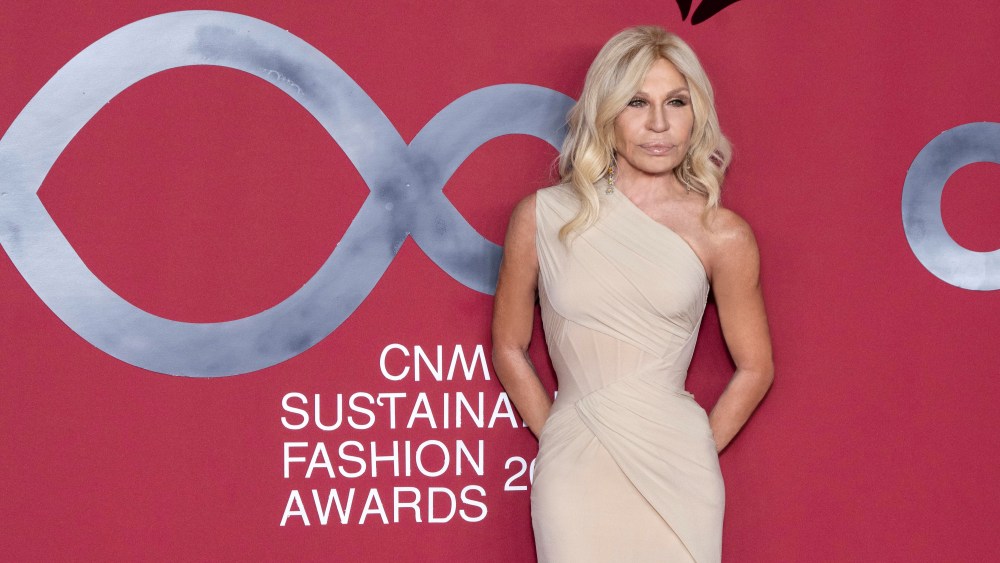
MILAN — “Marco says I am a queer icon and I am very proud of it,” said Donatella Versace.
She was referring to Italian singer and songwriter Marco Mengoni, who handed her the Humanitarian Award for Equity and Inclusivity at the conclusion of the Camera Nazionale della Moda Italia Sustainable Fashion Awards, held at La Scala theater on Sunday evening, at the tail end of Milan Fashion Week.
Versace, poured into a figure-hugging cream gown, said in Italy “supporting the voices of minorities has never been more important,” and she fired a zing to the government that “is trying to take away the right of people to live as they wish, they are limiting our freedom.”
Related Articles
She recalled that when she was 11, her brother Gianni told her he was gay. “For me, this changed nothing. I loved him and I did not care who he loved. His love and encouragement made me who I am,” she concluded, adding that she fights “for freedom, equity and inclusivity every day.”
You May Also Like
It was one of several moving moments of the event, in collaboration with the Ethical Fashion Initiative and the city of Milan. Unfortunately, these were overshadowed by the too-long evening and an ending monologue by emcee Sabina Impacciatore that can only be described as bizarre and that had industry figures fuming on Monday.
Versace was not the only leading designer to take the stage. Valentino’s creative director Pierpaolo Piccioli called his seamstresses and couture premieres on stage to share the Education of Excellence Award with them. This was bestowed to the house because it ensures that Italian fashion’s artisanal expertise is handed over and preserved for future generations through the “Bottega dell’Arte” school, first founded in 2015 and to be relaunched shortly, and the Valentino Accademia.

In a similar vein, the Craft & Italian Artisanship Award went to Dolce & Gabbana, handed to Alfonso Dolce by Bianca Balti, for the company’s preservation of artisanal traditions through the Alta Moda collections and Grand Tour of Italy, in locations such as Taormina and Capri to stage fashion events and promote local artistry.
Julianne Moore, who handed the Biodiversity & Water Award to Kering’s Marie Claire Daveu, the group’s chief sustainability and institutional affairs officer, told WWD on the sidelines of the event that sustainability “is an urgent issue for all of us, for all citizens of this planet and it’s our responsibility to do the best we can with the resources we have, to learn to how to preserve them to certainly use less to make it better for the future generations. This is the urgent issue of the day.”
Kering received the award for its Regenerative & Climate Fund for Nature initiative, providing grants to farming groups and non-governmental organizations to test and scale regenerative practices that positively impact biodiversity.
Gucci, under the Kering umbrella, also received a prize: the Ellen MacArthur Foundation Award for Circular Economy for its Circular Hub’s Denim Project, bestowed by Sinéad Burke to Gucci interim chief executive officer Jean-François Palus. The executive said that the first products within this project, in collaboration with International Promo Studio, Candiani Denim and Filatura Astro, will be in Gucci stores in 2024.
“Building scalable collaborations is a vital part of Gucci’s strategy and this project is an example of combining the many strengths of the house’s supply chain partners and leveraging innovative tech to enhance circular economy principles,” said Palus.
Jessica Chastain, who attended the Gucci show on Friday, was in the audience, donning one of creative director Sabato De Sarno’s first looks for the brand, a sleeveless white top with crystal embellishments and black tuxedo pants, carrying his revisited Jackie Bag in red.
Candiani also received the Groundbreaker Award from Coco Rocha for its Coreva stretch technology relying on a natural elastometer sourced from rubber trees and blended with organic cotton, almost entirely compostable.
Chloé was bestowed the Human Capital & Social Impact Award for its Fair Trade luxury collections, endorsed by the World Fair Trade Organization as ethically produced and environmentally responsible. Riccardo Bellini, president and CEO of the company, which is pledging to achieve 30 percent of product volumes certified Fair Trade by 2025, up from the current 16 percent, picked up the award.
The awards were a reproduction of Michelangelo Pistoletto’s Venere degli Stracci (Venus of the Rags), personalized for this occasion, 3D printed with 100 percent recycled nylon thread and hand-decorated with watercolors.
Ahead of the event, Jeremy Strong, walking into La Scala with Loro Piana CEO Damien Bertrand, told WWD how he first thought of wearing the brand playing Kendall Roy in the highly successful “Succession” series. “A few years ago, I was staying at Reschio, in Umbria, in this incredible hotel designed by Count Benedikt Bolza and Nencia Corsini. He is a brilliant architect, and they spent 30 years meticulously restoring this castle [whose early construction dates back to the year 900] and these villas on a massive piece of land,” explained Strong. “They are very elegant people and [Benedikt’s father] the Hungarian Count Antonio Bolza, is probably the chicest man I’ve ever seen, with his vintage convertible, hounds and horses, and always wearing Loro Piana. That was the signal to me that the brand represented something untouchable and rarefied, and that was when I knew I wanted to wear it as part of the television show. But I am genuinely honored to be here with this house, because to me they represent a constant striving for beauty and perfection and excellence. It’s a vertically integrated house, every single thread on any one of their garments comes from their own [manufacturing] and they last forever.”
Ahluwalia, by Priya Ahluwalia, received the Bicester Collection Award for Emerging Designers from Chiara Ferragni and Laurent Vinay for succeeding in connecting cultural heritage and sustainable innovation. The Climate Action Award was bestowed on Manteco, handed out by Samata Pattinson to Matteo and Marco Mantelassi for addressing climate change through science-based wool fabrics with much lower environmental impact.
Adut Akech Bior bestowed the Visionary Award on British Vogue’s Edward Enninful.
Remo Ruffini, Alessandro Sartori, Marco De Vincenzo, Alberta and Massimo Ferretti, Ubaldo Minelli, Stefano Canali, Margherita Maccapani Missoni, Rocco Iannone, Simone Bellotti, Nicolas Girotto and Stefano Sassi were among the executives and designers who attended the event, whose creative director was Villa Eugénie.
While organizers narrowed down the awards to 10 and the ceremony offered some chuckles and moving moments, sadly things seriously unraveled at the very end, as presenter Impacciatore of “The White Lotus” fame, who had by then received good vibes from the audience, opted for a long drawn-out monologue she had written herself that left many scratching their heads. Encouraging everyone to close their eyes and meditate, she rambled on for more than 20 minutes about the universe, menstrual cycles, the stars and cosmic time — causing much snickering and complaints given the late hour and empty stomachs.
Asked to comment on Monday morning, Carlo Capasa, chairman of the Camera della Moda, was careful not to throw the actress under the bus and said that a technical error — confusion over the pages of the different versions of the monologue that had been cut from 16 minutes to four — caused Impacciatore to improvise and lose her train of thought.
“She admitted she did not manage the emergency, but she had no time to rehearse, we had access to the theater only on Sunday morning,” said Capasa. “I have great respect for artists and they should have the space to express themselves, her speech was supposed to be focused on our planet and we thought it was in line with the concept of sustainability. Things like these can happen on stage, but I like to see the glass half full, there were many good moments throughout the evening.”