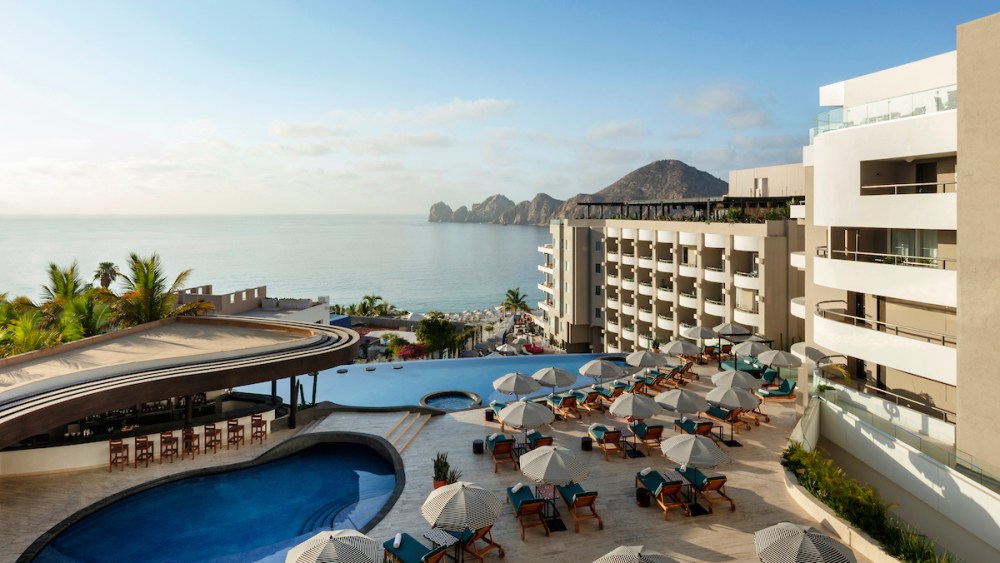
On the shores of Medano Beach in Cabo San Lucas, between the waves and the world of downtown’s dancing and dining, can be found a new property whose name speaks to both its location and its offer: Corazon Cabo — the heart of Cabo.
The $100 million resort and spa, Noble House Hotels & Resorts’ first foray into Mexico that was fully opened as of Feb. 1, puts its tastemaker guests right at the center of it all — and sets them up to wash away the woes of the pandemic in an expansive space complete with spa rituals, breakfast at the beach and décor that’s rich with local textiles and art that melds the cultural with the contemporary.
Related Articles
“Corazon means ‘heart,’ so what we’re trying to convey is that you are in the heart of it all. The property is centrally located near the downtown of Cabo San Lucas; it’s also very close to the marina, you can see the Lands’ End and The Arch from your guest room, and you have easy access via what is the only swimmable beach in Cabo, whether you want to take a paddle board, a kayak, we have electric foils on property, so it’s really in the center of everything,” says Noble House chief marketing officer Scott Colee.
You May Also Like
At the center of Corazon Cabo is a lobby that instantly gives away the interior designers’ sense of New York chic.

A collaborative effort between Carlita Alexander, who counts the W Times Square among her portfolio of properties designed, and Sofia Idoate, a onetime New York City resident who has led projects like the signature restaurant at the Ritz-Carlton in Mexico City, Corazon Cabo’s lobby looks a little like an art gallery. Sculptural gallery benches allow guests to sit and admire other sculptures on temporary assignment by Mexican artist Sergio Bustamante. The check-in desk is a jade colored, stone-effect leather backed by gabion walls.
Guests’ presence here will be a suspension of whatever they’d like to pause in favor of peace — and that’s what Alexander and Idoate were hoping for.
“The idea was to get this sense of being suspended in time,” Idoate says. “And that’s why you’ll see there’s this gabion wall where all the rocks are suspended and then this art that’s featuring these floating scenes — there’s a woman in a surfboard in the middle of the lobby and then there’s two guys jumping off the cliffs and they also give the sense of being suspended in time.
“That’s something that we really wanted to translate to the guests as they arrived: The feeling that their long trip is over, they finally got to a place of peace and it’s fun and it’s joyful but at the same time it’s calm.”
For those looking to ride that wave of calm, taking a sojourn away from laptop life and Zoom meetings they’d love to leave behind, there are 187 hotel rooms, 17 luxury suites and accessible rooms (with things like wheelchair access and flashing fire alarms for those with hearing loss) — many with floor-to-ceiling vistas of the Sea of Cortez. “The views are spectacular,” in Colee’s words.
In bed, decorative pillows are made from textiles woven with the telar de cintura, or waist loom, technique typical of Oaxaca, Mexico.
“They made these tapestries or textiles with the machine…attached to their waist and they move it with their hands, they’re almost like dancing,” Idoate says. “The women are geniuses on this. When you see them working on it, it’s beautiful, so we wanted to have that technique.”
Continuing the cultural design, headboards use horsehair straps inspired by traditional charro (a style of dress originating in Mexico based on clothing for a horseman, or charro) belts found in Tlaquepaque, and nightstands from the same town in the Mexican state of Jalisco reference traditional Tonala pottery. Around the room, guests will be able to admire copper sculptures from Santa Clara del Cobre, a copper mining community where as much as 80 percent of the population works in crafting copper, making the artistry unmatched.
Taking relaxation beyond the room could lead guests to the spa, where massage treatments come with names like “Subconscious Relaxation,” which promises two hours, four hands (thanks to two therapists in tandem) and caps off with wine and chocolate in a hot tub.
When it’s time to venture out further, there are two infinity pools — one on a rooftop and one with a poolside grill — plus a Wet Bar pool with a spot to swim up for drinks and a pool where only adults are allowed.
At the beach, it’s lively or lounge-y, guests’ choice. Pink plush beds shaded by umbrellas (or not, for those wanting to soak up the sun) promise all the chill, drink-in-hand vibes of a beach getaway. Or, for a livelier sea day, there’s surfing, kayaking and hydrofoiling available on-demand.
As the sun sets, Corazon Cabo’s Rooftop360, the highest rooftop bar in Cabo, is an ideal place to settle. Open air, ocean views and one of the two infinity pools are on offer — plus dining, where fresh seafood ceviche and Baja fish tacos are on the menu. Adding to the view? A leaf-patterned pergola ceiling made from Palo-de-Arco, a wood material often used for roofing in the region.
“That is super typical of the Baja [Peninsula], that you can see in the very most humble little house…you’ll see that technique is used,” Idoate says.
There are five other key areas for dining at the resort, including Aleta for seafood at the seaside, Corazon Beach Club for relaxed snacks, a café and Baja Brewing, the only micro-brewery in Cabo. Later this year or early next, Azure Cabo, what the property is dubbing the resort town’s “newest elite dining destination,” will join the fray.
Room rates range from the mid $400s a night to upward of $2,000 for the most elite suite. Guests booking stays at Corazon Cabo between now and May 22 will get a $200 resort credit per night to spend anywhere on the property.
The whole property, according to Colee, is “like ground zero for fun and adventure, but at the same time, if you want to just relax and enjoy the pool, that is there for you, too.”
For guests still preoccupied about the pandemic?
Beyond the cleaning protocols in place, Colee says: “All the outlets are open air, you’re outside, the rooftop is open air, the coffee shop is probably the only indoor outlet, there’s plenty of room to spread out and be, we call it, tropically distanced.”