As per the Oxford English Dictionary, quality can be defined by “the degree of excellence of something,” or a distinctive attribute or characteristic possessed by someone or something.
Visiting the Planeta vineyards peppering Sicily, the term comes to mind again and again, as it fits any of their wines, from the chardonnay to the syrah; the stunning views of their estates under the Etna volcano, those on the soft hills near Lake Arancio, or by the white rocks jutting out of Capo Milazzo; the perfectly tended rows of their carob, olive and almond trees in Noto, and their hospitality projects, from La Foresteria in Menfi to Casa Panitteri in the restored Sambuca hamlet that was first founded by the Arabs in 830 A.C.
Related Articles

To be sure, visiting the Planeta estates allows you to take a trip across Sicily, savoring the flavors that reflect the integration of the cultural, aesthetic and culinary influences handed down throughout the island’s Greek, Roman, Arab, French and Spanish dominations over the centuries.
You May Also Like
“There is a sense of a new rediscovery of Sicily now, a fresh buzz running through the island,” believes chairwoman Francesca Planeta.
Tourism is booming, also boosted by oenogastronomic trips. After an episode of the second season of HBO’s “The White Lotus” that was filmed at Planeta’s Sciaranuova estate, the company saw an additional leap in international tourism. At the location, actors Theo James, Meghann Fahy, Will Sharpe and Aubrey Plaza are seen trying out some of the estate’s signature wines, from the Carricante Sicilia Eruzione 1614 dating back to 2018 to the Etna Bianco 2020.
Planeta now offers a “Grand Tour” of the same name as the successful series that includes a tasting of wines and olive oils as well as a walk through the vineyards in Sciaranuova. “I’d say turnover and the presence on Etna has doubled — it was a huge success,” says Francesca Planeta.
Located in Castiglione di Sicilia, near Catania, Sciaranuova was established in 2012 among the lava flows and the forests that surround the town of Passopisciaro at more than 2,400 feet above sea level, and part of the old terraces were transformed into a theater, where a festival is held every summer. “The lava land has all it needs for the best wines, as it’s rich in minerals,” explains Alessio Planeta, Francesca’s cousin and chief executive officer of the family group.
However, Planeta is no newcomer to the scene, as its namesake family dates back 17 generations. Dispensa is its cornerstone in Menfi, in the southwestern shore of the island and “the heart of our family,” Francesca says. It still is, as walking into the kitchen you can spot her aunts making the “caponata,” personally stirring the recipe of eggplants, pepper and tomatoes in a large pot, the family dogs milling around in the garden. It is also where all research is kicked off, including the experiments and testing the protocols of sustainability of the wines. The set of protocols are part of the Planeta Terra program, which considers farming as a vehicle for sustainability and a source of well-being for man and nature. Since 2021 the entire cultivated area — vineyards, olive groves, almonds and cereals — is under organic certification. Planeta is also one of the founders and promoters of the SOStain program, established in 2011, which develops the regional sustainability protocol for Sicilian viticulture.
Francesca’s father and Alessio’s uncle Diego Planeta in the ‘80s set out to ennoble Sicily’s then-low-end wine making, at a time when the focus was on volume, not quality. “Our first vintage dates back to 1994 in Ulmo, around the fortified baglio [walled country estate] which came into our family by marriage in 1694, but our first experiments with vines began in 1984. We started with chardonnay, then merlot, cabernet sauvignon and franc, and syrah, followed by Sicilian varieties, Grecanico, Nero d’Avola and Grillo,” notes Alessio Planeta.
“Sicily offers very different and specific landscapes, weather, culture and food depending on the area, whether it’s the black rocks below the active Etna or the red sands at Dorilli, where we make the Cerasuolo di Vittoria, the only DOCG in Sicily, or the micro-climate at Buonivini, our Noto outpost, which has one of the lowest rainfalls in Europe and very limey soils, ideal for the Nero d’Avola and the Moscato,” he explains.
“It’s as if we delocalized without ever leaving Sicily,” he deadpans with a chuckle.
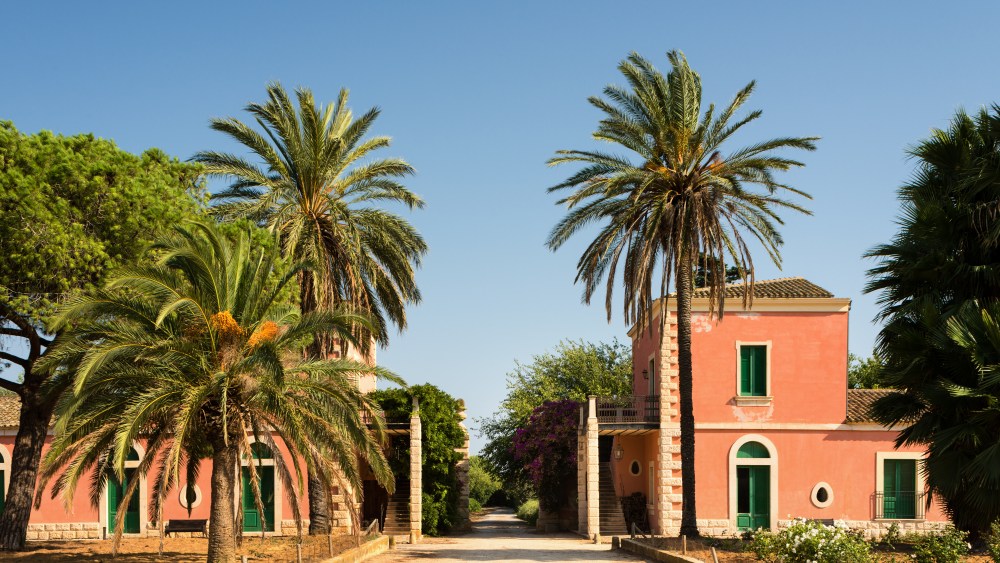
At Buonivini, where Planeta arrived in 1998, the family built the “invisible winery,” designed by architect Maria Giuseppina Grasso Cannizzo, a testament of their respect for the countryside as it is hidden among the luscious vegetation. In this vein, the family also rebuilt the “Case Sparse,” the informal brick-red rural houses dating back to the early 1900s, perfectly integrated into the estate, nestled among the seven hectares of almond trees and 40 hectares of vineyards, and part of Planeta’s hospitality project — the chirping of birds the only sound for miles. Abandoned wood cuts and other materials were transformed into new furnishings by Costanza Algranti — also in sync with the family’s sustainable mindset.
“We design the locations depending on the territory, based on our love and knowledge of the land,” says Alessio Planeta. “Yes, we are present but aim not to be very visible, bringing out the personality of the locations,” such as the Foresteria in Menfi, with its 14 rooms surrounded by a Mediterranean garden, offering views of the sea and not far from the archeological treasure of Selinunte and its ancient temples, or the nine apartments at Palazzo Planeta in the center of Palermo, with four more to come, he says.
“The aesthetic component is key as wine is produced in locations of extraordinary beauty and the bar is high. We consider the vineyards as gardens, and you lose sight that they are productions sites.”
Alessio Planeta in October was awarded the prestigious “Winemaker of the Year” title by specialist magazine Wine Enthusiast and will receive the accolade during the Wine Star Awards on Feb. 5 at the Eden Roc Miami Beach Resort. He is the fourth Italian to receive the award.
Planeta will mark its 30th anniversary next year and its wines are available in 75 countries but Alessio Planeta, who learned much of the winemaking skills from his “extraordinary teacher,” the late Piedmontese enologist Carlo Corino, says it is key to continue to study and innovate. For example, he has inked a joint venture agreement with the French Oddo family on the Serra Ferdinandea, an initiative showcasing biodynamic agriculture and wine growing.
Likewise, with the aim of preserving, developing and promoting premium Sicilian wines, Planeta has begun to distribute the production output of Feudi Spitaleri, located on the beautiful wine property of Castello Solicchiata at Adrano, near Catania and at the foot of Mount Etna. Planeta is set on identifying and developing hidden and potential resources “to burnish the image of Sicily as a historic cradle of Italy’s history and culture,” he says, naming this initiative Ab Insula [“From our Island”]. Coming up next is also a Ristorante Planeta at Palermo’s Falcone Borsellino international airport.
“The perception of the island has changed and Sicily has been assuming a place of honor on the Italian and international wine stage,” Francesca Planeta says proudly.