
The convergence of fashion and technology is firmly in place, and now includes wearables aimed at evoking an emotional response.
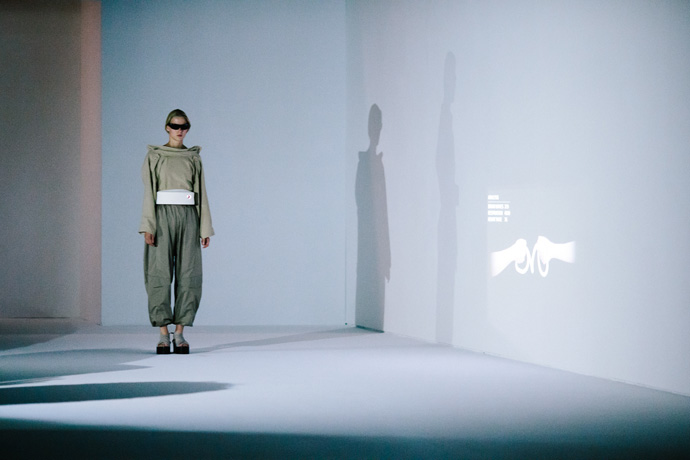
Last fall, for example, Hussein Chalayan and Intel innovation engineer Karli Cengija teamed up to launch wearable technology for the Hussein Chalayan spring collection. The technology showcased 3-D printed sunglasses and belts — designed to detect human responses, which included projecting images on the wall of the catwalk.
Each image symbolized a human response, allowing the wearer to get a deeper understanding of the connection between physicality and emotions. For example, the image of two hands pulling a rope to portray the tension between joy and sorrow. Cengija said “these accessories are pushing the boundaries, and making fashion more engaging and personal.”
Related Articles
“I jumped at the opportunity to work with [Chalayan],” Cengija told WWD. “I felt honored to work with a designer who has been combining technology with fashion since the 1990s, and was proud that we at Intel have developed our fashion and technology skills sufficiently to get to work with him.”
You May Also Like
When she arrived at Chalayan’s London studio for their first brainstorming session, the idea for the wearable body-sensing accessories for the spring collection took shape. “I work with designers like Chalayan to bring their vision to life,” Cengija explained. “My role is to help designers make adaptive clothing that shifts shapes, changes color or communicates the wearer’s changing emotional or physical state.”
Powered by a button-sized technology called Intel Curie — hardware created by Intel that offers an assortment of functionalities to wearable-tech goods — the sunglasses and belts shown on the runway were created by Cengija and an extensive team of engineers, designers and 3-D printing experts.
Within four months, the wearable body-sensing accessories came to fruition. Here’s what the team developed:
- Sunglasses that are equipped with sensors at the temples to measure EEG signals, which are electrical signals from the brain
- In the nose bridge of the sunglasses, a sensor shines light onto the surface of the skin, measuring reflected light, while another sensor picks up vibrations created from the wearer breathing
- Curie is designed to derive meaning from the sensors, Cengija said, noting that the reflected light becomes heart rate and vibrations become the respiration rate
- Curie is also equipped with Bluetooth technology, which is used to communicate the data to the Intel Compute Stick — a tiny computer placed inside the belt to translate the heart rate, EEG and respiration data into the projected images
Other similar projects and collaborations Cengija worked on include Dutch designer Anouk Wipprecht and a 3-D printed mood-logging dress in 2014, which measures and detects a wearer’s temperament and stress levels with the use of Intel Edison-powered technology. “We want to enable designers to use technology as another component of their creative process and not worry about designing around it,” Cengija said.
Cengija’s role in the company’s New Devices Group puts her on the front lines as wearable technology evolves. “Right now, we’re in the early adoption phase, and will continue to see innovations from many players, both established companies and start-ups,” she said. CCS Insight — an information analysis and intelligence company that focuses on the wireless and mobile industries — estimates that by 2020, the wearable technology industry will be worth nearly $34 billion, up from $15 billion in 2015.
“The convergence of fashion and technology continues to unleash new possibilities for designers,” Cengija said. “[It] enables us to create meaningful products and experiences for both designers and consumers.”