
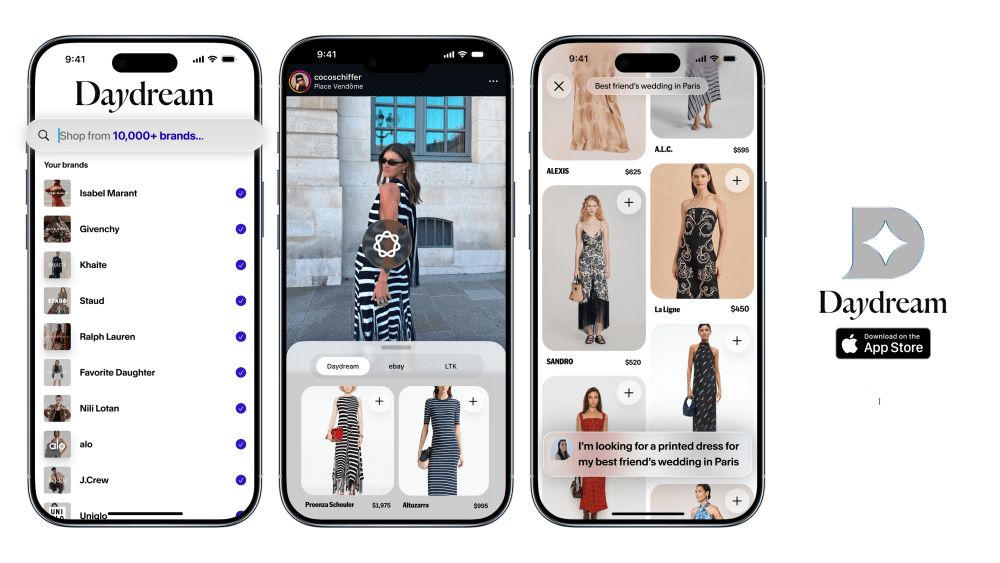
Daydream, an AI shopping tool that launched in July and has grabbed $50 million in seed funding, said Tuesday that it has put out an app, complete with Apple’s latest AI-based features.
Julie Bornstein, the company’s chief executive officer and cofounder, thinks of Daydream’s promise simply: to connect users to the exact items they want to buy without the hassle of manually finding them.
“We know that search is very keyword-based on the majority of e-commerce sites, and so if you’re not using the right terminology, you’re not going to get the right results,” Bornstein told Sourcing Journal, a sibling publication of WWD. “I think we all have gotten tired of going to 10 sites and paging through 20 pages of results to try and find the thing we’re looking for.”
You May Also Like
Related Articles
Daydream launched as a web-based tool; users can visit the company’s site to enter text-based inquiries meant to help them find items they love. For instance, a user might ask Daydream to “help me find a work-appropriate, festive dress for my company’s upcoming holiday party.” The large-language model (LLM) underneath the surface works to do just that, and surfaces dozens of viable options based on the user’s initial query.
Bornstein and Maria Belousova, the company’s chief technology officer, said Daydream works to match users’ intent with designers’ intent. The platform is already connected to over 10,000 brands and has access to millions of products.
Bornstein said Apple played an integral part in launching Daydream’s new app. The app is only available to iOS users; while between 60 and 70 percent of Daydream’s existing traffic comes from mobile devices, 90 percent of those devices are Apple products.
“We didn’t start with, ‘Oh, we need an app that will work for Android and Apple.’ Having built apps for many consumer companies, in the U.S., you need to build for Apple. Android is just a much-smaller market for the kind of consumer we’re going to be working with, and that allowed us to really go all in on Apple and build everything to optimize the Apple app experience,” Bornstein said.
Daydream has no plans to expand to Android, but the team noted that if it moves into the European market, it may reconsider. In the meantime, the company will continue to upgrade its web experience in tandem with its app to give users the best multidevice experience possible.
Around the time Daydream started building its app, Apple launched iOS 26, which is complete with several AI-based features, like Apple Visual Intelligence, which has become one of the core pieces of the Daydream app.
Visual Intelligence allows users to take a screenshot — or a regular photo — and immediately be presented with the option to ask one of their apps for further information. For instance, a user might see a pair of boots they love while out and about, snap an image of them and ask Daydream to show similar options. Bornstein said the benefit of Visual Intelligence is that users don’t have to undergo a multistep process to open the app and share the image — instead, it happens automatically.
“The fact that [Apple] is thinking about, ‘How do you shop your camera roll?’ is a very innovative thing that only Apple can do right now, and that gives us a chance to participate in that,” Bornstein said.
Because Visual Intelligence is only available on newer iPhone models, users without access can still upload images to the Daydream app.
Despite the Daydream team’s excitement about the more seamless integration of visuals, Belousova and Bornstein said they know users that are only beginning the discovery journey are most likely to turn to text-based queries first.
“It depends on where the shopper is in the funnel. They normally start with describing what is the problem they’re trying to solve, or where are they going — if it’s vacation, if it’s an event. Then later, [in] the mid-funnel, is where imaging — being able to do multimodal discovery and looking at images and reasoning — becomes very important,” Belousova said. “Now, if the shopper has already seen a style they like, either somewhere on social media or in real life, they’re essentially already mid-funnel, because now they already know, ‘OK, I want this product.’ Then images become really important.”
Bornstein and Belousova hope that the in-app experience helps users with their own style and with their holiday shopping. As the Daydream team built the app, engineers focused on lowering latency— or making the speed of results faster — which can be a difficult task with LLMs scouring for products that match a particular description. The team also worked to build out the app’s sharing capability to make using Daydream a more social experience.
And, because the holiday season is just around the corner, Belousova said the team worked to consider specialty prompts and products users might be seeking.
“One of the things that we really polished in time for the launch is our understanding of holiday occasions, such as ‘party with coworkers,’ ‘Thanksgiving dinner with in-laws,’ ‘New Year’s Eve party with friends.’ We’ve done quite a lot of in-depth analysis of intent and building out what we call a fashion knowledge graph, where we understand the social context of an event…so our results in the holiday occasions world are much deeper and more nuanced,” she explained, noting that Daydream will continue adding more context to the system’s training in the future.