
Summer might be a slow time for Apple, but everything is relative.
The consumer electronics giant posted big numbers — again — releasing the strongest third quarter in its history with a boost from wearables and services.
The three-month period ending July 1 sits in an awkward spot, coming several months after the holiday rush, but before new product launches in September. Still, the iPhone maker topped Wall Street’s revenue expectations for the quarter by $880 million.
“We generated $53.3 billion in revenue, a new Q3 record,” said Tim Cook, chief executive officer. “That’s an increase of 17 percent over last year’s results, making it our seventh consecutive quarter of accelerating growth, our fourth consecutive quarter of double-digit growth and our strongest rate of growth in the past 11 quarters.”
Related Articles
For the retail sector, particularly e-commerce merchants with mobile-first strategies, the performance of Apple’s iOS devices remains a key focal point. And indeed, the company draws most of its sales from its mobile devices. In the third quarter, the company sold 41.3 million iPhones and 11.5 million iPads.
You May Also Like
IPhone shipments were notably flat compared with the same quarter last year, but revenue on those devices was up 20 percent. The iPhone X’s more expensive $1,000 price tag could have helped boost results. But the company reported that Apple’s active install base grew by double digits.
“IPhone 10 was the most popular iPhone in the quarter once again, with a customer satisfaction score of 98 percent, according to 451 Research,” Cook said.
Services — a somewhat vague categorization that covers the App Store, iTunes, AppleCare, Apple Pay, licensing and other business lines — hit an all-time record revenue of $9.5 billion,” exceeding expectations of $9.22 billion.
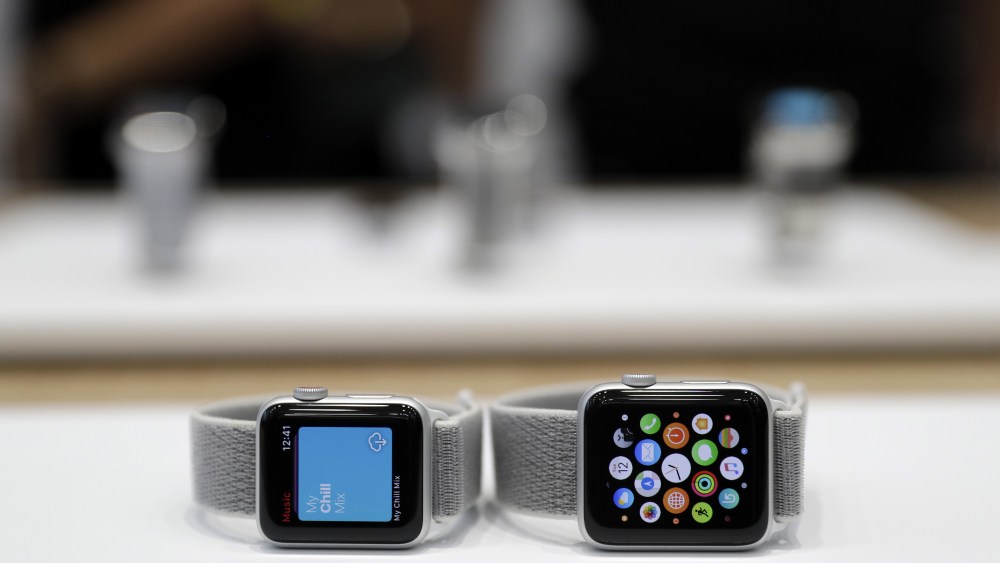
But the company’s “other products” segment, Apple’s smallest, is its fastest-growing, and wearables drove major gains for the segment.
“Our other products category also set a new record for the June quarter, with revenue of over $3.7 billion,” said chief financial officer Luca Maestri. “That’s up 37 percent from last year, with great sales momentum for both Apple Watch and AirPods. Apple Watch continues to be the best-selling smartwatch by a wide margin and units and revenue grew dramatically during the quarter.”
The device saw a major lift later last year as Apple introduced its stand-alone version three — a cellular-equipped smartwatch capable of working without a phone.
In terms of what’s next for the device, the company offered some clues.
“For Apple Watch, users will see a significant expansion of features and functionality in Watch OS 5,” Cook teased. “Apple Watch will become an even stronger companion for fitness, communication and quick access to information with features including new workouts, activity-sharing competitions, auto workout detection, advanced running features, walkie-talkie, podcast and third-party apps in the Siri watch face.”
The company also “returned almost $25 billion to investors through our capital return program during the quarter,” added Maestri, “including $20 billion in share repurchases.”
Apple shares rose 3.5 percent in after-hours trading, going up to $196.87. If those gains hold, the company will have a market capitalization of $968 billion.
That puts the tech company is a short hop to a $1 trillion market value and placing it ahead of Amazon, at slightly more than $870 billion; Alphabet, at $845 billion, and Microsoft, at nearly $815 billion.