
ASPEN, Colo. — Blame it on the thin air at 7,930 feet, but Aspen is full of anomalies. Clogs, for instance, tend to look better than pumps; billionaires come on to their ski instructors, and the local thrift store is situated across the street from Gucci. In fact, it’s not unheard of for Gucci wares to be found, for a fraction of the original price, at said thrift store. And up the street at Susie’s Ltd., one of the town’s two consignment shops, practically new merch from Oscar de la Renta, Prada and Fendi is as likely as a fresh inch of snow atop Aspen Mountain. A few blocks west is Gracy’s, which also stocks a bundle of designer labels, as well as dozens of fur coats displayed in their own special section.
But back to The Thrift Shop, which was my first stop on a recent visit to Aspen. The oldest store in the town, it was opened in 1952 by a group of women trying to raise money for the local hospital. These days, the nonprofit business donates some $250,000 a year to myriad charitable organizations up and down the Roaring Fork Valley.
A visit to the small, musty shop — packed high with everything from clothes to skis, bedding to furniture — can be a daunting experience for the secondhand novice, but my bargain-detecting eye quickly maneuvered the mess, despite the throngs of shoppers. I was hoping to snag some baggy wool dresses or cashmere sweaters that could be chicly transformed with the cinch of a skinny belt. Instead, what I found was an abundance of skiwear: coats, pants, even a whole section devoted to one-piece numbers.
Sue Kolbe, who serves as The Thrift Shop’s president, admits that the store sells very little of the last. “It’s Aspen, after all,” said Kolbe, a Michigan native who moved her family to the town 18 years ago. “People are looking for the most stylish things and the major brands. Anything by Patagonia, Obermeyer or Bogner flies out the door.”
Indeed, a Patagonia fleece jacket and pair of Bogner waterproof pants were steals at $5 and $8, respectively, but they were just too practical for my New York wardrobe. What I did buy, though, was a men’s pinstriped oxford for $3 and a striped wool zip-up cardigan that reeks of the Eighties, but at $8, I couldn’t resist. I also grabbed a handful of wide and thin belts, for $1 apiece.
Related Articles
You May Also Like
Downstairs in the basement, where the footwear, dishes, books and sports equipment are housed, I tried on several pairs of shoes that would have been perfect, had only they fit. First there were the Bottega Veneta red suede pumps with heart cutouts, then the forest green Ferragamos with gold piping, as well as the white leather and fake croc flats that only someone who works in fashion could pull off.
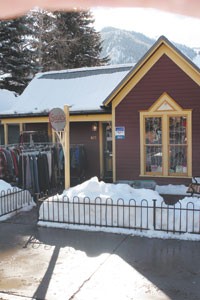
My next destination was Susie’s Ltd., a quaint Victorian house-cum-consignment boutique dedicated mostly to women’s clothes and accessories. Owner Susan Harvey, a former manager of Gracy’s, opened the store in 1990; seven years later, she opened a slightly smaller space directly behind the main shop that is devoted to furniture, bedding, jewelry and books. (At the end of each season, Harvey also receives new clothes from several local boutiques, which she sells for one-third of their original retail price.) At Susie’s, consignment customers receive 50 percent of the store’s ticketed price after the item is sold. Merchandise still unsold after 30 days is marked down half price, and anything left over after 45 days is donated to The Thrift Shop and other local charities. “We don’t really have a pricing system, but we do know the top dollar we can get for something,” said Harvey, who refuses less-expensive goods from brands such as Old Navy and discount department stores. “No one wears suits in Aspen, but they are looking for really fancy dresses for parties.”
Indeed, party dresses were plentiful, and I quickly zeroed in on a gorgeous Chanel black lace number with a layered skirt for $300. I then spied the most perfect spring coat: a midcalf version by Prada in pale rust wool with an extended silk hemline. At $800, though, I refrained from even trying it on. Speaking of designer labels, an entire rack of suits hung in the store’s back corner, where the brands rivaled those on Bloomingdale’s fourth floor — Prada, Chanel, Oscar de la Renta, Rena Lange, Joseph and so on. Prices here ranged from about $200 to $350, but, just as Harvey said, customers didn’t appear to be interested in them, and instead were flocking to the puffer coats, heavy sweaters and, of course, the party dresses.
As the store began to swarm with shoppers, I ducked into one of the two dressing rooms while I had the chance. A couple of cashmere sweaters (one in charcoal gray, the other in navy) were just OK, and the Ralph Lauren tweed gauchos with pleats were very chic, but would have been more so if I were five inches taller. An embroidered camel wool skirt by Rebecca Taylor was too small, and a pair of Joe’s Jeans, which cost only $30, also didn’t fit. I did succeed with a couple of items, though, such as a down bomber jacket from Polo Ralph Lauren with a fake shearling collar ($148) and a pair of flat Bottega Veneta riding boots with lace-up ties running up the back. They were marked at $160, but I scored them for only $80 because they had been on the selling floor for longer than 30 days. Next, I tried on a pair of black Bruno Magli pumps with tortoiseshell tips and heels for $18. Sadly, they were too big, but I bought them anyway for my friend back in New York.
On to Gracy’s, which, since opening more than 30 years ago, has withstood multiple owners and even more locations. In the five years since Karen Carner has owned the store, it’s been housed in three different spots. Now situated on Hyman Avenue, across the street from the Popcorn Wagon (a landmark for locals and tourists alike), Gracy’s sells secondhand clothes for women, men and children, as well as a smattering of new items that, like Harvey, Carner receives from Aspen boutiques at the end of each season. But while Susie’s turns away fur, Carner works directly with several area furriers. “They don’t want last year’s furs in their stores, so we sell them for about one-third of their price, usually from about $2,000 to $3,000,” she said. Indeed, the fur selection was plentiful, with brands that included Giorgio Armani, Kenneth Cole and Dennis Basso.
Gracy’s also gives consignment clients a 50 percent cut of the sold prices, which Carner said she and her staff determine on an individual basis. “We usually try to price items about one-third of what they would cost if new,” she said. “But our rule of thumb is if it’s not something we would wear, we don’t take it.” An interesting concept, given some of the store’s more eclectic items, such as a 100-year-old kimono ($425), an Oleg Cassini wedding gown ($400) and an orange tweed blazer ($100), custom-made for none other than Huey Lewis, who owns a second home in Aspen and has a consignment account at Gracy’s. “We receive a lot of clothes from celebrities who live here,” said Carner. “We had Sally Field for a long time, but she moved away. We’ve had some things in from Goldie Hawn, and we even had Steve Martin’s couch at our old store.”
Lewis’ jacket aside, I did take a liking to a gold pleated skirt from Prada ($50), a lynx trapper hat by Postcard ($60) — “the Rolls-Royce of skiwear,” according to Carner — and a vintage Fair Isle cardigan with toggle buttons ($90). In the front corner of the store, a section was devoted to designer clothes and new merch, most of it still with the original store tags intact. While on occasion Carner buys goods at trade and gift shows, a great deal of these items come from consignment customers. It begs the question: Why bother buying clothes only to turn around and sell them for consignment? Carner, it seems, has figured it out. “When people here can buy an $18 million house, just think how much they spend on clothes,” she said. “I had one lady in here recently who brought in 19 bags of designer clothes — all with the tags still on them. I asked her why she didn’t wear any of it, and her husband said, ‘My wife needs a hobby, and it’s obviously shopping, don’t you think?'”