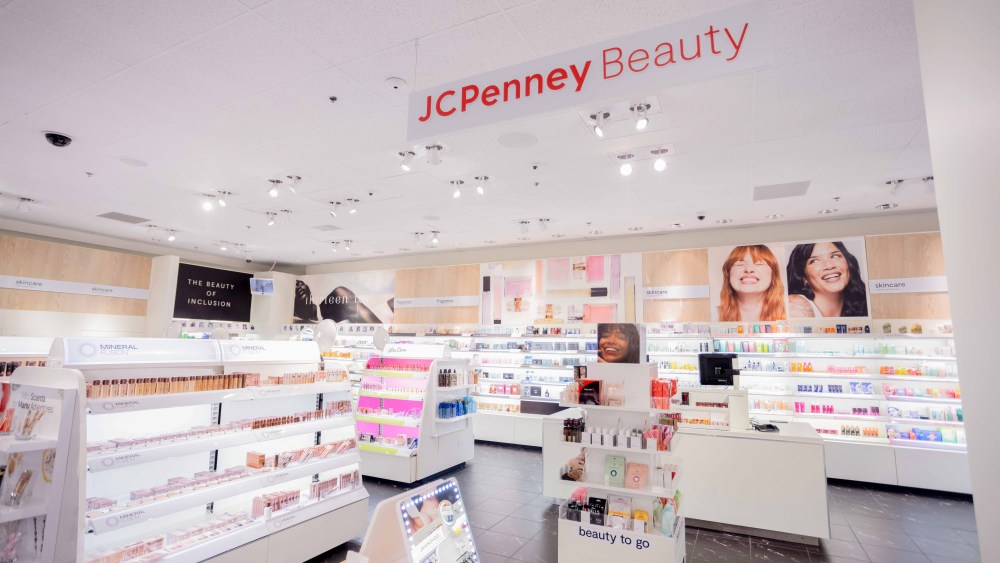
Under new ownership and management, JCPenney Co. is “getting its mojo back” with a game plan that’s coming into sharper focus.
While many have debated whether Penney’s can maintain relevance after three decades of top-level management change, strategy shifts and reversals, meddling by shareholder activists and private equity owners, there’s new life in the venerable retailer in the aftermath of its purchase by Simon and Brookfield Property Partners in 2020 for $800 million, lifting the business out of bankruptcy and cleaning up the balance sheet.
Related Articles
In a wide-ranging interview, Marc Rosen, Penney’s chief executive officer, laid out Penney’s evolving game plan, and a big part of it seems to center on efforts to capture more customers in the 20-to-40-year-old demographic through a battery of new strategies. At the same time, Penney’s must maintain its older, traditional base and working-class family appeal.
You May Also Like
Among the strategies: the rollout of JCP Beauty departments with its inclusive mix of masstige, prestige and mass brands from new, emerging and established companies, to all 660-plus stores following Sephora’s defection to Kohl’s, a direct competitor. It’s virtually finished, Rosen said. “As of last Friday, we completed the last round of soft launches.”
Rosen also underscored that Penney’s is pursuing additional collaborations with designers and celebrities, and has been advancing its private label programs by reducing redundancies and sharpening what each existing label stands for, while adding new ones. It’s an effort to cast a more modern, fashionable image and provide greater exclusivity.
In addition, Rosen said that the Plano, Texas-based Penney’s is:
- Continuing to grow digital sales, which currently represent about 30 percent of Penney’s total volume, compared to about 25 percent a year ago.
- Working to secure a bigger niche in dress-up categories such as dresses and men’s suits, at Penney’s customarily low prices. The private brand program and collaborations play a big part.
- Directing a significant amount of its capital-expenditure budget, which this year exceeds $250 million, to create centralized point-of-sale checkouts that will be replacing checkouts placed in different areas of the store, and equip associates with devices for mobile checkouts and easy access to information on product availability. It’s about providing speed of checkout, convenience and better service.
- Utilizing a portion of the cap-ex to spruce up stores with improved lighting and a fresh coat of paint. “We’re just making sure it’s an open and inviting shopping environment,” Rosen said.
While the fleet has stabilized at 660 stores after years of closing hundreds of units, there’s an eye toward some further closings, relocating stores to better sites, and even opening some new ones in certain markets, though the net store count, according to Rosen, should more or less remain stable.
“We have roughly the right number of stores in total,” Rosen said. “In some cases we need to optimize, location-wise. So there are some locations in cities where we are in a mall or shopping center where we may not want to be anymore, and you’ll see us relocate some of that. There are other places where we don’t have coverage where we could go into a city,” with a new store. “So I think you will see some adds. Some of those deals are getting solidified right now. Net, net, though, 660 is roughly the right number, between 650 and 700, for us to be able to reach the customer.”
On Tuesday, David Simon, chairman, president and CEO of the Simon Property Group, the nation’s largest manager and developer of shopping centers, said Penney’s “has its mojo back,” during his conference call with analysts following the release of Simon’s positive first-quarter results. Within Simon’s Other Platform Investments (OPI) group, Penney’s and the SPARC joint venture between Simon and Authentic Brands Group remains profitable, he said.
“The retail part of OPI we expect to be profitable in Q2 and Q3, but the vast majority (of the profit) will be in Q4. Retailers will all have tough comps for the first quarter. The fourth quarter will be much better. That does create a little volatility for us,” Simon said. SPARC includes Aéropostale, Brooks Brothers, Eddie Bauer, Forever 21, Lucky Brand, Nautica and Reebok.
On Wednesday, Penney’s CEO Rosen elaborated on the retailer and its mojo.
“We’re getting traffic back into the stores and really driving customer frequency,” Rosen told WWD. “The exciting thing is starting in late summer and the fall of last year, we saw that tick up last year and continue through the holiday season, for the first time in five years. There are a lot of things driving that. I would start with assortment,” Rosen said.
He cited the beauty rollout, the relaunch of the Worthington private brand and other in-house brands to better differentiate each, and the launch of new private brands, notably Mutual Weave, Penney’s first men’s denim lifestyle collection, which happened in February 2022, and the exclusive iMPower by Prabal Gurung for JCPenney collection of dresses and jumpsuits that launched this spring.
“Michelle has really clarified our product assortment,” Rosen said, referring to Penney’s chief merchandising officer Michelle Wlazlo. “Mutual Weave filled a big gap in the assortment (with) jeans, khakis, polos, T-shirts, colors, woven shirts. That brand has been super strong and grown significantly.”

He added that the home area is “really, really key,” citing Distant Lands, a line featuring colorful towels and bedding that was launched a year ago. “It’s aimed at the younger customer,” Rosen said. Home represents about 10 percent of Penney’s volume. Rosen said that while sales growth in home is seen, it’s not expected to grow as a percent of the overall business. The home business could benefit from the bankruptcy and shuttering of Bed Bath & Beyond, which was a competitor.
Rosen said that last year, men’s and women’s apparel, home and footwear “all took market share.” How does he know that? “We look at our growth, competitors’ growth and at market share data,” from research firms such as NPD.
Rosen told WWD that last year Penney’s volume was just over $8 billion, and flat against 2021 excluding the beauty business, which has been in transition. Penney’s volume peaked in 2006 at over $20 billion.
The company selectively revealed some other financial results for 2022, indicating that adjusted earnings before interest, taxes, depreciation and amortization exceeded $500 million; liquidity stood at $1.6 billion for a healthy cash flow; gross margin stood at 36 percent, and that there was less than $500 million in debt at the end of January. The latest quarterly figures on Penney’s were not available. Penney’s has about 50,000 employees.
“We feel like we’re in the strongest position that the company has been in many, many years,” Rosen said.
“A quarter to a third of the customers shopping JCPenney Beauty and iMPower are new customers to JCPenney,” Rosen said. “The customer is responding and also shopping other areas of our store. We have seen some new customer growth in that.
“Looking at our customer segments, overall we are very fortunate we do have a wide age range. We have a classic customer that is a little more traditional. They’ve shopped our brand for a long time and are engaged in our credit card program and things like that. But we also have the younger customer shopping things like Forever 21,” at Penney’s. “As we look at our future growth a lot of it will come from the younger group. Beauty is a big part of that.”
Rosen explained that much of this year’s $250 million in cap-ex will be devoted to improving the shopping experience at about 75 stores, with remodels, new technology for the centralized checkouts and associates’ mobile devices.
“We want to make sure there is a much more mobile-friendly experience in the store,” Rosen said. “With the mobile device, associates will have the ability to access product information and availability.” For example, if someone came to the store looking for a specific Stafford suit and the proper size wasn’t available, associates would be able to determine if that suit was available online or at another Penney’s store and could be delivered to the customer’s home or to the store the customer just shopped. The system will be piloted in 31 stores this year and subsequently expanded through the chain.
Asked if Simon was funding Penney’s, Rosen responded, “We are absolutely running on our own.” He added that Penney’s has a clean balance sheet, with low debt, at less than $500 million, and generates strong cash flow. “The restructuring put us in a position of stabilizing our operations and being able to make sure we are driving both sales and profits.”
Regarding the outlook for 2023 in terms of sales, Rosen said, “It has continued to be a challenging year for the customers with everything going on with the economy and inflation. Overall for the industry right now, traffic is the challenge. At the same time there is an opportunity for us to grow and take share by offering the best value in the marketplace. We are making sure we are price competitive.”
Since joining Penney’s 18 months ago from Levi Strauss & Co. where he served as executive vice president and president of Levi Strauss Americas, “We’ve really defined areas we are going to focus on,” Rosen said. “First of all, the big focus is on the customer and making sure we are driving long-term, profitable, sustainable customer growth. The focus is on making sure we are communicating to them about the unique reasons to come shop JCPenney.” That entails spotlighting the private label brands, the loyalty program and simplifying its messaging. He also cited personalizing communications to customers as a priority.
Another priority is “making sure we have the right product in the right place so we can get to it quickly,” Rosen said. From the time a customer places an online order, “We’ve brought the speed down to the three- or four-day delivery range,” he added. Efforts are being made at “optimizing our transportation and fulfillment,” Rosen said. Getting the merchandise out of distribution centers and delivered faster to stores and customers will lead to fewer markdowns, he said.
Rosen also said that the company is working to help customers understand the value is embedded in its products. “They are looking for coupons and deals. We will combine those with our loyalty program and our mobile app, and help customers understand up front what they are paying. It’s about making sure the customer understands the value we provide.”
Aside from improvements in the store, Rosen said that Penney’s has been transforming its website experience, implementing changes progressively since last summer. He said there is a new home page, and the website is doing a better job telling product stories, such as how to create outfits.
“Digital penetration is over 30 percent,” compared to about 25 percent a year ago. Asked how much digital sales could grow as a percent of the total business, Rosen said, “At the end of the day, the customer will decide,” though he added he expects “it’s going to settle around that 40 percent level. Stores still play a big role for customers and there are lot of categories, like beauty, suiting, dress-up where customers want to come in.”
As part of being an omnichannel retailer, Rosen said that Penney’s will be “ramping up” its buy online, pick up in store service. “We need to drive customer awareness” on that, he said.
In addition, “We are looking at other collaborations in men’s dress-up, and in home in areas like cooking,” Rosen said. “We are looking to do those collaborations with people who grew up shopping at Penney’s. It’s important.” He said he preferred to hold off revealing any upcoming collaborations.
In terms of product sales, Rosen said there was strength in most apparel last year and that continued through the first quarter of this year, in particular in dress-up categories such as men’s suiting, including the long-standing Stafford or J. Ferrar private brands, as well as in dress-up shirts. Dresses have also been selling well, from casual to formal styles, and in such labels as Worthington and Ryegrass, a two-year-old private brand that for Penney’s customers offers a more elevated, flirty and feminine look. He also touted the iMPower by Prabal Gurung collaboration as “super stylish and really relevant with dresses priced at $59, $69 and $79 price points. “It’s great dress-up product.”