
Retailers have been lining up at bankruptcy court as consumers continue to move from physical to online retail, which makes Westfield Corp.’s $9.5 billion retail development program of aggressively investing in new malls and expanding existing ones, look either extremely prescient or dangerously speculative.
Mall traffic declined 12.3 percent in November and December, according to Seeking Alpha. The National Association of Real Estate Investment Trusts reported that rent growth has slowed since a postrecession high; it was flat in the fourth quarter of 2016 compared to the previous three months. About 900 million square feet of shopping center space has been lost since 2015 due to department and specialty store closings.
Related Articles
But Westfield Corp. continues to bet heavily on malls, as evidenced by the company’s revelation Thursday that it had bought an additional 20 million shares in Intu, the largest mall operator in the U.K.
You May Also Like
The REIT operates two existing shopping centers in London, including Westfield Stratford City, and Westfield London. The latter will swell to 2.7 million square feet and become Europe’s biggest mall when a 740,000-square-foot expansion is completed in 2018. Both London properties are expected to do nearly $2 billion each in annual sales. There’s also a 50-50 venture to build a $1.75 billion mall in Croydon in South London.
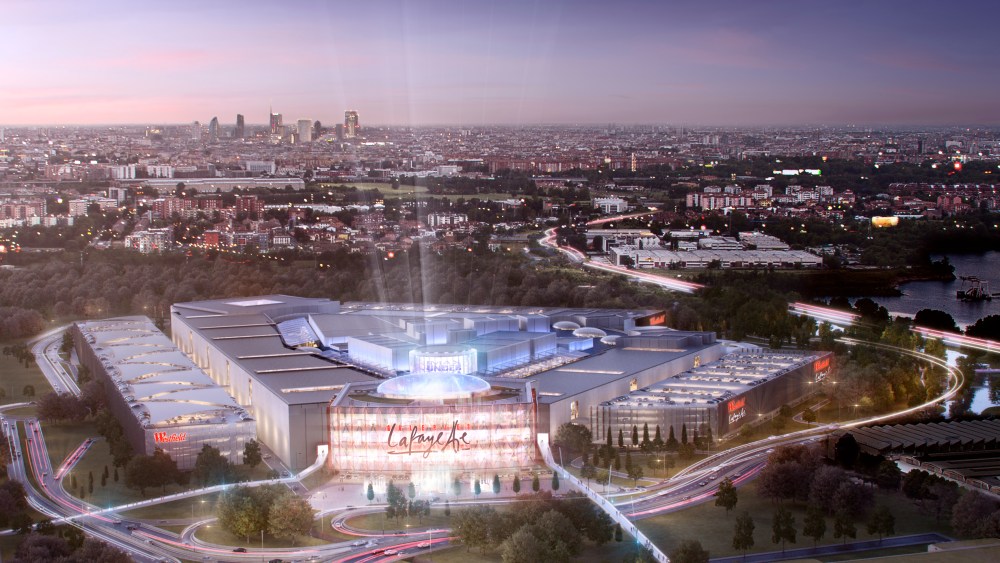
The construction of a 1.8 million-square-foot Westfield Milan is expected to be Italy’s biggest mall when it bows in 2019 — and that’s before Westfield exercises an option to expand the Milan center to 2.5 million square feet.
Other projects include a $1.1 billion expansion of Valley Fair mall in San Jose, Calif., and a $600 million expansion of UTC in San Diego.
“We’re confident about Milan, which will be a leading mall in Europe,” said Steven Lowy, co-chief executive officer of the real estate investment trust. “Milan is one of the wealthiest parts of Europe. Fashion, of course, is important in Europe, so there will be a heavy emphasis on fashion, food, leisure and entertainment. We’ll do each of those in a very big way, from the High Street to high-end.”
A four-level, 194,000-square-foot Galeries Lafayette flagship will anchor Westfield Milan along with a UCI [United Cinemas International] complex. “We hope to make some major announcements about Milan in six months,” Lowy said. “We’re in the process of finalizing other leasing arrangements.”
The shopping center giant’s financial results, released Wednesday, seem to justify its hefty investments in large brick-and-mortar properties.
Westfield posted net profits of $1.37 billion, calculated in accordance with international financial reporting standards, for the 12 months ending Dec. 31. Funds from operations were 33.7 cents a security with a distribution of 25.1 cents, in line with the company’s forecast. Comparable net operating income growth was 3.2 percent, with flagship properties posting a 4 percent gain.
According to Lowy, the decision in 2014 to break Westfield Group into two entities — Westfield Corp., which owns and manages assets in the Northern Hemisphere, and Scentre Group in Australia and New Zealand — has allowed it to continue building new centers and enlarge existing ones.
“It turned out to be a good hedge against traditional retailers such as department stores, which are having difficulty competing with the likes of Amazon,” Lowy said. “Department stores are going through a transformation and need to adjust. Macy’s plan to close 100 stores will only impact two Westfield centers and we’re buying back one of the spaces. Changing the capital structure of the company was the first part of the transition to get in step with the changing times. We’re not waiting for online to take our business.”
Westfield has been shedding lower-quality assets for several years in order to focus on fortifying its flagship centers. “We saw this trend many years ago, the shift from traditional retailing to online,” Lowy said. “Westfield’s development program is focused on assets in great markets.”
One example is Westfield Century City in Los Angeles, which is in the throes of a $1 billion, 422,000-square-foot expansion. The center is expected to do nearly $1.25 billion in sales when construction is finished.
“Westfield World Trade Center is 70 percent open,” Lowy said. “We’re thrilled. It’s already our highest-grossing mall per square foot globally. It will be nice when all subway stations and Tower Three is finished. It’s very early days. Our job is to make it part of the fabric of lower downtown.”
Lowy isn’t worried about the fact that retailers are opening fewer stores and instead are pruning their fleets. “We see retailers opening big stores for the purpose of showing products to huge numbers of consumers, not only for selling products. The number of stores retailers are operating is shrinking, but they’re making stores they [deem] important, bigger to accommodate bigger product ranges.
“The number of online retailers opening stores has accelerated from last year,” Lowy added. “Even Amazon is opening stores. We’ve opened more Apple, Tesla and Microsoft stores. Building bigger, more powerful stores is counterintuitive to what’s going on in the world. But, the reality is, the consumer doesn’t care where she shops. One day she’ll use stores to transact, the next, she’ll buy online. If that’s what the consumer is doing, retailers have to respond.”
Lowy said traffic at flagship Westfield centers for the seven weeks leading to Christmas was the same as last year but “department stores have gone down from last year. If retailers are to survive, store owners will have to share data with shopping centers. Everyone is concerned about Amazon because it has 40 percent of the online business.
“Amazon knows what you searched for and what you purchased,” Lowy added. “Retailers don’t know when a consumer is close to their stores. Shopping centers are conduits to consumers. We need to share with retailers when a shopper drives into one of our malls. If a Neiman Marcus customer drives in, we need to let Neiman’s know.”