Physical retail is back and direct-to-consumer brands want a piece of the action.
When the coronavirus forced brick-and-mortar stores to close and pushed many household names into bankruptcy — Brooks Brothers, Neiman Marcus and Men’s Wearhouse among them — observers once again sounded the death knell for traditional retail. E-commerce became the undisputed star as locked-down consumers made their purchases online.
But oh, what a difference a year makes. Now that consumers have proven they’re once again ready to shop in physical stores, the tables have turned and the direct-to-consumer companies are aggressively opening stores of their own as a way to continue to carve out additional market share. Among those with a large physical presence are Warby Parker, which went public in September and has a fleet of stores of more than 150 stores in nearly every state as well as Canada; Vuori, which has nine stores open now and is expecting to have 100 brick-and-mortar locations within five years, and the newly public Allbirds, which has said it will spend some of its financial windfall on opening stores.
Related Articles

You May Also Like
In many cases, direct-to-consumer brands don’t have the infrastructure or the skill set necessary to productively open and operate retail stores and have turned to other companies to help them make the transition. That includes independent operators such as Leap which has amassed a large group of direct-to-consumer brands for which it is opening brick-and-mortar outposts.
Leap was created in 2018 by entrepreneurs Amish Tolia and Jared Golden with $3 million in seed money from Costanoa Ventures, Equal Ventures and Brand Foundry Ventures. Right before the pandemic shutdown, it secured another $15 million in Series A funding from Costanoa, Equal Ventures, Hyde Park Venture Partners and Lightbank that it used to develop its technology, beef up its team and add more brands and stores to its footprint.
Leap’s operating model is that it works with digital brands seeking to open brick-and-mortar stores but lack the expertise and funding to do it alone. It opened its first store for Koio, an upscale sneaker brand, at the end of 2018, and now operates 32 stores for a variety of brands. That number is expected to hit 50 by the end of this year and 250 by the end of 2022.
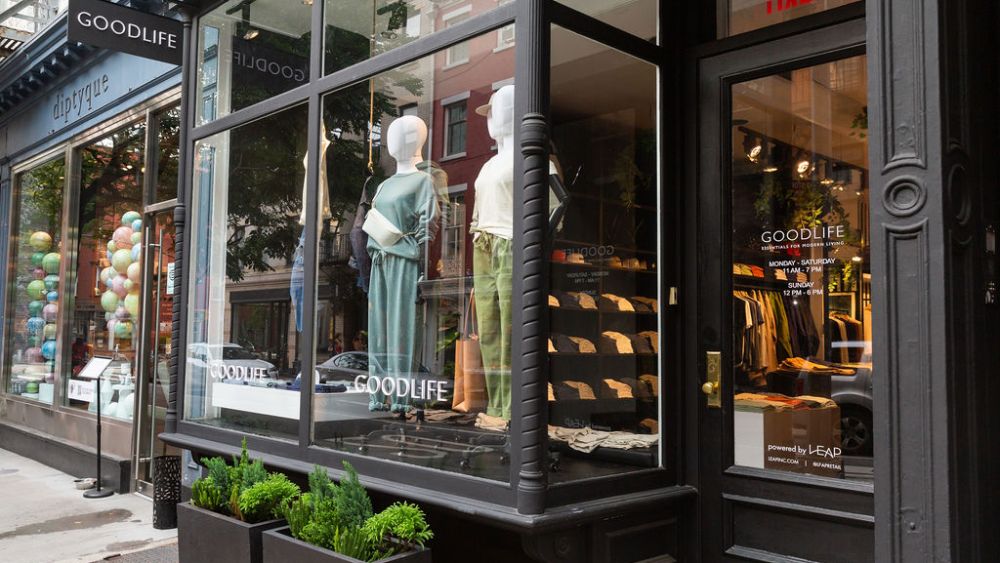
Before the pandemic, Leap had customers in eight markets: New York City; Chicago; Southern Florida; Austin, Texas; Dallas; San Francisco and Scottsdale, Ariz., clusters into neighborhoods such as Bleecker Street in New York City where it currently operates five stores: Naadam, Something Navy, Goodlife, Ring Concierge and Little Words Project. Coming soon is Mack Weldon.
Another popular spot is Lafayette Street in SoHo where Leap operates stores for Frank & Oak and Twenty Montreal.
About 50 percent of the stores are street level with the rest in indoor malls and lifestyle centers. New York’s Hudson Yards has two Leap stores: Goodlife and Yoga Democracy.
Tolia said that when the pandemic hit, Leap-operated stores were forced to close along with all the other brick-and-mortar retailers for more than four months. “But we realized that this would pass, the world would be restored and people would want human connections again,” he said. In preparation, Leap spent the third and fourth quarters of last year focusing on its infrastructure so that when its stores reopened, it could offer popular new amenities such as curbside pickup. Leap also put more focus on regions of the U.S. where stores were able to open more quickly such as South Florida, Scottsdale and Dallas.
So while COVID-19 certainly presented challenges to any retail operator, Tolia believes that ultimately it will accelerate business as clients seek flexibility and lower risk. “Once the vaccines rolled out, our phone started ringing,” he said. “We cannot keep up with the demand.”
Prior to the pandemic, Leap had nine customers, but today it has 32 with hundreds more in the queue wanting to launch including heritage and international labels in addition to strict d-to-c operators.
What is appealing to these direct-to-consumer brands is Leap’s core operational structure. The way it works, Tolia explained, is that Leap delivers “fully branded stores that we underwrite.” So once a brand signs on to work with the company, Leap finds a location, rents it, hires the employees, installs the point-of-sale systems, and works with the brand to build a distinct retail experience. Once the store is up and operating, Leap takes a performance-based percentage of sales as its fee, he said.
“We can get a store open in a matter of weeks,” Tolia said. “Acquiring customers online is becoming more challenging and costly, so they need an omnichannel experience. We tell the brands to focus on their product, marketing and supply chain and let us worry about the technology, labor and visual merchandising.”
Tolia said this helps alleviate the high cost of independently opening a brick-and-mortar location for direct-to-consumer brands. “The barriers to entry on a physical brick-and-mortar presence are incredibly high,” he said. Although there are any number of retail vacancies on street locations and in malls around the U.S, it’s still easier for someone with experience and clout to work as an intermediary. And with rents approaching pre-pandemic levels, having negotiating power is even more important. “There was a moment when there were COVID-19 deals, but now it’s back up to market rent,” Tolia said.
What’s interesting is that although the retail concepts may be different — women’s luxury merchandise or men’s basics — the store employees can rotate between concepts that are clustered in a particular area, such as Bleecker Street. “It helps the brands do better,” Tolia said.
Most of the stores are fairly small, around 1,000 square feet, making them more manageable. And Leap homes in on which concepts will work best in which locations, such as men’s wear, which is popular on Bleecker Street where 40 percent of customers are men, he said. “We understand shopper behavior and leverage that along with the brands’ e-commerce data” to find the most potentially successful locations.
“We think this is absolutely the wave of the future,” he said.
The brands that currently work with Leap have nothing but praise for the concept.
Matt Scanlan, chief executive officer and cofounder of Naadam, which was one of the first stores to open on Bleecker Street with Leap, said the cashmere brand had originally opened three stores on its own in New York City and Washington, D.C., but soon ran into challenges it hadn’t been expecting. These included poor negotiations for leases, pricey buildout costs and high employee turnover.
“We thought retail was a branding exercise, like Instagram photos,” he said. “But we soon realized our thinking was backward. Retail is tricky and we didn’t have the infrastructure or experience to hire people, incentivize staff and negotiate store leases.” So when Leap pitched the company, Scanlon decided to let it take the reins. He closed the D.C. store and turned over the operations of the units on Bleecker Street and in SoHo to Leap.
“They reorganized, remerchandised, eliminated the things that were creating a bad shopping experience,” he said. “They are a great risk mitigator and changed my perspective on retailing.” So much so that by the end of the year, Scanlan, who also serves as CEO of the women’s brand Something Navy, will have 14 stores operating with Leap in New York, Chicago, Los Angeles, Miami, San Francisco and Dallas. “And we’re looking to add another 10 to 15 next year,” he said.
“Ultimately, the pandemic lockdown was good for Leap’s business,” he said. “It showed retailers the risk of being overexposed. And now, brands’ demand for arms-length retailing [is exploding.] People missed in-person shopping and customers are coming back in a fierce way. We’re seeing store traffic and sales like we did in 2019.”
In terms of cost, he said he pays Leap a little under 10 percent over its monthly operating expenses. “If your rent and staff are $10,000, you pay them $1,000 for doing all the work,” Scanlan explained. “And if the store performs, they take a percentage of the sales that is negotiated by store.”
If the store is not successful, the two companies have a mutual “kick-out clause” where Leap can cycle in another brand or the brand can exit.
In Naadam’s case, the sailing has been smooth. “This allows me to expand the brand seamlessly and there’s a real chance this model will reset how retail works for the apparel industry,” Scanlan said. “It’s a great deal for brands whose core focus is not retail so they can concentrate on providing great e-commerce.”
Chris Molnar, founder and co-CEO of Goodlife, first opened a store with Leap in the fall of 2019 and in October moved into a larger space across the street on Bleecker Street.
“The biggest thing for growing a brand like ours is how capital intensive it is to open our own retail stores,” he said. “Even though you might have great industry experience, you don’t necessarily have retail experience in terms of staffing, logistics, point-of-sale systems — it’s quite daunting.”
So he also decided to partner with Leap. “There was so much less upfront capital required, meaning we can use our resources in other places. They ease the burden.” Goodlife too pays Leap a percentage of sales on a monthly basis after the operating expenses are covered.
Andrew Codispoti, Goodlife’s other co-CEO, said that while d-to-c drove sales during the beginning of the pandemic, brick-and-mortar has become more attractive now, prompting the brand to focus on opening more stores with Leap. “We’re a small, high-growth brand with no in-house expertise for brick-and-mortar,” he said. “We thought about going it alone, but we met the Leap guys and realized a lot more goes into opening stores than we realized and we can move our capital more efficiently if we work with Leap. In a short amount of time, it’s been a huge benefit having this relationship. We can open stores in much more of a ‘de-risk’ way so we’re not footing the whole bill.”
It was also the reason Goodlife was able to open a second store in Hudson Yards for a rent that “wouldn’t have been afforded to us as a stand-alone brand,” he said. “We have no negotiating power.” Ditto for its store in the Fashion Square mall in Scottsdale. “We flipped the lights on and it was profitable from Day One,” Codispoti said. With all its stores, the conversion rate is nearly 40 percent, which bodes well for the performance of additional physical stores.
As a result, Codispoti said Goodlife hopes to add three more stores within the next six to nine months. “For the foreseeable future, we will do it with Leap.”
But not every brand has had the same success. Paul Trible, cofounder and CEO of Ledbury, had ambitious plans for rolling out retail stores before the pandemic and opened its first store with Leap in 2019. “We had a couple of good months, but then closed the store,” he said. But it was more a function of the pandemic than a problem with Leap. Ledbury continues to operate two stores independently and is hoping to be in a position to reopen the conversation with Leap in the future to expand its retail footprint.
“We enjoyed working with them,” and found a lot of benefits in the lower capital expenditures and lease liabilities Leap provided, as well as its “deep retail background” and ability to run stores and help brands expand quickly, he said. “Those are all very attractive reasons to work with them. They’re in sprint mode now and hopefully we’ll join them again next year.”
Although Leap’s operating model is unique, there are other companies that have come up with distinct retail strategies, most of which involve more-temporary brick-and-mortar spaces.
These include Lion’esque Group, an experiential retail agency that has worked with brands such as J. Hilburn, Stella & Dot and Madison Reed on pop-up activations.
Melissa Gonzalez, CEO and founder of Lion’esque, said that since retail stores reopened following the pandemic shutdown, she’s seen a lot more interest from d-to-c brands looking to test the brick-and-mortar waters. The most popular categories are at-home fitness and beauty services, which performed well over the past year and are now looking to open stores as part of their growth trajectory.
Although rents had dipped during the height of the health crisis and landlords were willing to negotiate on the terms for both long-term pop-ups and permanent stores, “that window closed fast and it’s competitive again,” she said. That’s especially true in hot retail sectors such as SoHo, Fifth Avenue and the Flatiron district in Manhattan.
Outside New York, other cities such as Seattle, Boston, Chicago and West Hollywood are also experiencing a rebound in retail interest, she said.
Mall operators have also stopped offering short-term deals, she said. “We thought some mall groups would be excited by the idea of opening d-to-c stores, but they’re really not negotiating. They’ll tell us that if we don’t open in three of their properties, then there’s no deal.”
Looking ahead to next year, Gonzalez believes the pent-up demand that has driven sales the past few months will continue as the vaccine rollout continues for both adults and children. And while companies are still leery of investing too heavily in experiential events until consumers prove they’re comfortable shopping like they did in the past, she’s hopeful that will change by the spring.
“A lot of the high-end luxury brands can’t do events and pack stores like they used to, and with the supply chain issues, they don’t want to open stores and wait for deliveries,” she said. “But by the spring, once we get past cold and flu season, things will change. We see companies signing leases and eyeing spring 2022 openings.”