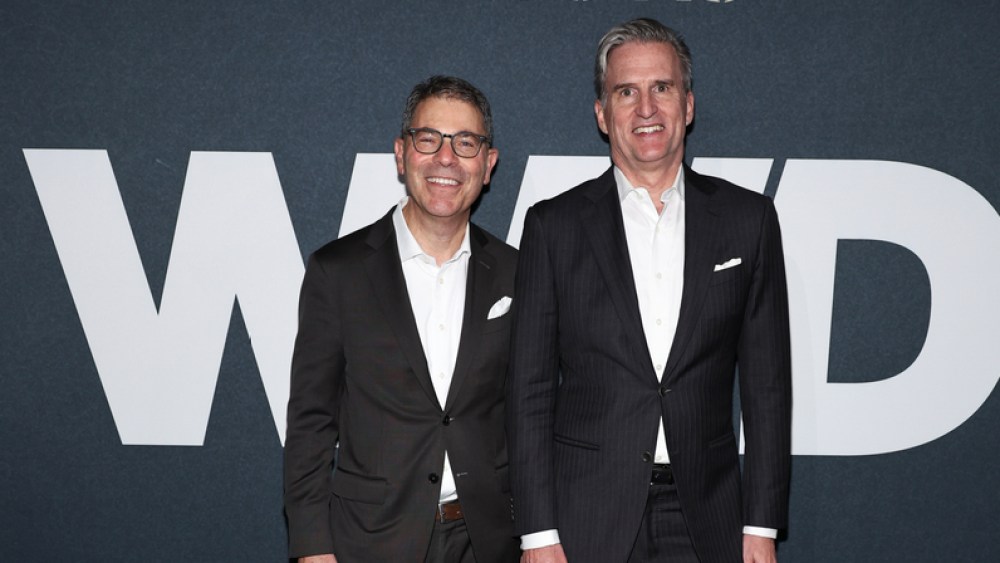
Last March, Jeff Gennette took the industry by surprise when he revealed his retirement as chairman and chief executive officer of Macy’s Inc., effective February 2024.
Being 61 at the time of the announcement and a 40-year veteran of the company, Gennette seemed too young and energetic for retirement, and in the midst of spearheading Macy’s Inc. transformation strategy, Polaris. He would be leaving Tony Spring, the chairman and CEO of Bloomingdale’s and his successor as the next CEO of Macy’s Inc, with a company with a healthier balance sheet and a path forward — as well as enormous challenges and some unfinished business.
Related Articles
“Look, you know when it’s your time and I knew when it was my time,” Gennette said at the WWD Apparel and Retail CEO Summit, explaining his retirement decision. “I accomplished a lot in my 40-year career. There’s many more things I want to do. I want to spend time with my family. There’s many subjects that I want to cover, hobbies I want to explore and potential new careers that I want to get into. So no announcement, but it’s time for a next chapter.”
You May Also Like
The big challenge for Spring, who shifts from running the $3 billion Bloomingdale’s business to the $24.5 billion Macy’s Inc. encompassing the Macy’s, Bluemercury and Bloomingdale’s brands, is figuring out how to consistently grow Macy’s Inc. profitably, Gennette said. “That’s the biggest challenge Tony has at Macy’s. We’ve had some good years. We’ve had some tough years. But how do we consistently show a CAGR [compound annual growth rate] that is consistent with where the market is growing and that we are not ceding market share.”
Gennette characterized Spring as “a great brand builder, a great innovator and huge talent developer.” He also said that last year, when Bloomingdale’s was celebrating its 150th birthday, the brand had its best year in terms of sales, profits and customer service. “That was a real testament to what I believe he’ll do for all three of the portfolio brands at Macy’s,” Gennette said in a conversation with WWD editorial director James Fallon.
He said up to 200 candidates across the globe in retail and other industries were considered as his possible successor. “I had a bias for internal. I was very clear with the board from Day One about that, but definitely kept all of our options open and did a rigorous search.”

At Bloomingdale’s, Spring is being succeeded as CEO by Olivier Bron in mid-November. “It’s a plum job,” Gennette said, noting that determining Bron as Spring’s successor and Spring as his successor also involved “exhaustive” search efforts.
“There are many parts of the country that Bloomingdale’s is not,” Gennette said of the retailer’s potential. “I would stack it up against any other retail and general merchandiser in terms of what it’s executing with right now. So we needed to find somebody that knew what to do to take that ticket to the next level, because we see lots of opportunity, lots of pockets of opportunity that we expect this new CEO to dive into.”
Bron has more than 20 years of experience in retail leadership roles, most recently as CEO of Central Group’s Central and Robinson Department Stores in Thailand. Earlier, he served as chief operating officer and director of strategy for French retail group Galeries Lafayette in Paris, and before that spent more than a decade at Bain & Company, the global consulting firm, where he focused on retail transformations. His background, Gennette said, “gave us all the confidence in what we believe he will do at Bloomingdale’s. It was a careful choice.”
At the Macy’s division, there’s work to be done managing the brick-and-mortar footprint. While the corporation is opening scaled down off-mall specialty formats, as well as off-price formats, department store and traditional mall closings are expected.
“I believe there is a great many malls, let’s call it 300, that are really, really healthy,” Gennette said. “Others will die over time. Macy’s is not in most of those, but we still will be closing stores.”
Gennette estimated that there are a total of 1,100 or so traditional malls in the U.S., most of which do not contain Macy’s and Bloomingdale’s.
“So there are thriving malls that are getting positive investment and changing the retail mix, becoming more vibrant destinations.” Those transforming to a more relevant, viable mix of services, eateries and retail, Gennette said, “are going to stand the test of time. And Macy’s and Bloomingdale’s are at the front door of most of those malls.”
While expecting to close some more department stores, Macy’s Inc. is advancing its off-mall specialty store strategy. After three years of testing and tinkering with scaled-down versions of its Macy’s store, the corporation poised to roll out the concept in a major way, targeting an additional 30 openings of small-format Macy’s through 2025. The wave of openings will commence in 2024 and occur across the country. Already there are 11 small-format Macy’s locations operating, with another set to open in November, meaning the store count on the format could increase to 42 in 2025. “In terms of our small-door strategy there’s no cannibalization with the efforts of that,” Gennette said.
He recalled one of his toughest moments professionally — navigating Macy’s Inc. through the pandemic.
“I don’t think anybody expected the depth of the world pandemic, and there is nothing that prepares you for that,” he said. “You can rely on muscle memory. You can rely on good experience. You can rely on a great team, a great board of directors. But it became very clear that as we were closing down stores, and we were deemed a nonessential retailer, we didn’t know when the team would be able to come back. We knew thousands of colleagues were going to be affected by that.…It was all about the preservation of cash. We changed vendor deals. We went to net costing. We basically worked on inventory control at an exponential level.”
The post-pandemic rebound was healthier than expected, excess cash was used to retire debt and clean up the balance sheet. “Macy’s [emerged] a healthier company coming out of the pandemic with a more agile transformed team than we were going in.”
As e-commerce surged during the pandemic and normalized as the pandemic dissipated, Macy’s kept a close eye on the nation’s shopper traffic, where people were shopping. “We got serious about looking at the nation’s traffic, and we just got more serious about an off-mall strategy. We got that courage and that conviction through the pandemic.”
In addition to putting the company on an improved financial footing and navigating it through COVID-19, Gennette cited bringing DEI more to the forefront of the Macy’s Inc. agenda as a major accomplishment. Macy’s Inc.’s new $5 billion Mission Every One program through 2025 to support products, programs and individuals working toward sustainability and equality “is a great example of something that I’m very proud to have been a part of with my team,” Gennette said.
He also said the company has a campaign encouraging people “to bring your authentic self to work. He said that being gay and open about it was never an impediment to working and advancing at Macy’s. The culture was right. Gennette remains one of the few openly gay CEOs of a major public company.
“Retail is a blend of art and science and the perspective that you have. It’s a hard business. Retail is detail. You have got to have great operators that really understand your culture and really understand your customer. But that also has to be imbued by new talent that comes in bringing new imagination for the consumers. And so we’ve done a pretty good job, before my tenure and through my tenure, of getting that great mash up between internal and external talent.”
Addressing the dearth of talent besetting the retail industry, he said, “Retail does not get the respect it deserves,” suggesting that many people choose any professions because they don’t comprehend “the myriad decisions that go behind a single product and the science involved with that and the technology and the human resources and finance and all the disciplines that go into that.”
Retailing as a career “is not enough of a conversation at kitchen tables in America. You’ve got to start at the high school level, at high school seniors that are thinking about going into a discipline. You’ve got to start at vocational community colleges. You can’t just look at the universities or the senior level of college when they’re thinking about going into a career. We have a bigger responsibility.”