
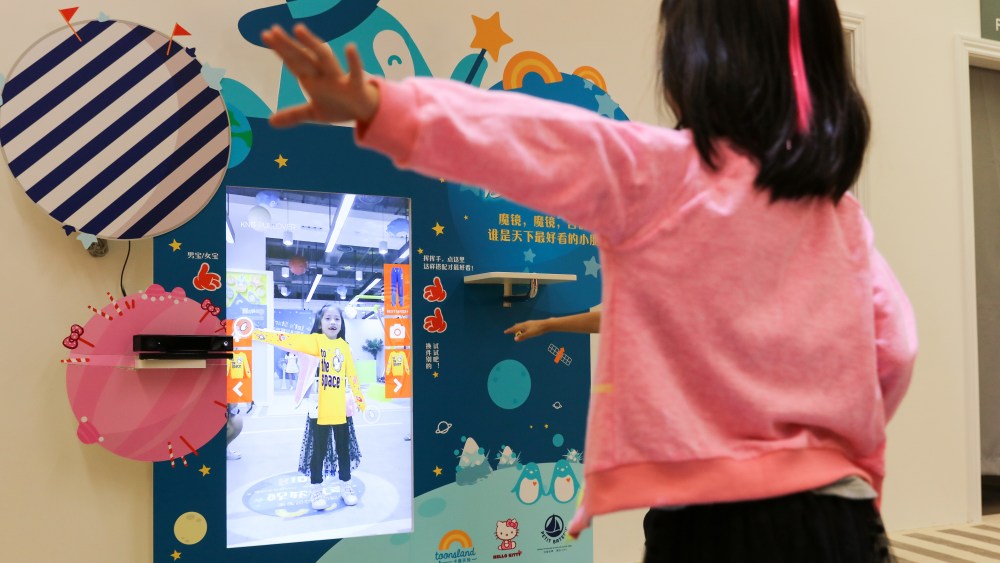
The Hong Kong-based Fung Group’s newly opened Explorium is essentially a large-scale laboratory designed to test omnichannel business models on real-life Chinese consumers.
The facility, located in Shanghai’s LiFung Plaza, will eventually grow to encompass 250,000 square feet of exhibition space. It will include technologies such as virtual-reality fitting rooms and magic mirrors that allow customers to visualize themselves with images of certain products. There are also 3-D printing services for creating customized goods.
Fung Group chairman Victor Fung said the laboratory is intended to test ways traditional bricks-and-mortar retail experience can embrace new technologies — allowing total fluidity for consumers in the online and offline research, purchasing and returning of consumer goods. A consortium of Fung Group, IBM and exhibition specialist Pico are jointly responsible for the space, which is open to members drawn from friends and family of the three companies’ employees. Explorium’s 12,000 members will use and interact with the retail and exhibition space at their leisure for the next 18 months. Data from their consumer behavior will be collected and analyzed. As consumer preferences become apparent, experiments and retail models will be added to the space.
Related Articles
With over 3,500 retailing units within the Fung Group, half of them in China, there was the option of in-store experimentation, but according to Fung, the process of installing these new retailing technologies, only to have to remove them if they proved unsuccessful, and disrupting existing customers in the process, was deemed to expensive and ultimately unpalatable.
You May Also Like
“Explorium is not a place to develop new technology, this is a place to see how to come up with different business models using existing technology, at the consumer interface. That is really the whole point of this,” Fung said in an interview at Thursday’s launch of the facility,
Whether it’s called omnichannel, O2O (online to offline) or a “bricks and clicks” strategy, there is little doubt that allowing this kind of flexibility to modern consumers is front of mind for many retailers.
What is in doubt, however, is the best way to balance competing desires for convenience, customer service, touch and feel and other elements of modern consumption.
“Everyone you talk to says this is going to happen and it’s going to happen very fast, but no one can tell you what the model is. In one way it’s very exciting, in another it’s kind of bewildering,” Fung said. “I cannot tell you what the model is either. The whole point is: how are you able to do rapid experimentation, learn from that experience and go on to the next experiment and trying not to lose your shirt while you are doing it?” he said.
Perhaps nowhere in the world is the omnichannel model more important than in China, where the size of the country and the impracticality of brick-and-mortar expansion to far-flung corners has driven an enormous e-commerce and m-commerce boom.
Current estimates from the China E-commerce Research Center have the sector on track to complete more than 15 trillion yuan, or $2.4 trillion at current exchange, in transactions this year.
Simultaneously, an oversupply of retail space, and traveling Chinese consumers discovering new products and experiences overseas, has led a new wave of brands to want to try their hand in the China market, ideally without the massive investment involved in an expansive brick-and-mortar strategy.
“If you think about it, if a store like Toys ‘R’ Us wants to test a new market, say Xi’an, a pop up might be a great solution, but the question is, how do you supply that store? It’s a huge logistical problem when your whole operation is on the eastern seaboard to supply your pop-up store in Xi’an. It becomes quite an expensive proposition,” Fung explained.
“Imagine a pop-up store, where all the items are there, but there is no cash register, you don’t buy anything, everything is there for you to click and then have delivered to your home later. Does that work? I don’t know,” the executive asked.
Though that is exactly what they hope to discover through their experiments at Explorium, which, in keeping with Fung’s Toys ‘R’ Us example, are initially focused on child and family-friendly retail experiences, before branching out more broadly into men’s, women’s and homeware categories in the coming months.
Fung said the company decided to open the testing facility in Shanghai because Chinese consumers are becoming some of the most discriminating customers in the world.
“These are hard-to-please and cutting-edge consumers, so if we can develop the model here, it will be applicable worldwide,” he said.