
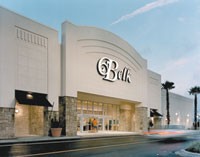
ATLANTA — Spurred by new leaders, streamlined operations and a focus on brands, Belk Inc.’s purchase of Proffitt’s and McRae’s gives a regional retailer that isn’t known for acquisitions the challenge of integrating major companies and signals its desire to stay in the hunt for businesses.
“We would consider other opportunities, but our immediate objective is to transition the Proffitt’s/McRae’s stores into Belk,” said Steve Pernotto, senior vice president, human resources. “This … enables us to expand our footprint into important markets within our primary trading area.”
Belk, the largest privately held U.S. department store company, closed on the deal Tuesday. It paid Saks Inc. $622 million and assumed $1 million in capitalized lease obligations and other liabilities to add 47 stores and an estimated $700 million in annual sales. The stores are to be absorbed under the Belk nameplate by fall 2006, giving the Charlotte, N.C.-based retailer a total of 275 units in 14 Southern states and projected annual sales of about $3.15 billion. Last year, Belk opened 14 stores, renovated eight and expanded three.
Amid continuing retail consolidation, Belk — a family-owned chain like the larger Dillard’s — stands out. Call it the anti-Wal-Mart. It is rooted in small markets such as Greenwood, S.C. (pop. 22,071), and has grown to serve the booming outer suburbs of Atlanta.
With similar demographics, Proffitt’s and McRae’s will give Belk deeper penetration in Kentucky, Tennessee, Mississippi and Louisiana, Pernotto said. Belk will also open 12 stores this year.
“Fifty-store chains are tough to run these days,” said Toni Browning, president and chief executive officer of Proffitt’s/McRae’s, who will stay with the company through September, when Proffitt’s Alcoa, Tenn., headquarters closes. “To fight a Federated, something had to happen. For economy of scale and dealing with vendors, acquisitions make sense.”
Belk might be a player for some units that Federated must shed from its May Department Stores acquisition to eliminate store overlaps, or for smaller regional chains.
Industry experts said the deal for Proffitt’s and McRae’s reflects more progressive management at Belk.
After the death of company president Thomas Belk in March 2004, his sons took over. Thomas “Tim” Belk Jr., 48, became chairman and ceo; H.W. McKay Belk, 47, co-president and chief merchandising officer, and John “Johnny” Belk, 45, co-president and chief operating officer. The three are nephews of former ceo John Belk, 84, named chairman emeritus last year after 59 years with the firm, and grandsons of William Henry Belk, who founded the company in 1888.
Related Articles
You May Also Like
Family members declined requests for interviews.
Belk, like all department stores, faces the challenge of differentiating itself as well as maintaining its regional identity, Browning said.
“We have to figure out how not to be perceived as dinosaurs,” she said. “It starts with the culture of the company, being unique and embracing small vendors, being open to nontraditional marketing and special events.”
Retail experts said Belk can thrive by offering small town America, a fertile, yet underserved market, life after Wal-Mart. While Belk is in a few larger markets, such as Charlotte, it mostly targets towns with populations of about 20,000 and median household incomes of $30,000.
By avoiding direct competition with retail giants, Belk brings consumers the only high-end, branded clothing — Jones New York, Liz Claiborne, Polo Ralph Lauren and cosmetics brands like Estee Lauder — they may find without a trip to a metropolitan area. Belk embeds itself in communities, sponsoring high school football and other events, in the manner of Main Street merchants of another era.
Jan Martinez, president of Ashford Management, an Atlanta retail executive recruiting firm that has worked for Belk, said the values that made the company may have also slowed it down.
“It’s like the guy you marry because he’s generous and then divorce because he gave all the money away,” she said. “They made sure everything they’ve done is right, fair and wonderful, and they’ve watched everybody else grow all around them.”
Whether or not Belk expands beyond its comfort zone, the retailer hasn’t run out of places to grow, said Scott Evans, a partner at Ernst & Young for real estate advisory services in the Southeast.
“There’s plenty of room for retail expansion, in suburbs and exurbs that have had huge growth in cities like Atlanta,” Evans said. “In the future it will be a challenge to have much new department store urban infill. These established regional retailers have their formulas down and are quite successful at what they do.”
Belk’s strategy fits in the current retail landscape, Pernotto said.
“There aren’t 12 new regional malls opening to put 12 new stores,” he said. “We’re not looking to be a mall-based retailer. A downtown urban area, like Charlotte, N.C., may have 12,000 people living there, but is that enough to sustain a store, given the rule of thumb — one square foot for one individual? We’re looking at population trends that will support shopping patterns. When the population is right, the retailer will come.”
The vendor structures and promotional strategies of Belk and Proffitt’s/McRae’s are similar, but Proffitt’s/McRae’s women’s target market was a bit younger, 25 and up, compared with Belk’s sweet spot of 35 and older, Browning said. Belk will benefit from absorbing Proffitt’s/McRae’s well-developed private label program, and the chains’ common geography and target markets create a good match, she said.
There are no immediate plans to close any Proffitt’s or McRae’s stores, although some overlap with existing Belk units.
Arnold Aronson, managing director of retail strategies, Kurt Salmon Associates, said Belk’s strategy has been updated with a focus on brands and streamlining of operations and costs that has prepared it for growth, including acquisitions.
“The Proffitt’s/McRae’s deal, which will increase their Southern imprint 30 to 40 percent, is an aggressive move that means the market and financial community has confidence in them,” he said. “The stores are in the same terrain, with the same seasons and lifestyle, so there’s a comfort level and minor risk, with only minor cannibalizing.”
A major restructuring in 1998 consolidated Belk’s 112 separate companies, which were started by founder William Henry Belk as the retailer expanded. Leaner operations, centralized buying and distribution and a focus on name brands resulted in improving sales that reached $2.45 billion in the fiscal year ending Jan. 29, 2005, up 8 percent from the same period the previous year.
Senior economist Mark Vitner of Wachovia Corp., based in Charlotte, said solidifying its Southern position gave Belk an edge over other retailers because Census figures indicate that two-thirds of U.S. population growth in the next 25 years will be in the South.
“People thought going head-to-head with Wal-Mart in small towns wasn’t smart,” Vitner said. “But not everybody wants to shop Wal-Mart. Belk brings glitz and glamour to Main Street America. Belk is looking unique and desirable, like an old-line department store model that people thought was dead.”
In-store Belk shops, complete with signage and visuals, showcase sportswear brands. Misses’ career departments have in-store shops for Sag Harbor and Alfred Dunner. Misses’ private label sportswear, under the Madison Studio label, is prominently merchandised in the front of women’s departments of Belk stores. Knits, in basic and novelty tops, are a big category, with colorful sweaters by Joseph A, Cable & Gauge and Rafaella, and merchandised with printed novelty pants and skirts for summer. Prices range from about $20 to $60, but promotions during June ran sales from 25 to 50 percent off.
Catering to more suburban sensibilities, offerings lean toward traditional and preppy, rather than trendy merchandise. An exception is a small contemporary area called “New Directions,” which offers updated looks such as lace-trimmed satin camisole tops and broomstick skirts by Uniform by John Paul Richard and AGB, a division of Byer of California.
Cosmetics areas carry the same lines as major departments stores, including Lancome, Clinique and Estee Lauder, and shoe departments offer labels such as Easy Spirit, Lifestride and other department store brands.
Capturing the hearts of small towns requires community involvement and personal service, areas where Belk excels, Vitner said. In addition to sponsoring community events and teams, services include free alterations and free gift wrap for credit card customers, flexible exchange policies and limited interest-free credit cards, along with intangibles, such as friendly sales associates.
Analysts agreed that do-the-right-thing ethics, always a key component of the Belk philosophy, will continue regardless of size. And, as a family-owned chain, Belk can control its destiny better than publicly owned retailers that are subject to the pressures of Wall Street.
“Their small-town charm is their greatest asset, and they won’t abandon it,” Vitner said. “But they can also move into cities and do well. They can, and are, starting to compete with bigger retailers. They can pick and choose when the time is right.”
BELK INC.
- Leadership: Thomas “Tim” Belk Jr., chairman and chief executive officer
- Founded: 1888 by William Henry Belk
- 2005 sales: $2.45 billion
- 2006 sales: $3.15 billion*
- 2005 net income: $124.1 million
- 2005 net income growth: 11 percent
- Headquarters: Charlotte, N.C.
- Original slogan: “Cheap Goods Sell Themselves”
- Stores: 275 in 14 states
*Estimated