
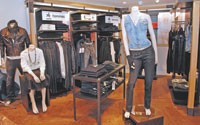
PARIS — Get ready for an outbreak of retail blues — denim blue, that is.
Some of the world’s most powerful denim brands are charting ambitious retail rollouts, opening boutiques at a breakneck pace in Europe before moving elsewhere, as a way to fend off fierce competition from fast-fashion giants and adapt to changing shopping patterns.
“Growth of retail stores is our key strategy in growing our business,” said Mark Sanders, head of global retail for Levi’s Jeans, which on Thursday is to christen its first Paris flagship on Rue Etienne Marcel, the French capital’s burgeoning denim hub. “It is our key way to grow over the next three to five years.”
Lee, G-Star, Lee Cooper and Replay are among other denim brands launching concepts and locations in an effort to grab market share, increase sales and create a richer brand experience.
Brands are choosing Europe to test retail concepts because the continent has a fashion-forward consumer base and competition issues between multibrand stores and monobrand doors is less intense than in the U.S., industry insiders said.
“Clearly, denim brands are looking for ways to grow business,” said Richard Traich, European managing director at Kurt Salmon Associates. “Denim brands must maintain margins and grow sales in order to protect themselves from the value discount market and high street chains. Retail is the way to do so. It creates more uniqueness for the brand as wholesale is proving to be very difficult to manage.”
In Europe, “it is no longer possible to sell jeans as a commodity, you must sell as a lifestyle product,” agreed Antonio Gnocchini, European marketing director for VF Corp.’s Lee. “It is impossible to create a lifestyle brand just through traditional marketing. The full values of the brand can only be strongly communicated through concept stores.”
In an effort to lure European customers weaned on fast-fashion chains, Lee has been introducing stores it bills as lifestyle playgrounds, with locations in Antwerp, Belgium, and Berlin added in recent months, bringing its complement to five. Three more European flagships are slated for 2007, and more in 2008.
Gnocchini expects retail sales from fully owned concept stores to reach 10 percent of total Lee sales in Europe by 2010.
Related Articles
You May Also Like
“Multibrand denim stores are really struggling,” he added. “They are squeezed between the fast-fashion chains and the high-end fashion boutiques….Retailers cherry-pick styles from collections according to their needs, leaving us with no control of our brand image.”
European brands as diverse as G-Star, Replay and Acne are also pursuing the retail route.
“Wholesale is still a driving force but we will put more energy every year into retail,” said Marco Bortoletti, chief executive officer of ReplayJeans, which counts 180 doors worldwide, 50 of which are fully owned.
Bortoletti anticipates 50 more Replay stores to open next year, 10 of them company owned. A similar increase is expected for 2008. Replay grew its sales 41 percent to 329 million euros, or $423 million, last year, 42 million euros ($54 million) of which were generated by fully owned Replay stores. For 2006, Replay expects to increase its store sales to 50 million euros, or $64 million, on full-year sales estimates of more than 350 million euros ($450 million). All figures are at current exchange.
Traich of Kurt Salmon Associates considers Levi’s one of the retail pioneers in Europe.
Dubbed “Revolution,” Levi’s new retail concept opened in May 2005 with a store in Brussels, near its European headquarters. There are 64 Revolution stores, 37 shop-in-shops and five factory outlets. Paris is the first of four European flagships to be fully refitted with the Revolution store concept.
Levi’s new Paris store boasts copper wall paneling and oak display units that are juxtaposed with modern touches such as plasma TV screens and a sprawling denim bar. The store also plans to showcase collaborations with local artists and musicians, as well as offer tailoring services.
“Every time customers come to the store they will experience something new,” said Brice Penaranda, president of Levi’s France.
The store stretches over two floors, with the brand’s “red tab” label showcased on the first floor and Levi’s high-end lines, such as Levi’s Blue, Levi’s Vintage Clothing and Engineered, and children’s apparel on the lower level. “The store offers a new way of talking to the consumer,” Penaranda said.
Experts agreed retail has become a powerful new communication tool for denim brands.
“Retail marketing has become more efficient than conventional marketing,” said George Wallace, ceo of Management Horizons Europe, a specialist retail practice. “Stores are more efficient than media and advertising and are therefore becoming part of the marketing budget.”
Retail concepts, however, must offer something special to attract the attention of savvy shoppers. “It’s one thing to have a store, but in order to be successful you can’t just be about selling jeans,” Wallace said.
Lee’s first flagship, which averages some $3 million in annual sales, opened three years ago on London’s Carnaby Street and has served as a template for the openings that followed in Milan and Paris.
All have unique features. The London branch, for example, has a large glass window that serves as stage for up-and-coming rock ‘n’ roll talent. Franz Ferdinand has teamed up with Lee and contributed graphics for women’s and men’s styles that will launch next spring, with proceeds going to charity.
Similarly, Lee’s 1,720-square-foot Antwerp store features striking burnt shelving units by Belgian industrial designer Maarten Baas, and the Berlin shop worked with graffiti guru Mode 2 to jazz up its interior.
“A store measures the pulse of the market,” Gnocchini said. “It has the ability to track what works and what doesn’t work; it is a fantastic feedback machine. It is a three-dimensional instrument where consumers can experience everything about the brand.”
Although Levi’s and Lee are U.S.-based firms, both brands chose Europe to launch their new retail expansion strategies.
“Both Lee and Levi’s are major distributors in the U.S.,” said Management Horizon’s Wallace. “Competitive conflicts with other channels are less of an issue in Europe.” He noted that product ranges in Europe are more fashion-oriented than in the U.S.
At Lee, for example, its European concept stores primarily showcase the brand’s upscale denim lines such as LWD and X Line as well as its premium collection Gold Label, which uses Japanese denim in avant-garde cuts. Prices for the latter collection range from 200 euros to 250 euros, or $257 to $321, at retail.
Michel Schwarz of Retail Transformation, a Paris-based consultancy specializing in distribution strategies, cautioned that the cost of opening stores has increased in Europe and locations are increasingly difficult to find as fast-fashion chains often benefit from privileged relationships with real estate brokers.
U.K.-based Lee Cooper last week announced plans to accelerate its retail rollout. “It is essential to control how a product looks and how and where it is shown,” said Peter Baker, head of retail.
Lee Cooper, which counts some 490 stores worldwide, expects total group sales to reach around $500 million in 2006. Retail accounts for some 35 percent of the brand’s business, which the group hopes to increase to 50 percent over the next three years. As part of Lee Cooper’s new retail strategy, the brand said that it would repurchase certain of its franchises, including its Swiss and Indonesian distributors, and set up joint ventures in some of its markets.
“Joint ventures gives us more control over our image,” Baker said.
Yet other manufacturers noted that franchises allow brands to accelerate their retail reach at a quicker pace. “Franchises are our preferred business model, we are able to go much faster that way,” said Levi’s Sanders.
“We started a new franchise strategy four years ago called ‘retailer made’ that has boosted sales; today we have 75 stores,” said Deepak Gayadin, G-Star sales director for North America. “We plan to double that figure by next year.”
Retail counts for 10 percent of G-Star’s total sales. The group expects sales from all its doors to reach one-third of G-Star’s business over the next five years.
Manufacturers acknowledged that replenishing collections and continually adding new styles are among chief challenges. It’s particularly difficult for denim firms boasting a plethora of sizes, lengths, styles, washes and colors for every collection.
“We are working very hard to replenish our classic ranges,” said Lee Cooper’s Baker.
Kurt Salmon’s Traich said wholesale clients typically purchase collections and just sell until stocks are depleted. However, “Consumers are changing, shoppers are looking for much more excitement in product range and speed to market has become very important,” he said. “Brands must rotate new ranges more quickly. Brands are therefore expanding product categories, transforming the jeans brand into a lifestyle line that also carries accessories, fragrances, etc.”
Wallace said, “Brands like Diesel, G-Star and Replay have been on the retail track for years. Brands want to control their distribution in order to get closer to the customer. They realized that controlling the image of a brand was worth paying for over the advertising prices.”
Learning from their elders, even niche labels are jumping into the retail game early.
“Our stores help consumers understand who we are and what the brand is about,” said Mikael Schiller, president of Stockholm-based Acne Jean.
With already seven stores in Europe, Acne’s full-year sales for its stores average around 2.5 million euros ($3.2 million) or 25 percent of group sales. Schiller said he was eyeing other major capitals such as Paris; New York; London; Hamburg, Germany, and Oslo for new store openings as early as next year.