
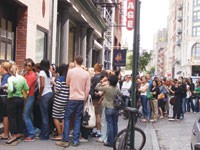
While many people trudge through the crowds in department stores and malls, sprier ones are dashing out on their lunch breaks or queuing up before work to jostle with another breed — sample-sale shoppers.
No longer synonymous with discounted schlock, sample sales have evolved, with many offering fresh-from-the-runway styles instead of poor-selling basics. Many companies are even opening their showrooms and lining up rolling racks for this seasonal occasion, rather than holding them in a vacant space where cardboard boxes serve as bins.
But the transformation of sample sales from low-key occasions meant for a few family members and friends to serious revenue-generating businesses has brought an unwelcome guest: thieves.
And they have plenty of ways to find out about potential targets. Sample-sale notices are routinely e-mailed as urgent messages or flagged in newspapers and Web sites like Dailycandy.com. Until last month’s arrests of three alleged shoplifters who tried to run off with thousands of dollars of merchandise at an adampluseve sample sale, there was little public discussion about the five-finger discounts that are considered by many to be part of the cost of doing business.
For some, the attempted theft was another reminder of the need for constant vigilance during a sample sale. Rebecca Taylor now only allows shoppers to carry wallets while browsing. All bags must be checked at the entrance. In the past year, the company has hired extra security guards who have the task of checking everyone’s receipts with what is inside their respective shopping bags. As another precaution, Rebecca Taylor staffers circulate on the floor “to provide extra customer service,” a company spokeswoman said.
Tocca stages a sample sale three times a year, and, inevitably, there is some shrinkage, according to vice president of operations Joyce Ramos. Shoplifters have never been caught, but Tocca interns wander around to help make sure people don’t slip any items into their bags, she said. The company typically sells a few thousand units at a sample sale, Ramos said.
“We try to be as preemptive as we can.” she said. “It’s really the cost of doing business in these types of sales. It’s not as monitored as if it were a retail store.”
Related Articles
You May Also Like
Another detriment of sample sales is having to deal with some customers who try to return something they bought at one, Ramos said.
As shoplifters have gotten more sophisticated, so must designers with their security. Having been in the business of running sample sales for two decades, Elysa Lazar said, “Twenty years ago a friend of a friend was your security system. Now there are lots of eyes watching.”
At Lazar-organized sample sales, there are armed off-duty members of the New York City Police Department watching. Nor should designers limit their precautions to working hours. Lazar said she makes a point of having at least one of her own security guards work the overnight shift. “If not, a lot of things can walk during the night,” she said. “Also, many shoplifters have gotten smart about when inventory is moved in or moved out for sale.
“Shoplifting at sample sales is something everyone faces, unfortunately,” Lazar added. “But my sense is, it is getting better than it was.”
Theory prefers to outsource its sample sales to SSS Sales, partially to help curb shoplifting. In addition to being responsible for the inventory, SSS hires plainclothes and uniformed security, limits the number of items allowed in a dressing room and requires that all coats and oversized bags be checked, said Craig Leavitt, president of retail. “We have been fortunate that it has not been a significant issue. Of course, it’s always a challenge. Just as you would expect in a retail store, it’s a fact of life. There is some shrinkage within the normal perimeters,” said Leavitt.
Management at Metropolitan Pavilion, which oversaw this month’s Kate Spade and Catherine Malandrino sample sales, is also proactive. All new employees must fill out background questionnaires, and background checks are run on all event supervisors, according to a company spokeswoman. The building’s entrances and exits are monitored with digital cameras, and there is 24-hour building security. A security consultant routinely does spot checks and regularly reviews security procedures. In addition, clients are recommended to have 24-hour security, the spokeswoman said.
After losing $18,000 worth of merchandise at their sample sale in 2003, Lutz & Patmos has learned to be on the lookout. “It was just a slow morning, and we didn’t pay enough attention. This group of women came in, and they didn’t really look like sample-sale shoppers. They were too big to fit into sample sizes, and they had all these plastic bags with them,” Tina Lutz said. “It seemed like they were organized because they were very good at distracting us. They asked us for business cards and sent us looking for different sizes. We turned our back one too many times.”
After they left, she and her business partner, Marcia Patmos, realized something was askew and chased after them, catching two. But the shoppers’ plastic bags were empty so they let them go, only to realize more was missing once they returned to their West 13th Street showroom. They informed the police, and Patmos pored over photographs of potential suspects but never found them. When they described the shoplifting scenario to John Bartlett, he told them he had experienced something similar. The fact that the thieves only took items upon which Lutz & Patmos had received editorial coverage made Lutz think they were savvy. For the sale held earlier this month, all shoppers had to check bags and coats, and ample security was on hand. “The sale can be a madhouse. It’s hard to see what everyone is doing, so now we really take precautions.”
Another headache is shoppers stealing other shoppers’ personal belongings at sample sales, as has happened at Yigal Azrouël. “Two sample sales ago, they were even stealing from the people shopping. One woman had her Blackberry stolen,” said Reesa Toppel, a public relations executive for the firm.
During last month’s sale at Yigal Azrouël, a group of women tried to run off with some stolen merchandise down the stairwell, but a receptionist warned them an alarm would sound if they opened the door. They jumped on the next elevator, going up, but the group was gone when it stopped moments later on the way down.
Toppel suspected another quartet of women as well. They shopped together and always wore trenchcoats, whether it was May or November, she said. Aside from their outerwear, their tendency to shop the size-2 merchandise also set off alarm bells with Toppel. “They’re obviously not size 2s. That’s when I use the best customer skills I have,” Toppel said. “I ask them if they’re shopping for a gift or would like help finding their sizes.”
When browsing at Yigal Azrouël’s sale last month, Toppel trailed them. “Basically, I follow them. I don’t care if I’m blatantly following them. You never know how much they’re stealing,” she said. “One of the things they took was an archived leather jumper, a very special item. I assume they get it and sell it on eBay.”
Consignment shops would be a more likely place to try to unload stolen goods, but Carrie Peterson, owner of Beacon’s Closet, a two-store clothing exchange business in Brooklyn, has safeguards. Her store’s policy of photocopying every purchaser’s and seller’s photo ID is a deterrent. But she still sees her share of shoplifting.
“They bring bags and pile stuff in — mothers with strollers, a grandmother with two grandchildren — it’s really shocking,” Peterson said. “I can’t really imagine why they steal used things. It’s more about getting away with something.”
A spokeswoman for eBay said the company does work closely with law enforcement agencies to try to prevent the online sales of stolen or counterfeit merchandise. She advised any brand owners or designers who have had merchandise stolen to start with law enforcement. “What we hear consistently is that eBay is probably one of the dumbest places a thief could go. We verify financial information, e-mail accounts and mailing information,” the spokeswoman said. “It’s not a question of if you’re going to get caught, it’s more of a question of when.”
As general manager of Soiffer Haskin, which handles 30 to 35 sample sales annually, Scott Bevan doesn’t consider shoplifting to be a rampant problem. He is also paid to be aware of what is going on more so than an intern or staff employee might be. At Soiffer Haskin-organized sales at a 6,000-square-foot space at 317 West 33rd Street, shoppers must check their coats and bags. There is at least one security guard if not more, depending on the client, and the facility has security cameras. “We’re probably more protected than most,” Bevan said.
Still, some companies prefer to play it safe rather than sorry. Marc Jacobs and Vera Wang sidestep shoplifting by only inviting those they know to their respective private sales. And having suffered its share of sample-sale stealing, Carmen Marc Valvo made last month’s sale a private one for the first time. In years past, 600 to 800 people might troop through the showroom, making it “impossible to keep track of what people took into the dressing rooms,” said communications director Frank Pulice.
The company sold 700 units during last month’s sale. “Private is definitely the way we will choose to go in the future. We were able to match the numbers we did when it was an open-door policy.” he said. “And we didn’t need any extra security, and people didn’t have to check their bags or anything like that.”