
BANGKOK — The state of emergency that has been in place here for eight months was lifted Wednesday, and retailers are ready for a revival.
Malls and merchants are heading into 2011 flush with money for marketing, more sophisticated security systems and hopes for recovering from the antigovernment demonstrations that forced lengthy closings and caused the destruction of a major shopping center.
Retailers are trying to lure back international and Thai customers who have stayed away since protesters barricaded themselves into several downtown blocks starting last spring and set fire to buildings. About 90 people were killed and more than 1,400 injured before government troops were able to dispel the mobs.
Related Articles
The antigovernment Red Shirts, made up largely of Thailand’s rural poor who want the ouster of Prime Minister Abhisit Vejjajiva and the dissolution of Parliament, have not completely gone away. They are staging twice-a-month protests in downtown Bangkok and Sunday blocked the retail center of the city and forced the early closure of Central World.
You May Also Like
“Hopefully, we’ll recover, and in one more year we hope to be open 100 percent,” said Patson Sarindu, marketing manager for Central World, the 6-million-square-foot mall in the center of Bangkok’s retail district that was burned by protesters in May.
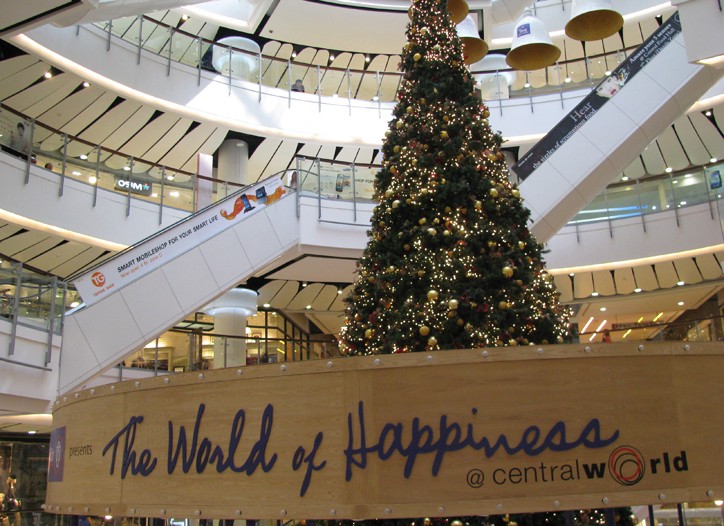
Central World embarked on a $300 million reconstruction and renovation that included air conditioning systems, escalators and elevators. A portion reopened on Sept. 28, and subsequent sections of the mall launched this month, bringing reopened space to about 80 percent of the total.
The holiday marketing budget is $6.6 million at Central Pattana Public Co. Ltd., which manages all of the mall’s retail properties. The campaign at Central World, dubbed “World of Happiness,” includes a New Year’s countdown at the Central World Plaza, a 100-foot Christmas tree, 10-foot-tall Russian dolls and life-size glass snow globes that people can enter for pictures. There is also an indoor ice skating rink, a parking area reserved for female drivers and new shops by Fred Perry, Stradivarius, Footwork Noir, Daks, Techno Marine, Berskha and Glam Rock.
More than 600 tenants and 15,000 employees were displaced by the Central World fire. Mall management devised a plan in June to help tenants and rebuild. The effort involved finding alternative retail sites for tenants, rent waivers and contract renegotiations with tenants.
Customer visits at Central World are down from a peak of 120,000 a day before the fire to 90,000 daily, said Sakorn Thavisin, assistant vice president of marketing. But mall officials are confident they will rebuild their customer base.
“Going to malls is part of the Thai lifestyle,” Sarindu said.
Central World has spent $5 million on new security systems, while Siam Paragon, a neighboring 5.4-million-square-foot luxury mall, and Gaysorn Shopping Centre, a five-level upscale mall, have increased their security budgets by unspecified amounts. Gaysorn and Siam Paragon were also targeted by antigovernment protesters who tried to set them afire, but mall employees were able to extinguish the flames.
At Gaysorn, which features Louis Vuitton, Gucci, Prada, Dior, Fendi, Salvatore Ferragamo, Emilio Pucci, Burberry and Max Mara, spending has gone toward metal roll-down doors to block entrances, closed-circuit TVs and guards. Siam Paragon has increased its security force by about 15 percent, and also has installed bomb and metal detectors, armed door guards and closed-circuit TV.
At Siam Paragon, which is built on land owned by the Thai royal family and is next to one of the king’s palaces, security is tight because of government cooperation, said Kriengsak Tantiphipop, chief operating officer of Siam Paragon Development Corp.
“We already have maximum security,” said Tantiphipop, adding that mall employees also have been trained in protective measures. “I don’t think things will get that bad again. Both sides realize the situation was not good for anyone and that what happened just damaged the city.”
Siam Paragon was closed for two months during the protests. Despite that, sales were up 5 percent for 2010, Tantiphipop said.
“If we hadn’t been closed, our sales would have increased 20 percent,” he said, crediting some 300 marketing events since the mall reopened with helping to boost its bottom line.
Gaysorn Shopping Centre, in addition to security spending, is devoting about $3.2 million to repairs and renovations because of damage from the mobs, said Atchareeya Nimmannit, public relations manager for Gaysorn Land Asset Management Co.
Damage to merchandise owned by Gaysorn tenants was minimized because mall management had advised them to move their inventory out of the building during the riots. Management also arranged for tenants to erect temporary selling space at the five-star Mandarin Oriental Hotel across town on the Chao Phraya River while the mall was closed.
Sales at Gaysorn are now 80 percent of what they were before the riots, Nimmannit said. Promotions staged to bring back shoppers include lucky draws, hotel packages and end-of-year sales, she said. A Louis Vuitton art exhibition is planned for early 2011.
“[It] was a tough year for us,” Nimmannit said. “After being closed for two months, our sales are about even with 2009. The riots tested us and we passed this test. We survived.”
The Mall Group, the second-largest Thai retailer, is continuing the pop-up store effort that was used during the protests. From Dec. 17 to 26, it rented out space in BITEC, a Bangkok convention center. Retailers selling everything from toothbrushes to designer shoes put up booths in a 215,000-square-foot space for 10 days. At the first BITEC event, staged by The Mall Group in June, average spending per person was about $112, more than the $88-a-person spending in its retail outlets.
Abhisit has said he’s not worried about the protests because leaders have pledged that they will remain peaceful.
Somphols Manarangsan, a political economist at Bangkok’s Chulalongkorn University, said the Red Shirts are weaker and don’t pose a threat to the country’s security. He also said that Thailand’s plans to hold new elections within six months could stem their complaints.
Government efforts to rebuild Thailand’s economy, including a hike in the minimum wage, salary raises for government workers and subsidies to businesses hurt by the protests, will boost retailing in 2011, Manarangsan said. He predicted the Thai economy would grow 4 percent to 5 percent in 2011.
Tourist visits to Thailand are up 12.6 percent from January through November, according to the Thai Tourism Authority. Most of Thailand’s visitors are from East Asia, followed by travelers from the Middle East and Russia. India is Thailand’s fast-growing tourism market.