PARIS — Three years into a brand transformation under chief executive officer Valérie Dassier, French heritage label Aigle, best known for its rubber boots, has repositioned itself from a diluted lifestyle concept to a focused “French outdoor lifestyle” label.
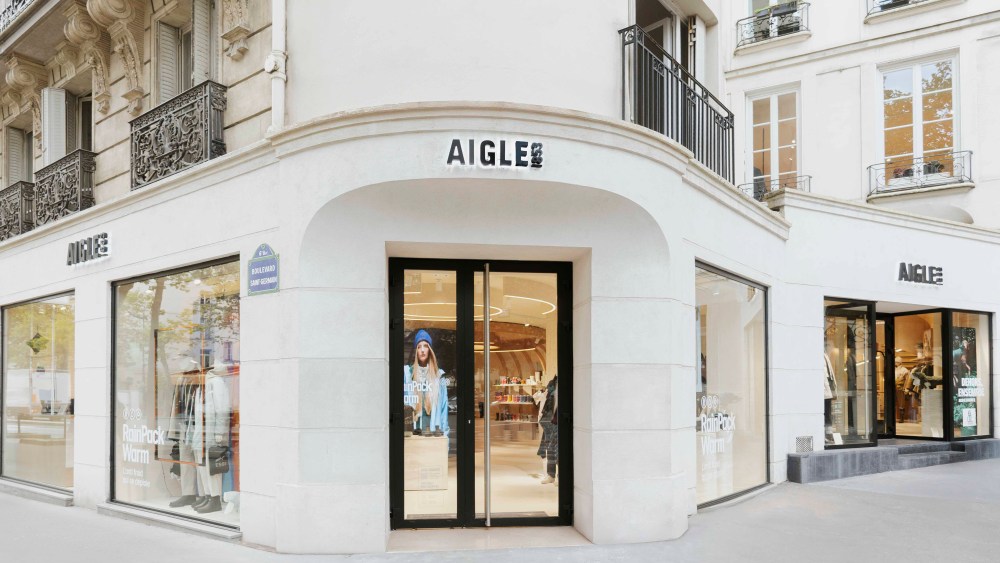
To highlight its shift, the brand revamped its Paris and Hong Kong flagships with a sleeker, more contemporary look, redesigned its logo and focused on key core items — all while delivering double-digit growth across key markets.
Related Articles
“First we have reworked the brand positioning,” said Dassier. “Before my arrival, the brand was a bit too much ‘lifestyle.’ So I put it back in the market of outdoor; first, because that is our DNA, and secondly, because it’s a market which is booming.”
You May Also Like

Dassier, who took the helm in 2022, focused her rebuild on three pillars: product, marketing and store experience.
One key change was in design direction. Études Studio, which previously handled the entire collection, stepped back to focus on a more fashion-forward capsule. This freed Aigle’s internal studio to develop the main line, drawing inspiration from the capsule while ensuring alignment with brand DNA.
Dassier pared down an array of styles and concentrated on what she calls the brand’s “iconics”: 10 core items including rubber boots, parkas, fleeces, trenchcoats and safari jackets, to hone the aesthetic.
“Let’s be the best in the world on those 10 iconics,” said Dassier of her vision. An item like the trenchcoat line is hugely popular in Asia, she said, with the coat’s inherent Frenchness a main selling point.
The physical manifestation of this identity overhaul is most evident in Aigle’s redesigned Paris and Hong Kong flagships, both unveiled in September. Gone is the cozy, woodsy chalet aesthetic; in its place, a clean, bright space featuring light woods, travertine stone, curved lines and forest-inspired arches that highlight the brand’s artisanal rubber heritage.
The architecture was reimagined in house by Celine Saenz.
The space, central to the ground floor at 139 Boulevard Saint-Germain, is “like a cocoon for one of the most important products in our history,” Dassier said. “We are the last manufacturer in France, and the space has been reworked to make it a temple to the rubber boot.”
The rubber boot display mirrors how the products are hung heel-up when placed in the oven during production, in order to reinforce Aigle’s craftsmanship and brand storytelling. Photos of the factory are placed inside the cocoon area, and a QR code allows visitors to take a virtual tour of the Aigle factory.
Further into the store, the brand has created a “sound shower” with audible gusts of rain and wind to bring the outdoor elements to life.
The concept was developed over the past year, and the store closed for two months for the revamp. It will serve as a calling card for both customers — particularly tourists who come to Paris — and potential partners as she eyes expansion.
“The redesign [of the store] is very important, because it is the image of Aigle in France. When I have some prospective partners that I want to work with in Asia, they come to Paris and see the store. It is the window of the brand,” she said.
Speaking of windows, the company now uses half of its storefronts to display detailed product information so passersby get tech specs, and this has been carried through to hangtags on racks throughout the retail space.
With a physical French factory still at the heart of the brand, Aigle has ramped up not only communication on its in-house production, but also invested heavily in manufacturing innovation. It tripled its research and development budget over the last three years to launch new products while simultaneously improving safety and sustainability.
“Manufacturing is our treasure. So you need to invest in it,” said Dassier. “It’s a differentiation tool for us.”
That investment has paid off. Aigle has launched five rubber boot designs in just one year, with a sixth on the way in 2026. A new 100-euro entry-price model is aimed at recruiting younger consumers, while trendier silhouettes like biker boots and the brand’s first heeled style aim to appeal to more fashion-forward customers.
Developing that many products within a short time frame is “huge in terms of industrialism,” she said.
A technical redesign of the Parcours 2 boot is also set for the shoe’s 30th anniversary in 2026.
Aigle Flies in Asia
International growth is central to Aigle’s next phase. After its success in China, where it has more than 200 stores, the brand is looking toward wider Asian expansion. It launched in South Korea in partnership with Lotte earlier this year.
Next, the first priority is India, where Dassier sees immense growth potential.
“India is the China 20 years ago in terms of potential, in terms of people, and it’s huge in volume as well,” she said. “And the younger generation, 20 to 35 years old, that have done their studies [abroad] are going to back to India and bringing with them the lifestyle they knew in the U.S. or U.K.”
Aigle will host a strategic event in November with potential partners from more than 50 countries, aiming to expand via franchise or distribution deals. Its strength and popularity in China also give it additional brand cachet in the region, such as in Malaysia, Singapore, Thailand and Vietnam.
The expansion has been facilitated by two key hires, with director of APAC development Timo Vollmer and EMEAA export director Marie-Astrid Erbsheuser joining the team.
In Europe, Aigle is expanding in the U.K. and Germany, though rubber boots are their hero product in those markets. Dassier sees growth potential in ready-to-wear there, and plans a big push into Scandinavia and the Nordics, which would be a natural fit for their outdoor products.
Despite the burst of international growth, Aigle is holding off from entering the U.S. market right now. However, Canada, with its large Chinese diaspora that Dassier believes can translate to popularity there, would be a more likely target in the short term.
The product-first transformation is accompanied by a revamp of the brand’s marketing. Rather than high-concept fashion campaigns, Aigle relies heavily on user-generated content, such as a recent campaign in which customers were invited to submit photos of themselves in Aigle. The photos line the wall of the dressing rooms at the revamped store.
There’s also plenty of word of mouth and just plain visibility due to its prominent upper-arm logo. Just look around any metro car in Paris and you will likely see a handful at any given moment.
“The trend for Aigle is coming from the street,” said Dassier. “Our best marketing tool is the product.”
The brand has doubled its desirability over three years, according to Ipsos brand equity tracking, ranking first among outdoor brands in France. Around 50 percent of global sales now come from new customers, built upon this upscaled equity, Dassier said.
Another UGC campaign is coming, this time to push the new line of dog coats. Customers are invited to submit photos of their dogs in order to be selected for the brand’s official campaign. Dog-outfitting is a huge growth target for Dassier, who said coordinating human-and-animal Aigle trenchcoats have already been a hit with their customers in Asia, where pet culture is hugely popular.
“In Japan, there are more dogs than children right now,” Dassier said. “Clearly, the dog industry is booming. Plus, when you have a dog, you are outdoors, so that’s totally linked to our DNA.”
Ready-to-wear makes up more than 70 percent of Aigle’s global sales, though footwear remains a key focus going forward. A significant footwear initiative is planned for 2026.
Aigle’s revenue is on track to be “just under” the 300 million euro mark, said Dassier, with growth now balanced 50-50 between Europe and Asia, a shift from the previous 60-40 Asia skew. Europe has seen double-digit growth over the past two years.
“We are in line with the objective for 2025 after two years of strong growth,” Dassier said. Growth is coming from improving store performance and like-for-like sales increases, as well as new product launches.
Digital sales now account for 20 percent of global revenue. Meanwhile, the company’s sustainability performance has outpaced its own road map, hitting its 2027 targets two years early. Over 70 percent of the current collection meets the brand’s eco-design criteria, said Dassier.
“We are now a purpose-driven company,” Dassier said, citing recycled materials and the launch of in-house repair services as pillars of their “Aigle for Tomorrow” strategy. The company has also transformed its factory from gas to electric using solar panels, and earned important environmental certifications.
Aigle, which has shown on the Paris Fashion Week official calendar in recent seasons, does not have any immediate plans for another appearance soon.
“It helped us to showcase the change of the brand, and having part of the collection belong to the fashion world with some incredible products was helpful,” she said. But the “iconics” and outdoor positioning are what are bringing in new customers and pushing brand growth. “So we don’t need to be the most fashionable brand in the world.”