
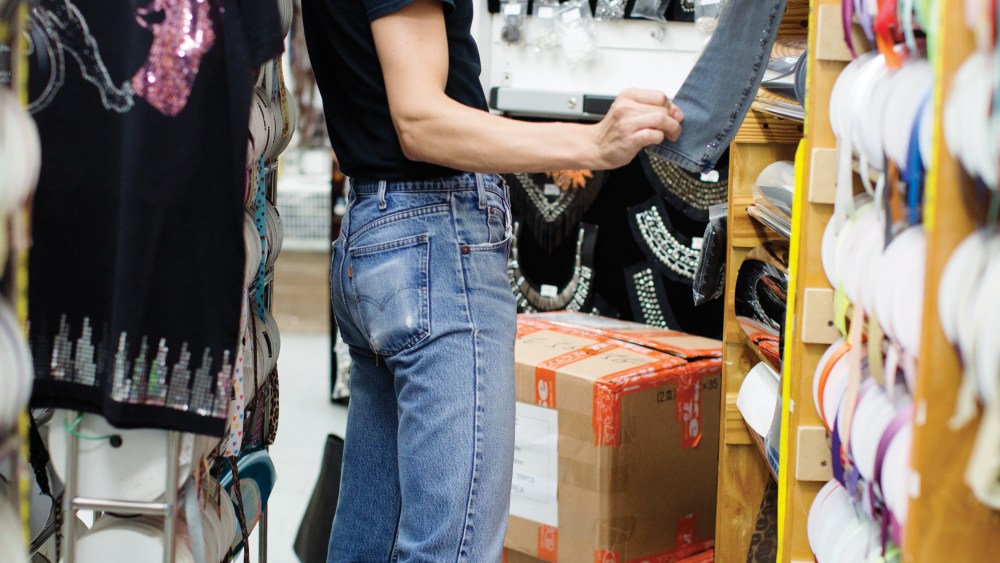
NEW YORK — As construction cranes continue to redesign Manhattan’s skyline, garment center tenants and supporters are wary of city officials’ aim to rezone the district.
While Mayor Bill de Blasio’s plans for a $136 million “Made in New York” campus at Bush Terminal in Sunset Park triggered cheers from many, other Midtowners are concerned about how the spotlight on Brooklyn will affect apparel manufacturing. At play is about one million square feet that has been earmarked for apparel manufacturing and another one million set aside for support purposes. While Broadway and Seventh Avenue are the main throughways, the district runs from Fifth to Ninth Avenues stretching from 35th to 41st Streets. New York’s fashion industry sustains 900-plus companies generating $98 billion in annual revenues and creating more than 180,000 jobs.
Related Articles
But as this month’s New York Fashion Week attendees can attest, Manhattan’s Garment Center and designer base have ebbed into an assortment of neighborhoods in recent years. At the same time, as Manhattan real estate developers are ever on the hunt for additional commercial and residential space, there are rumblings of city officials examining ways to take action to free up the garment districts.
You May Also Like
A New York City Economic Development Corporation spokeswoman said Monday, “This administration is deeply committed to protecting and supporting garment manufacturing across the city. We’re working closely with industry stakeholders to ensure New York remains a global hub of fashion and strengthening local garment manufacturing is central to that effort.”
“This administration has made clear that any decisions about the future of the garment center will be made in direct consultation with the fashion industry,” a spokesman for the Council of Fashion Designers of America said. “We continue to work with the city to invest in the future of garment manufacturing in New York.”
Despite those assurances, several industry executives involved with preliminary discussions voiced concern about initial suggestions that could lead to Manhattan manufacturing being transferred to Brooklyn. The $25 billion new Hudson Yards project under way and Penn Station’s $2 billion overhaul are two other factors that have some garment center tenants feeling hemmed in.
In a letter to de Blasio dated Feb. 15, New York City Council member Carlos Menchaca, Congresswoman Nydia M. Velázquez, Congressman Jerrold Nadler and Brooklyn Borough President Eric L. Adams noted that “we wish to better understand how the city will support garment center jobs in the garment center in Manhattan and how the $136 million ‘Made in New York’ campus at Bush Terminal will fit in with broader planning for Sunset Park especially South Brooklyn Marine Terminal and future port expansion.”
Manhattan Borough President Gale Brewer said Monday, “From what I’ve heard, April 3 is the date the city would like to certify changing the beginning of the discussion for the zoning. Number one, that date has to be postponed.”
Having met with executives at the NYCEDC a few days before the Bush Terminal announcement earlier this month, Brewer said it hasn’t been determined if Brooklyn has enough space to absorb displaced apparel manufacturing. “In Manhattan, I don’t think you should change the zoning until you know what’s going to happen in Brooklyn. I would like to see more of a two borough hub so that you have manufacturing in Manhattan and in Brooklyn,” she said.
Despite the fact that some Manhattan buildings are older, and in some cases with smaller elevators and floor plans that are not ideal, there are companies that would like to stay and workers from New Jersey, the Bronx and Queens who would have a more difficult commute to Brooklyn, Brewer said. “Also, who would pay for all of these moves and the shuttles and so on?” Brewer asked.
“We need a lot more discussion. Community Board 5 has not been met with. There are just so many questions,” Brewer said, adding another concern is that some manufacturers will relocate to New Jersey where they already have offices.
“Certification is just the beginning of any Uniform Land Use Review Procedure. It’s the beginning of having hearings at the community boards, the borough president office, the city planning commission and the city council but you don’t have much time. There’s a clock — tick, tick, tick,” she said. “Certification would mean the paperwork is correct, but it has nothing to do with answering these questions. All of these questions normally would be discussed. There would be an agenda, collaboration, good faith and all that. That’s normally what happens before something of this magnitude takes place.”
A source, who declined to be identified, said via e-mail, “This is not a rezoning. The city’s intended zoning action would lift special zoning regulations that were implemented in the late Eighties that have not done enough to protect garment manufacturers and only served as a road block to new investment. This is a change to the underlying zoning to keep manufacturing use 100 percent intact for the Garment Center and not allow for any new residential development or changing height rules.”
Executives at Community Board 5 declined to comment and representatives at Community Board 4 did not respond to a request for comment. Community Board 5 represents the Garment District among other neighborhoods. Community Board 4 covers Chelsea, Clinton and Hell’s Kitchen.
Familiar with the fashion industry in part through New York Fashion Week’s prior move to Lincoln Center and Bryant Park before that, Brewer noted NYFW’s plans to relocate to The Shed in Hudson Yards 2020. “The prep time is months and months. The discussions are very integrated. I don’t know how that would work with a Brooklyn location,” Brewer said. “This is an industry that likes to collaborate. They like to talk to each other. They go from shop to shop, floor to floor.”
Adam Friedman, director of the Pratt Center for Community Development, stressed the importance of strengthening urban manufacturing due to the high-quality jobs it creates. Noting that the fashion industry is one of the major sources of manufacturing jobs in the city, he said, “It’s really open to somebody who has a different set of skills. They may have a good eye, or good hands or a variety of talents so retaining that industry is critical. We really believe there is enough talent, energy and demand to support at least two fashion centers in Brooklyn and the garment center. And there should be great synergy and great job creation.”
Having connected with NYCEDC officials and still waiting for a response, Friedman said, “we are at the very beginning of this process and there is a lot more outreach the city should be doing….What happens when city planning starts the process, it defines the scope, how big it will be and a lot of the components of the change — what the city can do, what the city is ready to do, what it’s requiring the landlords or building owners to do.”
He continued, “If the city were to change the zoning in favor of Class B office space or a creative office district, it doesn’t have to be all or nothing. The city, I would argue, should be looking for ways to support production centers, design centers in both clusters. Maybe a good example of that is what it has done in the film industry. There is a film hub in the Brooklyn Navy Yard and one in North Brooklyn, and another in Long Island City. And there is one emerging in the South Bronx.”
That will change on March 22 when longtime garment center advocate Yeohlee Teng and other supporters gather for a town hall meeting to discuss the situation. Designers, contractors, labor union officials, manufacturers, community board officials and students will be invited to the event.
Rezoning the district was a recurring debate from 2009 to 2012. Two studies by the Design Trust for Public Space “Made in Midtown” and “Making Midtown” helped to lead to some changes but nothing dramatic. “Change is change, but change that is thoughtful, progressive and inclusive is really important — so an open dialogue and good planning are what we’re calling for,” Teng said.
Making the point that the garment center employs a good number of immigrants in various capacities, Teng said, “Do they need the added stress of job insecurity?” alluding to President Trump’s controversial proposals of deportation for illegal immigrants.