
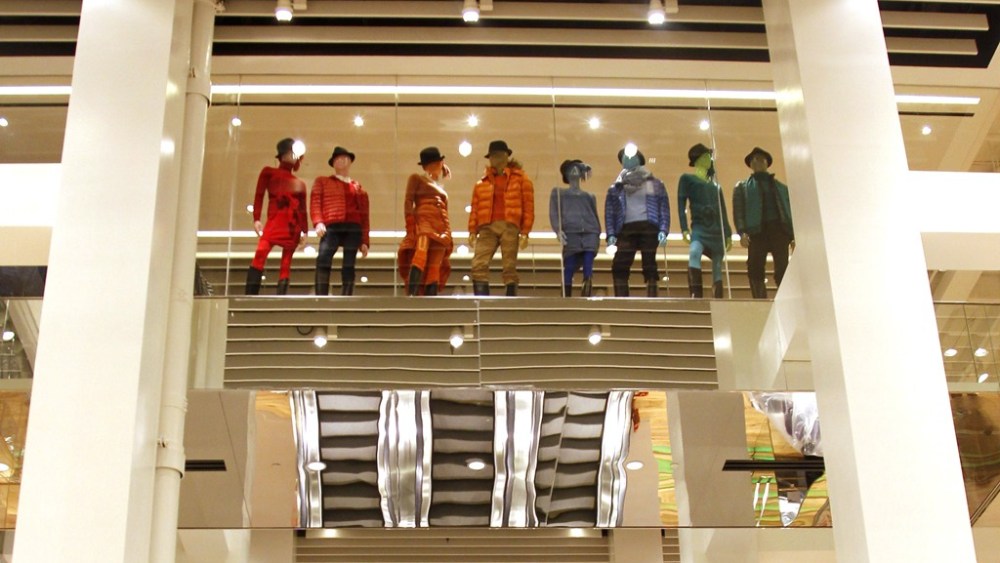
NEW YORK — With its soaring three-story atrium, glass elevators and 300 LED screens, the 89,000-square-foot Uniqlo flagship opening Friday at 666 Fifth Avenue and 53rd Street is a symbol of Japanese determination and optimism in the face of the global recession.
Uniqlo signed a lease to pay $300 million over 15 years, or $2,000 a square foot, to rent the space, which remains the richest lease in Manhattan’s history. According to real estate and construction sources, the flagship cost between $20 million and $25 million to build. The company declined to comment.
Nonetheless, company executives said they’re confident of the flagship’s ability to remain profitable.
Related Articles
One week after the unveiling of the Fifth Avenue flagship, Uniqlo’s largest store worldwide, the company’s second biggest, a 64,000-square-foot unit, will bow on Oct. 21 at 31 West 34th Street, between Fifth and Sixth Avenues.
You May Also Like
The Japanese brand in July unleashed an advertising and marketing campaign that included temporary shops ranging in size from 2,000 square feet to 11,500 square feet and illuminated Uniqlo cubes selling products at the High Line and other areas of the city. “Made for All,” an ad campaign featuring accomplished New Yorkers, appeared in print, on billboards, taxi tops and subway turnstiles and trash bins. It was all designed to create “a Uniqlo citywide takeover,” the company said.
In addition, Uniqlo employees dressed in traditional Judogi jackets handed out packages of tissues — a marketing phenomenon in Japan — with a map of the store’s location and opening information.
“We only have one store in New York so a lot of people still don’t know about Uniqlo,” said Shin Odake, U.S. chief executive officer.
With a length of 297 feet — more than three-quarters the size of a football field — the flagship has oak floors, steel railings and staircases that glow with LED lights in a rainbow of colors. Glass boxes house featured products and 300 ultramodern mannequins designed for Uniqlo are distributed throughout. Rotating mannequins will be seen in the first- and second-floor windows along 53rd Street, and spinning mannequins will be perched alongside the escalator.
Near the entrance is a massive 29-foot escalator that goes up, but doesn’t come down. The one-way ride is part of a deliberate strategy. “The design is sort of like an airport where you draw visitors directly to where they need to be,” said Odake. “Each floor is larger as you go up and therefore the most merchandise is on the third floor, so the escalators bring customers directly to where the most product is so they can quickly and easily get what they need. We specifically chose to do it this way rather than forcing them to go up one floor at a time.”
Uniqlo’s promotional lineup for the opening includes merino wool sweaters for $29.90; jeans, $9.90; cashmere, $49.90 for women and $59.90 for men, and ultralight down jackets, $59.90. Long-sleeve Heattech shirts will be priced at $12.90. The products are displayed in what Odake calls the Heattech tunnel, which has mirrored ceilings, metal floors and LED tickers around the perimeter that read, “Engineered for warmth” and “Warmth with less layers.” Uniqlo formed a strategic partnership with technology and manufacturing firm Toray to produce Heattech. “Toray now has a task force team working in our offices,” Odake said, adding that the companies push the boundaries of technology “to come up with what we need next.”
Odake said Uniqlo is planning to sell 100 million pieces of Heattech items worldwide this year.
The third floor is divided equally between men’s and women’s, which is exactly how Uniqlo’s business breaks down. Because the retailer began as a casual men’s line, “there’s still lots of the women’s business that needs to grow,” Odake said. “The ratio of our women’s penetration is lower than the market.”
In Japan, Uniqlo has an 8.7 percent share of the men’s market, but just 4.1 percent of women’s, which led the company to conclude that “developing more women’s products holds the key to future growth.” Odake said Uniqlo also hopes to launch children’s in the U.S.
On the second floor, the +J collection designed by Jil Sander has a bigger space than usual, despite this being its last season. “We bought quite a substantial quantity of +J,” Odake said, noting the last shipment is due on Nov. 2. Women’s tailored clothing will subsequently move into the space. “We have to do something similar to +J,” Odake said. “We’d want to see the new collection in stores as soon as possible. We’d love to get [a designer] by next fall.”
The Uniqlo Innovation Project is designed by creative director Nicola Formichetti, who is also Lady Gaga’s stylist and designer of Mugler, and design director Naoki Takizawa. “It’s the fashion of technology,” Odake said. “Activewear is getting closer to [fashion] every day. This is an ongoing collaboration and we’re planning to expand the line. We want [Takizawa] to eventually oversee other areas of design.”
With 44 cash wraps and 100 fitting rooms, “We don’t want our customers to wait,” Odake said. “Most of the time in the U.S., service is good in upscale stores but not at lower-priced stores. Our service is quite unique because we give the sales associates responsibility, ownership and a career path.”
The SoHo store, which opened in November 2006, continues to log impressive results and had a 40 percent sales increase last year over 2009. “SoHo is constantly in the top three stores,” Odake said. “This, we think, is going to hopefully surpass SoHo. There’s more traffic on Fifth Avenue than there is in SoHo.”