
The media industry as a whole is attempting to figure out a new normal as advertising budgets shift, distribution channels become more disparate and consumers spend more time swiping rather than reading. But as of late, changes at men’s titles specifically have dominated headlines, with Details folding, GQ going after a younger reader with GQ Style, and major editorial changes happening at Esquire.
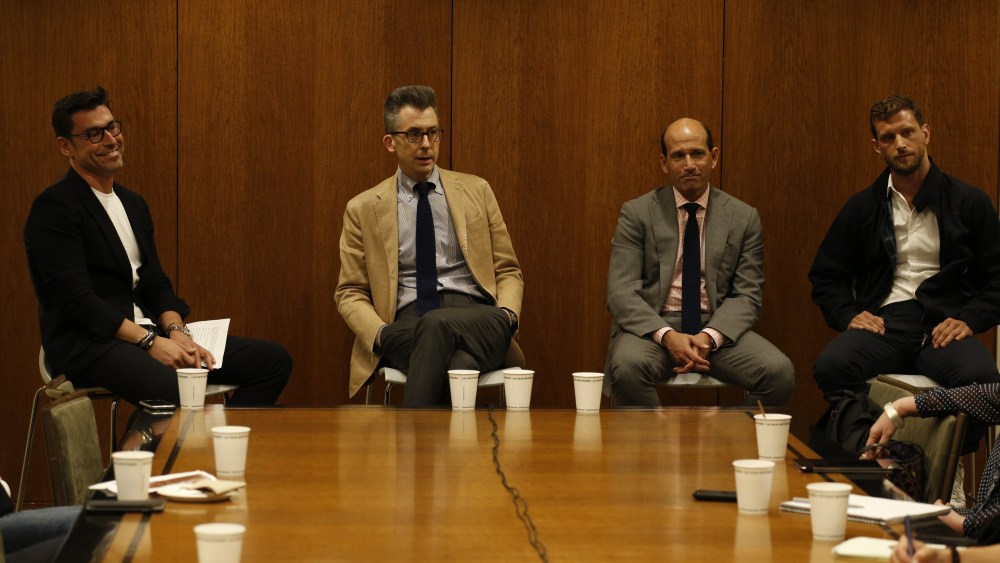
WWD hosted a panel Thursday morning at the Paley Center for Media in New York to discuss the evolving landscape of men’s media with Michael Hainey, executive director of editorial at Esquire; John Brodie, vice president of content and branding at J. Crew, and Erik Rasmussen, editor in chief of At Large Magazine. The panelists, who were moderated by WWD’s men’s fashion director Alex Badia, talked about Millennials, influencers, native advertising and other topics. Here are some of the highlights of the conversation.
Related Articles
On the role of the magazine today:
Michael Hainey: It’s the role that it’s always been, which is to edit your world.
John Brodie: Magazines are more valuable now because in a way, a magazine is a bespoke offering in a world where there’s so much media. When someone sits down with a magazine, they are making a commitment to spend time with something and you have a real level of interest and engagement. It’s a lot different than somebody just flicking on a screen.
Erik Rasmussen: All magazines should embrace the slow. You should spend more time and create better content. For us, the role of magazines is to say, “Look at us,” and the role of the web site is to say, “This is what we are looking at.”
You May Also Like
On the role of the editor today:
M.H.: Editors should have confidence in what we do. We do something that no one else can do and any great media property today has print, has digital, has social. We have to be where that reader is, but that print piece has the ability to push through the culture in a way that very few things can. A lot of editors have this “print is dying” mentality and they’ve lost their confidence.
J.B.: Curation will always be important because there is always going to be more noise and more people competing for your attention. The value of being able to cut through the clutter and say this is important or this looks good or we believe in this is a great thing whether you are a men’s magazine, a site or a brand.
On Millennials:
M.H.: We should be thinking about sensibility. What sensibility are you trying to appeal to? That’s not an age-specific demographic. There’s a difference between a demographic and a sensibility.
J.B.: Sometimes brands try to do too many things, but sometimes it’s better to put more wood behind fewer arrows. It’s one of the reasons you see more Millennials are connecting with Everlane. It’s a very small assortment with this wonderful curated story behind each of the products.
E.R.: Millennials care about different. They aren’t into the mass experience and that’s because of technology.
On advertising and native content:
M.H.: When John and I started at magazines, that was the golden era of church and state. The ad department couldn’t talk to you. You existed so independently. Now the reader knows we are all in the same business. We have to say that this is going to be branded content and it has to be done smartly and transparently so the reader knows why it’s there.
On Instagram influencers:
M.H.: At a certain point, you are just pushing product on your Instagram and if people know that then, that’s great. But how does that person evolve? I’m not calling it out, I just wonder about it. But there are plenty of people in this room that hold budgets for these influencers.
On producing more content for clicks:
M.H.: Everyone needs to figure out their mission and ask themselves what they stand for. Are we mass or are we class? Are we quality or quantity? Or are we a hybrid of these things? From where I sit I believe in quality, not quantity.
On p.r. teams pitching publications:
J.B.: Come up with ideas that are going to cut through the noise. Burberry does this as well as anybody because if you can get Cara Delevingne on a swing in Shanghai, you can get everyone’s attention. But even smaller brands can create ways to get people’s attention, too.
E.R.: Create context. The Internet has collapsed context for the consumer, so creating that helps you cut through.