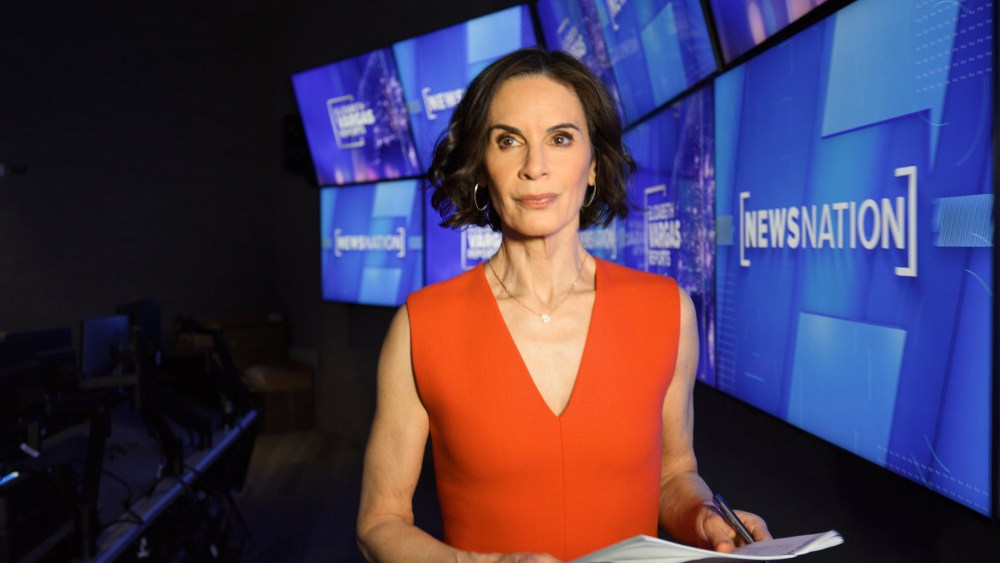
Elizabeth Vargas is an old-school anchor. She spent more than 20 years at ABC News, on “Good Morning America,” “World News Tonight” and primetime newsmagazines including “20/20.” For most of her time there — her tenure began in 1996 as a newsreader on “GMA” and concluded in 2018 — Americans agreed on basic facts and TV news anchors took pains not to reveal their political preferences.
Not anymore.
Opinion programs have proliferated across cable news. Social media has enabled an echo chamber of misinformation and disinformation. And Donald Trump’s vilification of the press has deepened skepticism of the media.
Related Articles
Vargas is willingly joining this volatile stew. Beginning Monday, she’ll anchor a nightly newscast — “Elizabeth Vargas Reports” — on upstart network NewsNation.
You May Also Like
“Our target audience,” says Vargas, are “people who are sensible.”
Vargas, and executives at Nexstar-owned NewsNation, are banking that there are enough sensible people left in America.
“We know that 10 percent of the population are far right, and they watch Fox News and other smaller, even more rightwing networks. And about 10 percent of the population are far left and are watching MSNBC,” she continues. “NewsNation, from its inception, has targeted the vast majority in the middle. What I will be doing is straight news. I’m not here to share my opinion. I’m here to do an in-depth look at the biggest stories of the day affecting people across this country.”
Nextsar became the largest owner of local stations in the country (110) after it acquired Tribune Media (owner of WPIX and WGN) in 2019 for more than $4 billion. Last year, Nexstar purchased a majority stake in The CW. And it has funneled millions into its flagship cable network NewsNation, which it launched in 2021, building a new studio in Manhattan and amassing a roster of TV news talent. In addition to Vargas, there are Dan Abrams, Ashleigh Banfield and Chris Cuomo, whose show is very much an opinion program.
In 2021, Nexstar acquired the Washington, D.C.-focused digital publication The Hill for $130 million, and on April 24 will launch a 5 p.m. The Hill-branded panel show hosted by Leland Vittert and featuring rotating panelists including George Will and erstwhile Fox News political editor Chris Stirewalt, who joined NewsNation last May. The network’s daily audience is dwarfed by more established media brands but, according to Nexstar, NewsNation reaches 70 million people each month. (The network is available on cable and satellite as well as streaming platforms including YouTube, Hulu, Sling and via the NewsNation app.)
For Vargas, 60, who also hosts a syndicated true-crime series, the volatile news cycle was actually the reason she took the job. “I could not sit on the sidelines during this news cycle,” she says. “It’s so incredibly important right now.”
After years of displaying empathic interviewing skills on national TV, Vargas’ battle with alcohol addiction is perhaps the thing that most humanizes her. Her 2016 memoir, “Between Breaths,” is a brave confessional. She writes of multiple stays in rehab; passing out on a New York City park bench and nearly being assaulted; waking up in the hospital with no idea how she got there. Her podcast, “The Heart of the Matter,” which is part of the work she does as a board member of The Partnership to End Addiction, is honest and, at times, darkly funny. For Vargas — who has two sons ages 20 and 16 with ex-husband Marc Cohn, a singer-songwriter — alcohol was a way to deal with crippling anxiety and panic attacks related to childhood trauma. Her book and her podcast — which features interviews with others in recovery including Matthew Perry, Tommy Davidson and Sober Mom Squad cofounder Jessica Landon — have made her something of a celebrity in the recovery community.
“I still get messages on social media, people will stop me in airports or gyms or restaurants, and tell me that my book helped save their lives,” she says. “I can empathize with all the people in this country who are suffering, and not just with drugs or drinking, but with anxiety and depression. I feel really lucky that what turned out to be the most painful chapter in my life turned into something that I could use to help other people.”
Here Vargas talks to WWD about her new show, why addiction is losing its stigma and why the doublespeak from Fox News opinion hosts hurts the honest TV news anchors.
WWD: Mental health is a national story right now. Are you going to explore some of these issues on your NewsNation program?
Elizabeth Vargas: Absolutely. This is the newscast of record for NewsNation, so we will be covering all the most important stories each night. And mental health is an issue of huge importance in this country, and substance use disorder is a crisis in this country. We have more people dying of drug overdoses than we ever have before. Why can’t people access affordable treatment? Why is the treatment that we know works so hard to find, and so difficult to afford in this country? I hope to make this a show where we can discuss those issues in-depth and responsibly. I believe that we cannot cover this story without also addressing the demand. A large part of the reason why people use drugs and alcohol is to numb feelings that they don’t want to feel. All of this is intertwined. You cannot fix this crisis without addressing the American demand. And you can’t fix the American demand component if you don’t talk about mental health.
WWD: There is still a lot of stigma associated with addiction. How do you think people view you now?
E.V.: I’ve been in recovery now for nearly a decade. I was at ABC for 23 years. It was only four years during that time that I was really struggling. I was outed when I was in rehab, forced to issue a statement from rehab. It was the most painful chapter of my life and it all played out in public because somebody decided to place a call to The New York Daily News. I’m not sure I would have written the book had I not been publicly outed. But when I got out of rehab, one of the things that really helped me was reading other people’s books, mostly from [female authors], about their struggles with alcohol. I thought, I may as well tell my story and not have somebody else giving their version of my story. And maybe I’ll help somebody.
WWD: Athletes and Hollywood celebrities have been opening up about anxiety and addiction. Is the stigma waning?
E.V.: That’s why I do my podcast, and that’s why I want to cover it on my show. When people speak out, little by little, we can chip away at the stigma. Seeing all these professional athletes now coming out and talking openly about their struggles with anxiety and depression, it helps. It’s like turning an oil tanker, it’s going to take a long time. But enough people are out there doing their best to turn it and it’ll pay off.

WWD: What’s your assessment of the media landscape right now? Because it’s pretty rocky. Every day, sadly, seems to bring another announcement about layoffs at another media company.
E.V.: We’re definitely going through a sea change. People are changing how they consume news. But I think it’s up to us to continue to do the best work we can do and trust that, eventually, people will develop enough information literacy to understand that just because you read it online, doesn’t make it true. When I go on television and say something, I have lawyers fact-checking me, producers going over my scripts, [telling me], you can’t say this; where’s your backup for that; how many sources do you have for that; show me your documentation for that? Versus somebody online just spouting off. The fact that people are getting their news from Facebook and TikTok and Instagram is crazy. But the solution isn’t to run away from it. The solution is to do a show that is smart, where we do our homework and quadruple check everything. I am never going to lie to you. I’m never going to allow somebody to say something on my show that I know to be false. We have to earn the trust of our viewers every night. And I think you do that by being a careful discriminating journalist in a landscape where there are a lot of people out there who are not practicing careful, responsible journalism.
WWD: And yet, some of them still have the largest audiences in cable news. What do you think about the revelations that opinion hosts at Fox News privately harbored a lot of skepticism about Donald Trump’s stolen election lies and yet they carried his water on the air?
E.V.: Honestly, it hurts all of us. Because there’s a tendency to believe — and I’ve heard people actually say this — “Oh, they’re all like that.” Chris Cuomo and I worked together at ABC News for many years. Chris worked at CNN for many years. As Chris himself put it, he was fired from CNN, but never, ever did anybody ever say to him: “You can say something untrue; you can lie to your audience.” Never did that happen. At ABC News, we checked everything. We would have arguments with the lawyers in screenings. We would be asked to show them the transcripts, show them the backup, the court documents, the deposition statement. We would have to show them all that to justify every single word in our script. But that stark [difference] is lost on the audience when they hear revelations of hosts at Fox News saying one thing to each other and saying something entirely different on the air. It hurts us all. But all we can do is continue to do our very best work and hope the audience figures that out.
WWD: You worked with Barbara Walters. What is the most important lesson you learned from watching her/working with her?
E.V.: Barbara was legendary for her preparation. She literally never stopped studying and planning and rewriting her questions for her interviews. It was remarkable to see someone at the very pinnacle of success who continued to work so hard. She taught me that no matter who you are, or how accomplished you are, you can always do even better.
WWD: She once told me, jokingly, that the key to her success was that she never sweats, and she never had to go to the bathroom. If we were to channel Barbara, what would you say is the key to your success?
E.V.: The key to my success is never faking it. I am truly, authentically interested in the stories I tell, and the people I interview. I try never to pretend I know something I don’t, or to be something I am not. This is a life lesson that took me a long time to learn. I remember my boss telling me when I was first filling in as the host of the “Today” show when I was just 29. He said, “Just be yourself, don’t try to be the person you think you should be.” The key to success, for me, is doing everything possible you can do to prepare, and then being as fully as possible in the moment.