
LOS ANGELES — Retail buyers and vendors at the spring market here from Oct. 16 to Oct. 20 embraced the reality of consumer frugality.
At Designers & Agents, Brighte Cos. and the showrooms in the New Mart, Cooper Design Space and California Market Center, there was an acknowledgement that operating in today’s marketplace requires keeping a keen eye on prices and shaping new lines to court pragmatic customers.
“Two years ago, you didn’t have to be as methodical and as detailed,” said Gorjana Reidel about launching her namesake Laguna Beach, Calif.-based company’s first handbag line, priced at less than $400 retail. “People aren’t exuberant in their spending, but they will still buy things if you have perceived value.”
Related Articles
Gorjana handbags were introduced this month on Shopbop.com and will be sold at Bettina Duncan at Fred Segal and Blue Bee after the e-tailer’s two-month exclusive ends. There are four styles, including a top-selling satchel for $155 to $165 wholesale, for the debut fall collection. Ten more will be released for spring in an array of colors such as navy, coral, lavender and blue gray.
You May Also Like
Corey Lynn Calter unveiled a subbrand, Bird on Wire, whose 14 styles — ranging from camisoles to V-neck Empire-waist maxidresses — wholesale for $34 to $69 so that retail prices stay under $200. The styles are based on best-selling silhouettes in Calter’s eponymous contemporary label, even some of the girlish prints in the inaugural spring collection were previously used in the more expensive line.
Vena Cava integrated more jersey in an effort to decrease its opening price point. While the average wholesale price of its silk dresses is $200 to $250, the items combining silk and jersey cost $90 to $120. “That was our recession tactic,” said Sophie Buhai, co-designer of Vena Cava.
Kazuyo Nakano, who premiered her namesake handbag collection in 1997, has helped create a less expensive line called KNNY featuring a double-faced linen handbag with braiding accents for $172 wholesale that’s been picked up by Anthropologie, said operations manager Shirley Chou.
The attention to price reflected many buyers’ focus on affordable items, especially those that retailed below $150. Regardless of the price, though, retailers were hesitant about placing orders out of a worry they would end up with unsold stock — the circumstance encountered widely during the recession’s dismal holiday and spring seasons.
“It’s whatever we have at $50 that sells out…so we’re sticking closely to that where we can,” said Ali Wieseler, who was buying for her two-year-old boutique near Seattle called Head Over Heels. “I feel like things are getting better, but I’m still being very cautious.”
In denim, legging jeans continued to be a top-selling category. Hudson Jeans spruced up its ultraslim styles wholesaling for between $70 and $75 in acid wash. GoldSign sewed a contrasting elastic panel on the waist of its legging jeans.
Often paired with slim bottoms like legging jeans, boyfriend-style tops and cardigans remained essentials for easy dressing.
Kaori, a Los Angeles-based knits line launching for spring, scored with its $178 cardigan handloomed out of black and gray interwoven yarns. Junk Food’s oversize T-shirts were appealing, even though they cost $1 more than the conventional items. Re Collection reworked a men’s flannel shirt into a billowing blouse with elastic trim and wide sleeves, while What Goes Around Comes Around spruced up flannel button-up shirts with studs. L’Koral Group’s PJK Blue Label, which launched last fall with everything wholesaling for $44, cut plaid cotton fabric into oversize sleeveless Henleys and button-up shirts with rolled up sleeves.
For spring, retailers also liked lightweight leathers deemed investment pieces.
Barlow, a new label launched by Green Mochi, the parent company of Mike & Chris and 12th Street by Cynthia Vincent, offered a $363 washed leather jacket with mesh panels and a $270 stamped snakeprint vest with a lattice back. Based on orders from Shopbop.com, Intermix, Harvey Nichols in Hong Kong and other stores, Barlow expects to generate $2 million in first-year sales.
Corson, owned by Bellevue, Wash.-based Derek Andrew Inc., was another line debuting for spring. With wholesale prices between $22 and $150, Corson benefited from the leather trend that made its most expensive item — a cropped leather vest with an asymmetric hem — the most popular.
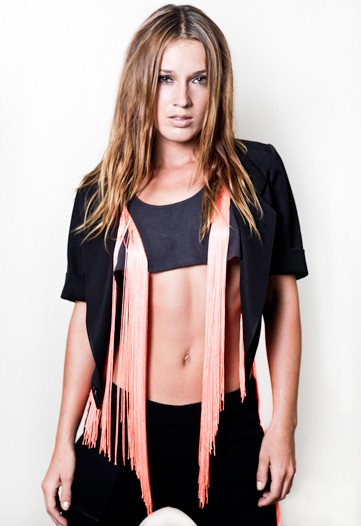
Mainstay A.B.S. by Allen Schwartz identified street chic, Native American, Eighties, Bohemian and chain gang as sportswear buzzwords for spring exemplified by a fringe vest for $185 wholesale, a leather jacket for $230, iridescent denim shorts for $89 and blazers with power shoulders from $145 to $160.
Sinath Benjamin, who was buying for the new boutique Iconic in Arizona, favored romantic pieces she saw emerging for spring. “There’s a very sweet, modern element to what I’ve seen for spring, like dresses [and] flowing skirts paired with tight tops,” she said. “I’m looking for tops and skirts in particular.”
Accessory vendors found that seasonal fads have become less important for bags than versatility and timelessness. For example, Kelly Boyd, operations manager at Monserat De Lucca, pointed out a palette developed for the L.A.-based handbag brand for spring with white, purple, orange, turquoise, yellow and red was pushed up to winter because of retail receptivity. “I feel like nobody cares about colors [for specific] seasons any more,” she said.
At West Orange, N.J.-based handbag brand Sorial, which showed at Brighte in Los Angeles for the second time, crossbody bags, notably a flat style for $125 wholesale, with convertible straps were hot items. “People are not buying three bags,” said Sorial vice president Tanya Bannout. “They are buying one bag to wear day and night, and year round.”