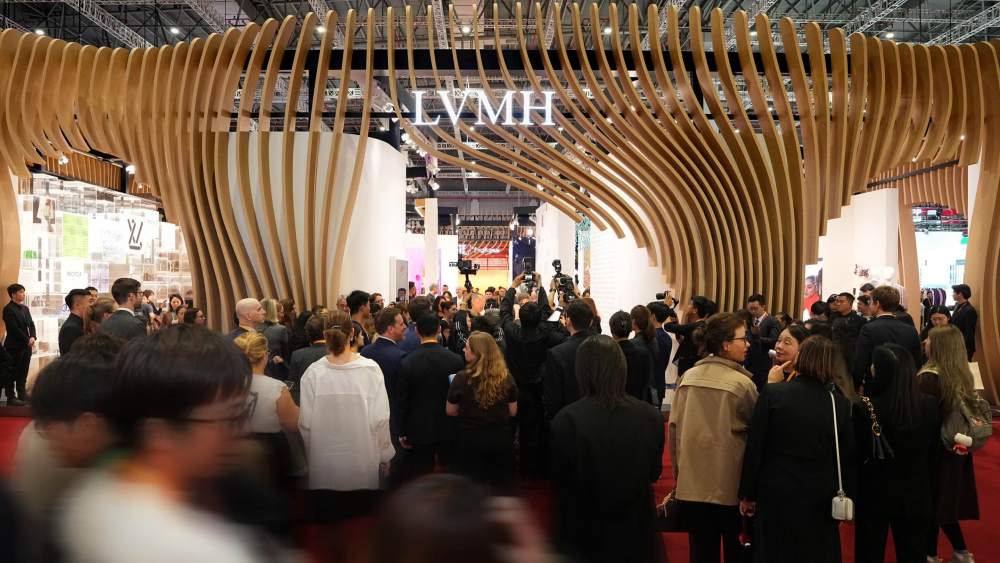
Following the celebration of 60 years of diplomatic ties between France and China and on the eve of the 10th anniversary of the Paris Agreement and COP21, LVMH Moët Hennessy Louis Vuitton has unveiled its latest showcase at the China International Import Expo, or CIIE, an annual trade fair that runs from Nov. 5 to 10 in Shanghai.
“We know that this CIIE comes at a crucial time for China and for the world,” said Marc-Antoine Jamet, general secretary of LVMH.
“This is the key message we want to deliver at the CIIE this year. China, for us, is a partner,” Jamet continued, emphasizing the need to continue to invest in the market to foster a lasting relationship.
You May Also Like
Related Articles

“Our relationship goes far beyond business. That’s the reason why we have a deep commitment to China and a real appreciation for the partnerships we’ve built with the Chinese people, from artisans and suppliers to customers and creative communities,” Jamet added.
“We will continue to create exceptional places and experiences, such as The Louis in Shanghai, and offer meaningful products crafted with passion and responsibility,” he added, referring to the futuristic ship-shaped retail project at Shanghai’s HKRI Taikoo Hui shopping mall — which has become a defining cultural moment for the market this year.
With sustainability as this year’s central theme, LVMH brought along seven of its iconic maisons, including Bulgari, Christian Dior Couture and Parfums Christian Dior, Guerlain, Hennessy, Louis Vuitton, and Tiffany & Co., to showcase a pavilion that “celebrates excellence, creativity and savoir-faire,” the French luxury group said in a press release.
At the opening of the LVMH pavilion on Nov. 5, a delegation of top LVMH executives, including Charles Delapalme, president and chief executive officer of Hennessy; Jean-Christophe Babin, CEO of Bulgari and LVMH Watches; Gabrielle Saint-Genis, CEO of Guerlain, and Andrew Wu, LVMH Group president of Greater China, as well as Jamet, engaged in a series of panel discussions celebrating LVMH’s work in the market and its forward-looking ambitions.
Creating a dialogue between LVMH employees and external players, the talks centered around themes including Hennessy’s lasting embrace of Chinese culture, Guerlain’s perspective on the dynamic beauty market, and Bulgari’s approach to navigating China’s evolving jewelry landscape.
“It’s a very difficult year for everybody; as the weather indicates, it’s cloudy today, and sometimes it’s even turbulent, and that’s why the symbol of the boat is very important for connecting with the people,” commented Wu during opening remarks, circling back to The Louis project.
Speaking of Laopu, a trending gold jewelry brand dubbed Chinese luxury, Bulgari’s Babin said the Italian high jeweler’s connection to Laopu goes back more than 1,000 years.
“Laopu is successful by using symbols, themes and values that have been shaping Chinese culture over thousands of years. This is a brand with pure Chinese roots,” said Babin. “Bulgari has been doing exactly the same in Italy; in this way, we share the same values.”
“The fact that there is a reemergence of Chinese pride in its arts is the best that we can expect, because more than ever, we are close to Chinese values, and together, we will broaden the Chinese market,” Babin continued.
Despite China’s rocky recovery story, a recent Laopu store opening attracted shoppers to queue up overnight for its store opening at Plaza 66, a top luxury mall in Shanghai.
During a visit to Shanghai a month ago, Bernard Arnault, chairman and CEO of LVMH, was spotted visiting a Laopu store, where he spent over half an hour inside. According to local media reports, Arnault found the gold jewelry brand “exquisite and interesting.”
A recent research paper from Bernstein characterized the Laopu phenomenon as an example of how Chinese luxury consumers continue to “spend differently.”
“Aspirational buyers are becoming more discerning…concentrating their spending on ‘investment-grade’ brands, such as Louis Vuitton, Hermès and Chanel, or the hottest and most innovative, including Miu Miu, Laopu Gold, etc.,” wrote the report.
After installing a dramatic dragon last year, Guerlain celebrated its dedication to biodiversity with an illuminated orchid tree this year, representing its rare and endangered species program within the Tianzi Reserve in Yunnan province.
The program, launched last year, has made a pledge to plant around one million orchids within the area.
Commenting on the Chinese beauty market, Guerlain’s Saint-Genis said the local consumer has become “more demanding” in the years following COVID-19.
“The market will continue to grow at a lower single-digit pace for the coming years, at least for international brands. Within that market, I see a craving for the exceptional, and there, we have a lot to do with Guerlain,” observed Saint-Genis.
A few months ago, the prestige beauty brand launched its first mainland China spa flagship within the prestigious PuXuan Hotel near Beijing’s Forbidden City.
Similarly to Babin, Saint-Genis is just as well-acquainted with emerging local players. “With beautiful local brands such as To Summer and Documents, they started from scratch and invented new things — new ways to create olfactory discoveries,” observed Saint-Genis.
“Another example, they are shifting fragrance into lifestyle accessories — you can put it on your belt, on your bag; it’s simply fascinating,” she added, stressing the importance of communicating the brand’s olfactory “hyper-sophistication” and multifacetedness in the market.
“It is also our job to adapt to the taste, the spirit, and the mindset of the people at the right moment,” said Saint-Genis, bringing up the example of how the brand developed the packaging for the lipstick line Rouge G in China.
In a Thursday panel with local government officials and landlords, LVMH China’s charismatic Wu, who has become an unofficial spokesperson for The Louis in China, shared stories behind the creation of The Louis — one that epitomized “a new model of government–business relations,” said Wu.
“Many people may still think of government-business relations as something that exists between individuals, done behind the scenes, with directives given in private. This is absolutely not what today’s government-business relationship look like — it now involves open discussions and joint decision-making among all relevant departments,” Wu added.