
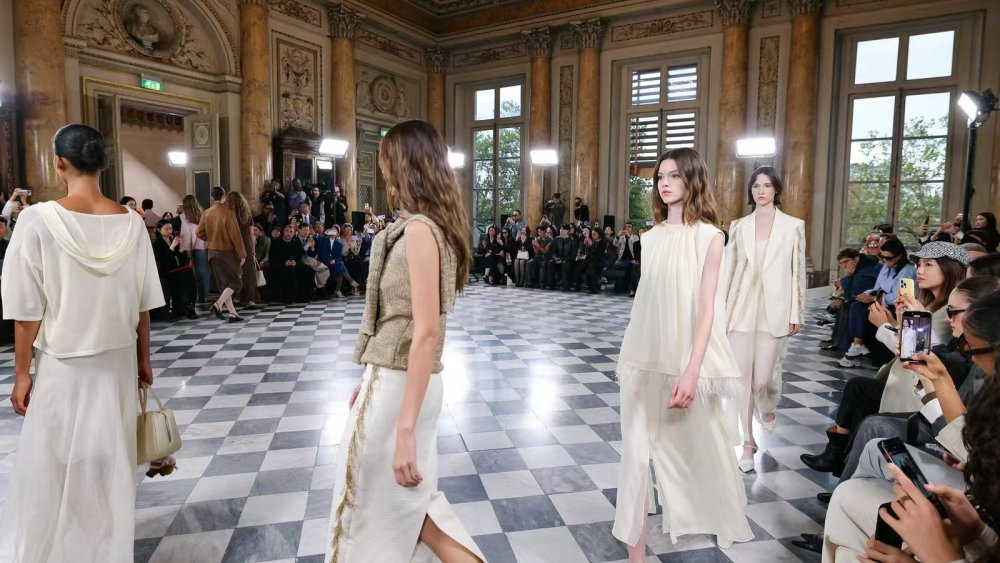
LONDON — German fashion label Laurèl debuted a high-end atelier line in Paris on Monday as part of a trio of fashion showcases supported by the Shenzhen municipal government.
Presented at the Monnaie de Paris, the Laurèl atelier collection featured minimalist tailoring and dresses inspired by the Bauhaus ethos of “form follows function” in a soft mint and chocolate brown color palette layered over neutral gold and black-white tones.
In 2015, the Shenzhen-based fashion group Ellassay paid 11.18 million euros for the ownership of Laurèl’s design, pricing and production rights, as well as all the German label’s stores on the Chinese mainland.
Related Articles
A decade later, the brand now operates 92 stores in China across tier-one and tier-two cities, and logged a 19 percent increase in revenue in 2024, with online channels like Tmall, Douyin leading the growth, up 51.6 percent year-over-year.
You May Also Like
Xia Guoxin, founder, chairman, and general manager of Ellassay, said the Paris show marked a milestone in Laurèl’s evolution as well as helping to solidify Ellassay’s position as an internationally oriented fashion conglomerate.
“As the fashion capital and birthplace of haute couture, Paris offers a unique contemporary artistic atmosphere that naturally resonates with the Bauhaus-inspired DNA of the Laurèl brand,” Xia said.
With an annual turnover of 3 billion renminbi, or $420 million, the 32-year-old group has been listed on the Hong Kong Stock Exchange for a decade. It fully owns Iro Paris and the distribution rights to Self-Potrait and Nobis in mainland China, Hong Kong and Macao.
The Laurèl showcase alongside fellow Shenzhen-based brands Nexy.co and Yiner in Paris is the latest example of cultural exchange between Paris and Shenzhen, the tech hub and a fashion powerhouse of China.
According to Dan Wang, secretary general and creative director of the Bay Area Sustainable Fashion Alliance, by joining the official “Welcome to Paris” program of the Fédération de la Haute Couture et de la Mode, brands like Laurèl gain “exceptional visibility among international media, buyers, and opinion leaders.”
“This dialogue with Paris highlights the refinement and creative strength of Shenzhen’s designers, while placing them within a broader conversation about the future of fashion. It shows that Shenzhen is not only a dynamic hub of innovation, but also a source of cultural richness and design excellence that resonates on the world stage,” Wang added.
Prior to the Paris showcase, numerous French brands have participated in fashion events in Shenzhen over the past two years.
In 2024, the world’s first Madame Figaro Café opened at the Bay Area Fashion Center in Futian Bay in Shenzhen. The same year, French brands Mossi and Isabelle Anselot joined the lineup for the International Designer Brands Fashion Show in Shenzhen.
For the opening of Galeries Lafayette’s South China flagship in UpperHills, Shenzhen, in 2023 more than 50 French brands showcased a wide range of products, including wine, fragrances and home goods. Dior and Hermès also hosted events in Shenzhen that year.
Wang said the Shenzhen municipal government has been investing heavily in cementing the city as the headquarters and showcase hub for the fashion economy in the Greater Bay Area, a megalopolis concept consisting of some of the most developed cities in Southern China: Dongguan, Shenzhen, Huizhou, Guangzhou, Zhuhai, Jiangmen, Zhongshan, Foshan, Zhaoqing, Macao and Hong Kong.
In 2024, local authorities issued an action plan for the grand vision and placed fashion alongside finance and technological innovation as the three priority industries in its mid- and long-term development goals.
It’s estimated that the added value of Shenzhen CBD Futian district’s fashion industry reached 91.91 billion renminbi, accounting for 15 percent of its GDP, last year. The district was home to more than 1,700 major enterprises with an annual revenue of more than 524 billion renminbi.