
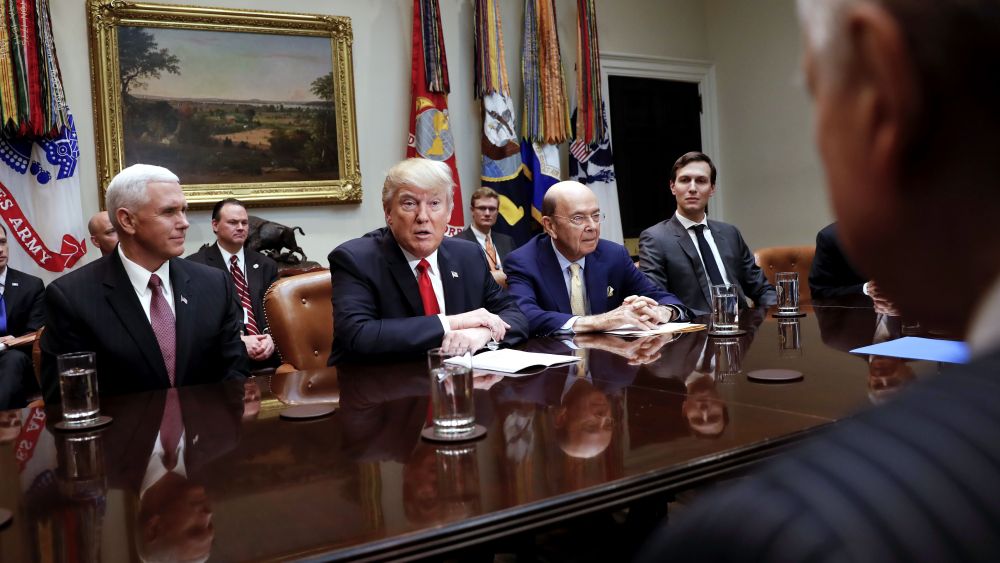
WASHINGTON — President Trump indicated to top lawmakers on two key Congressional trade committees Thursday that he is open to a “new” North American Free Trade Agreement with Mexico and Canada, beyond a renegotiation of the trade agreement.
“I have very serious concerns about NAFTA,” Trump said at the meeting, according to a read-out in a White House pool report. “NAFTA has been a catastrophe for our county. It’s been a catastrophe for our jobs and our country…I want to change it and maybe we do it and maybe we do a new NAFTA and we add an extra ‘F’ in NAFTA ‘for free and fair trade’ because it’s very unfair.”
Trump and his aides have argued that the $58 billion trade deficit the U.S. has with Mexico is unfair to U.S. companies that lost jobs over NAFTA and needs to be reduced.
Related Articles
Trump met with Sens. Orrin Hatch (R., Utah), chairman of the Senate Finance Committee; Ron Wyden (D., Ore.), the ranking Democrat on the panel; House Ways & Means chairman Kevin Brady (R., Tex.), and Rep. Richard Neal (D. Mass.), the ranking Democrat on the panel.
You May Also Like
“We will make great trade deals,” Trump said, according to the pool report. “I don’t care if it’s a renovation of NAFTA or a brand new NAFTA, but we do have to make it fair and it’s very unfair to the American worker and very, very unfair to companies in this country.”
Trump’s unfolding trade agenda has created a wave of concern and confusion for the fashion industry, which is highly exposed to any changes in trade policy, having imported $105.3 billion in apparel and textiles in the year ended Nov. 30.
NAFTA has been an important trade deal for the U.S. fashion industry, which has developed a strong Western Hemisphere supply chain that is vital for apparel brands and retailers making clothes in Mexico and Canada, as well as a key export market for U.S. textile producers.
Industry officials have said they are keeping a close eye on Trump’s approach to NAFTA, noting that a complete withdrawal from the regional trade deal would be highly disruptive and devastating, as would a trade war with an important trading partner. A renegotiation of the trade deal could also be disruptive, depending on what changes are made and officials said they will consult closely with the administration to express their concerns, as well as areas where they see opportunities.
Trump said the administration is trying to adhere to statutory guidelines regarding NAFTA, but would like to “speed” up either a renegotiation or talks on a new trade deal.
White House Press Secretary Sean Spicer later told reporters at the daily press briefing that Trump has “expressed concern time and again with NAFTA, which he believes is an out-of-date agreement. The ultimate goal is to ensure the best and fairest treatment of U.S. workers and businesses and the President believes that those interests are best secured by bilateral rather than multilateral trade deals.”
Trump was joined at the meeting by Vice President Mike Pence, Commerce Secretary-designate Wilbur Ross and Jared Kushner, his senior adviser and son-in-law.
“We put together an all-star team of top-level people that are working on trade,” Trump said.
He said Ross, who is awaiting confirmation by the full Senate, will be “representing us in negotiations” and noted he will be “fair to other countries” in trade talks.
Hatch said in a post-meeting statement that he supported Trump’s “ideas to modernize NAFTA.”
“NAFTA has served as a strong anchor for our markets in the Northern Hemisphere and helped to expand trade opportunities for American products, goods and services,” Hatch said. “Given that the trade pact is now more than two decades old, a re-examination of the agreement to ensure it remains the best possible deal for American workers and entrepreneurs in the 21st-century global economy makes sense.”
But Hatch also stressed that “major shifts in policy” should be made in consultation with Congress, which “under the Constitution, has authority over tariffs,” Hatch said.
“To that end, I appreciated the opportunity to talk with President Trump and discuss the path forward on our trade agenda,” he added.