
Four months after President Donald Trump declared the U.S. “liberated” from pervasive global trade imbalances by implementing a new tariff regime, a revamped set of duties on the country’s most prominent trade partners has gone into effect.
Thursday saw dozens of nations integral to the fashion supply chain hit with steep, double-digit duties. The European Union’s 27 member countries now face 15 percent tariffs on U.S.-bound exports, while Cambodia, Indonesia, Malaysia, Thailand and Pakistan were all hit with 19 percent tariffs and Bangladesh and Vietnam saw their duty rates set at 20 percent.
Related Articles
Earlier this week, the president threatened to elevate tariffs on India, already set at 25 percent, to 50 percent due to the country’s continued purchase of Russian oil. He slapped Brazil with an analogous sky-high rate for pursuing criminal charges against its former president, a Trump ally.
You May Also Like
But one key U.S. trading partner — and the historic object of Trump’s most fervent ire — faces a separate deadline. The three-month bilateral tariff truce between the U.S. and China expires Tuesday, and state officials on both sides have been fervently negotiating with the aim of brokering a deal before the 55 percent tariffs on Chinese shipments kick in.
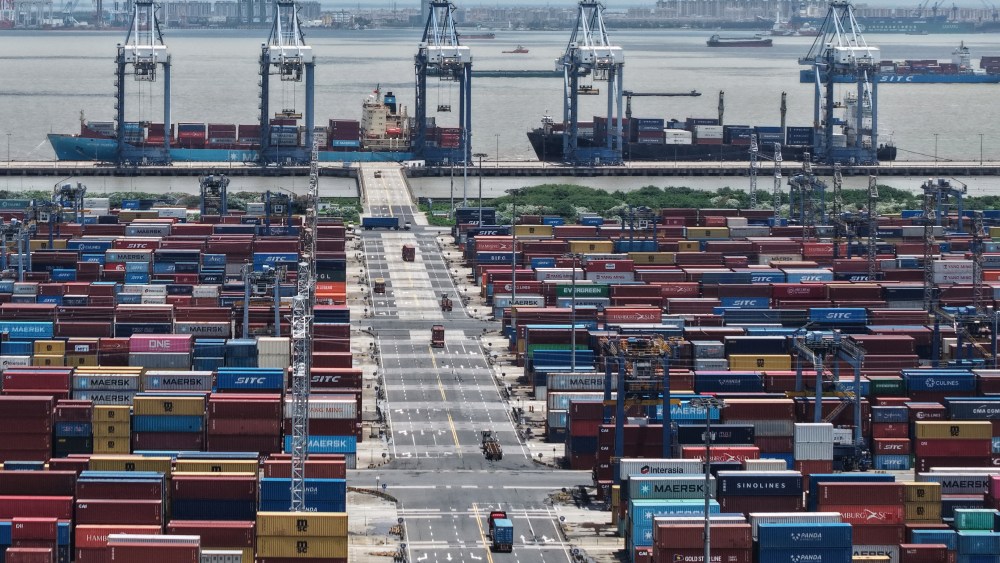
Whether the pause is extended (as Commerce Secretary Howard Lutnick said Thursday is likely) or another resolution is reached, importers have been clamoring to ensure that their China-originating goods are loaded onto vessels bound for U.S. shores before the pause is due to expire.
Chinese exports grew 7.2 percent year-over-year to $321.8 billion in July in a sign of strength for the market as shippers rush product out of the country ahead of a looming negotiating deadline with the U.S.
The country’s outbound shipments heavily outperformed the 5.4 percent jump calculated by a Reuters poll of economists, and represented an acceleration over export totals in May (4.8 percent) and June (5.8 percent).
The ongoing trade war between the trans-Pacific powerhouses has resulted in a collapse in goods sent directly from China to the U.S., with exports falling 21.7 percent in July, according to data from the General Administration of Customs.
But July figures from the National Retail Federation’s Global Port Tracker still indicate some semblance of a pull-forward, with major U.S. ports expecting to pull in 2.1 percent more 20-foot equivalent units than the year prior — the most containers entering the country since May 2022.
American companies that are still importing cargo from China via ocean or air are likely looking to get out in front of a potential increase in price — again.
Both the U.S. and China engaged in talks in Stockholm to prevent tariffs from returning to the elevated levels they reached in April and May. The U.S. had hit Chinese goods with tariffs as high as 145 percent, with China retaliating with an 85 percent duty before the countries agreed in May to mutually reduce their tariffs for 90 days.
When including a 20 percent punitive duty for fentanyl trafficking, U.S. tariffs on Chinese exports currently stand at 55 percent.
The deadline for the countries to negotiate a new trade deal is Aug. 12. If a deal is not made, the tariffs before the May truce would go back into effect.
Lutnick indicated in a Thursday interview on Fox News that it is likely that the countries will come to an agreement that would extend the deadline for another 90 days.
But even with the tenuous relationship with the U.S. knocking down export numbers to the country, China has been able to more than make up for the gap elsewhere.
The country’s shipments to the 10 countries comprising the Association of Southeast Asian Nations increased 16.7 percent year-over-year. This includes markets like Vietnam, Indonesia, Malaysia and Thailand.
China has increasingly relied on third countries such as ASEAN to circumvent tariff barriers and for the manufacturing of final products or components. The White House has explicitly targeted Vietnam and Thailand as countries that are participating in this transshipment process, with the U.S. hitting the former with a 40 percent tariff for goods transshipped into the U.S. from China.
Outbound shipments to the European Union increased by 9.2 percent in July, while exports to Latin America ticked up 7.7 percent. Africa had the largest increase in shipments on the receiving end at 42.4 percent.
Maersk CEO Vincent Clerc said in a second-quarter earnings call that the strength of Chinese exports to the rest of the non-U.S. world will dictate the wider growth of the container market.
“On the back of the industrial successes that they’re having and the overcapacity that there is in China, this could actually carry stronger market growth than anticipated for a few years,” said Clerc.
China’s imports, meanwhile, rose by 4.1 percent year-over-year last month to $22.3 billion, representing the sharpest gain since July 2024. The numbers defied expectations of a 1 percent decline in the month, and build on a 1.1 percent gain in June.
The strong import month points to improved domestic demand as Beijing has placed a stronger focus on stimulating consumer spending.