
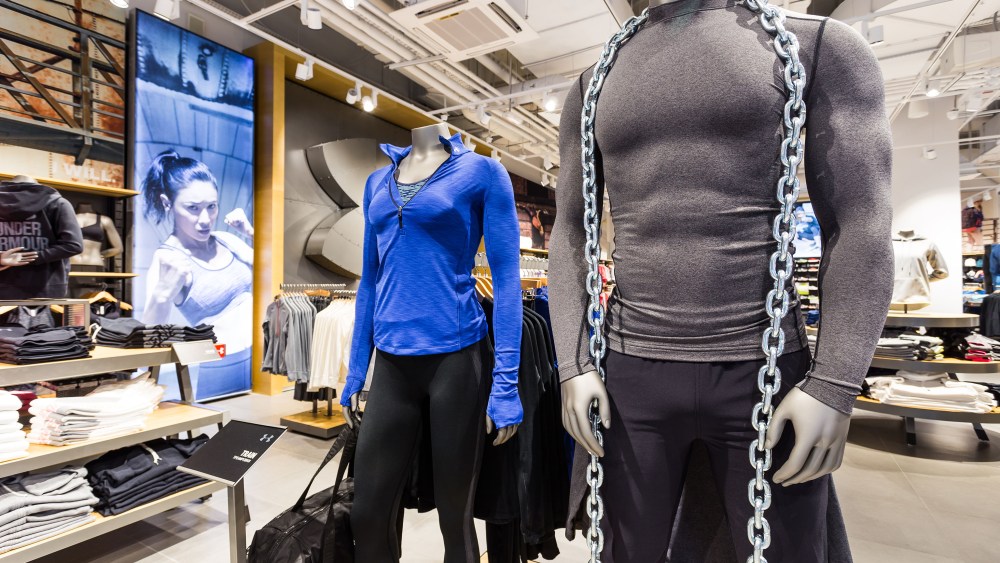
Under Armour Inc. is on the move — cutting back on its assortments, focusing on its best wholesale accounts and restructuring operations.
And on Thursday, Wall Street gave the company credit for its leaner and meaner approach, looking past second-quarter losses and driving shares up 4.1 percent to $20.54.
But Kevin Plank, chairman and chief executive officer, who referred to Under Armour as “a human performance company” on a conference call with analysts, made clear he’s not forgetting the half of humanity that drives most fashion sales.
“The opportunity we have in women’s is, obviously, one of the largest white spaces that we look at as a company,” Plank said. “We’ve also been able to establish a $1 billion business there, but we recognize that we’ve been somewhat inconsistent. What we do have there is, we own the base layer for that female athlete and it’s her bras and her bottoms.
Related Articles
“And so we want to double down there, we want to make sure that we own that position,” the ceo said. “And then we’re going to continue to find things like in the footwear space like we did with HOVR [running sneakers]. And also some new franchises, we’ve been building on things like our product called Breathe Lace [in shoes]. So we’re seeing some success and we’re not where we need to be yet but we see great opportunity in women’s, there’s a massive, massive opportunity and initiative for this brand.”
You May Also Like
Plank is on a mission to focus the business, starting with product working to build momentum with a steady stream of innovative merchandise.
“The reason for Under Armour is that every product does something,” he said. “We lean on this performance mentality as a company and as a business because when you put up an Under Armour product on, your natural question should be, ‘Well, what does it do?’ And the fact is, it should make you better.”
It’s a long road still, but investors seem to see a company that’s headed in the right direction.
Under Armour’s net losses for the second quarter extended to $95.5 million, or 21 cents a share, from $12.3 million, or 3 cents, a year earlier. Excluding the financial impact of the company’s restructuring efforts, losses tallied $34 million.
In February, the company laid out a plan to retool the company that would lead to pretax charges of $110 million to $130, but on Thursday those efforts were extended as the company identified another $80 in restructuring efforts.
Revenues were up 8 percent to $1.2 billion with a boost from apparel, which saw sales increase 10 percent to $747 million.
But that pace isn’t expected to be maintained.
The company is looking for revenues to increase by 3 to 4 percent this year, reflecting a low- to midsingle-digit decline in North American and growth of more than 25 percent abroad.
Analysts had pegged the company for 4.3 percent growth this year.