
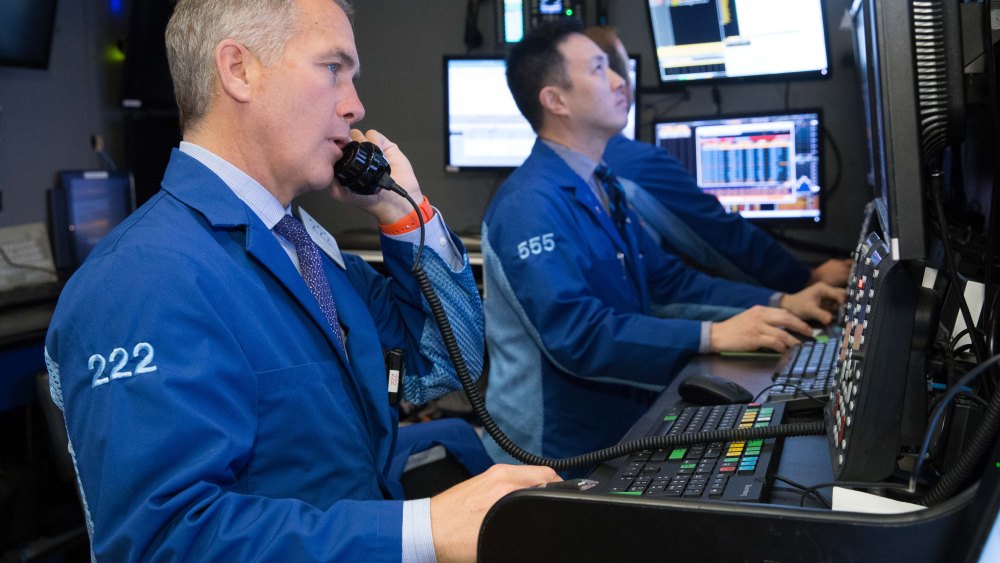
Wall Street has a worsening case of the Brexit blues.
The Dow Jones Industrial Average recovered some from steeper losses during morning trading, but was still down 254 points to 17,1543 at midday. The S&P 500 dropped 35 points to 2,002 and the Nasdaq lost 112 points to 4,595.
All three of the indices broke below their 200-day moving averages, indicating that selling could escalate again.
Among the fashion companies getting hit in the market were PVH Corp., down 8.2 percent to $85.93; Abercrombie & Fitch Co., 6.0 percent to $16.72; VF Corp., 5.1 percent to $58.16; Kate Spade & Co., 4.7 percent to $19.08; Coach Inc., 3.6 percent to $37.10; Lululemon Athletica Inc., 3 percent to $67.55; Macy’s Inc., 2.3 percent to $31.33, and TJX Cos. Inc., 2.1 percent to $73.11.
Related Articles
The dollar posted its biggest two-day gain since November 2011 and the British pound was down more than 30 percent versus the U.S. dollar indicating traders are looking to the U.S. as a safe haven given the turmoil of the U.K. vote on Thursday to leave the European Union.
You May Also Like
British Prime Minister David Cameron spoke to Parliament to try to stabilize the turmoil in the U.K. and the rest of the world.
Cameron said the vote would stand, but that the move to leave wouldn’t officially start until a new Prime Minister takes over. The U.S. stock market tumbled, in part, on confirmation that the move would happen, albeit on a slower timetable than might have been the case.
“There’s definitely concern,” said Jon Corpina, senior managing partner at Meridian Equity Partners. “I think the weekend was welcomed and everyone was hoping that with two days off, people would approach this week differently.”
Instead Corpina said no one was willing to take a stand in stocks without know how this would play out.
Cowen & Co.’s analyst Oliver Chen said beauty and wellness trends would remain resilient in this period of uncertainty benefiting companies like Ulta Salon Cosmetics & Fragrance Inc. and Lululemon Athletica Inc.. “We also prefer the middle- and lower-end consumer, benefiting Ross Stores Inc. and TJX Cos. and have greater anxiety on the higher end meaning Restoration Hardware Holdings Inc. and Tiffany & Co.” He also believes companies with prior exposure to currency and tourism issues like Macy’s Inc. and Tiffany’s could continue to experience those problems.
RBC Capital Markets Brian Tunick also said the stronger dollar would continue to pose a problem for companies that depend on tourists and those with outlet mall exposure. He also mentioned Tiffany’s and Macy’s as companies that are sensitive to the tourist headwinds and Coach Inc. and Michael Kors Holding Inc. as having outlet mall exposure.
Gold, however, is shining. The precious metal jumped from roughly $1,250 on Thursday to $1,350 on Friday and has risen more than 8 percent in the past 30 days. “It could easily go to $1,400 an ounce by the end of the year,” said David Williams, director at Strategic Gold Corp. He expects that markets will be unsettled until after the U.S. election.
“It’s the old flight to safety,” Williams said, adding that he wouldn’t be surprised to see gold go to a whopping $3,000 an ounce.
“It may take some time for the shock to fully work through the economic, financial and political systems in the U.K. and Europe,” said Jeffrey Kleintop, chief investment strategist at Charles Schwab & Co. “With no visible catalyst to halt the slide, the decline in global stocks may continue as the risk of a recession increases.” He said short-term focused traders should expect further stock market declines over the next three to six months, similar to past market shocks.
As Bette Davis said in “All About Eve,” “Fasten you seat belts, it’s going to be a bumpy night.”