Updated 2 p.m. ET May 8
In tumultuous times, German sportswear company Puma will be keeping calm and carrying on, executives said during a press conference in Germany on Thursday morning.
During the first quarter, Puma’s sales were flat, rising only 0.1 percent, in currency adjusted terms, to 2.07 billion euros. In the same period last year, Puma sales equaled 2.1 billion euros.
Puma’s EBIT — earnings before interest and taxes, or operating profit — also dropped over the first three months of the year, falling 63.7 percent to 57.7 million euros from 159 million euros.
You May Also Like
Related Articles
Last year was sluggish for Puma, with sales either static or dipping slightly in most quarters. That pattern seems to be continuing.
Uncertain macroeconomic conditions, which include the Trump administration’s on-again, off-again tariffs, are not helping. Neither is internal turmoil at Puma. In early April, the company’s chief executive officer Arne Freundt left the top job over differences in strategy with Puma’s board. Freundt took over the top role in 2023, having succeeded Bjørn Gulden who left for Adidas.
Freundt will now be succeeded by Adidas alum Arthur Hoeld, a former athlete who had been with Adidas for more than two decades before leaving his post as global sales director there last October. But Hoeld won’t start until July.
So for now, the sportswear company is being run by a triumvirate: Markus Neubrand, chief financial officer, Matthias Bäumer, group sales director, and Maria Valdes, chief product officer.
“We are working together very closely,” Neubrand explained of how the company is being run. “What are our priorities for the transition period? We continue to focus on driving the business [and] we are now also focused on fostering a sense of stability and calmness.”
Puma is focused on controlling what it can, Neubrand continued. The company has instituted an efficiency program called “nextlevel.” This involves cutting 500 jobs from corporate-level staff by the end of the second quarter and the closure of about 30 unprofitable stores by the end of the year. Puma has about 1,000 stores around the world.
In the first quarter, Puma’s best results came in its home market of Europe, the Middle East and Africa, where sales rose 5.1 percent, in currency adjusted terms, to 891.7 million euros.
The biggest fall was in Asia-Pacific, where sales slipped 4.7 percent to 430.5 million euros. Puma attributed the fall to “ongoing softness in Greater China.” Sales decreased there by 17.7 percent.
In the Americas, sales fell 2.7 percent to 753.7 million euros. In North America, they sank 11.1 percent while in Latin America they rose 13.1 percent.
Although footfall is down in the North American market, the Trump administration’s tariffs didn’t have much impact on the company’s first-quarter results, Neubrand said. He explained that Puma had done much the same as its competitors and tried to bring as much stock into the U.S. before tariffs were imposed. Fully loaded inventories mean there shouldn’t be any strong impact from tariffs on China until the end of June, he concluded.
About 10 percent of Puma products going into the U.S. are made in China so these are most impacted by tariffs. However Puma is also dependent on products manufactured in — in order of importance — Vietnam, Cambodia and Indonesia to supply the U.S. market.

The Trump administration has also ordered tariffs of 46 percent on Vietnam, 49 percent on Cambodia and 32 percent on Indonesia — although all those rates have been suspended until early July and trade negotiations are ongoing.
“Uncertainty around the negotiations between the U.S. and sourcing countries remains high which makes it difficult to quantity [tariff] effects,” Neubrand explained.
As for price rises in the North American market, Puma was not planning to be the first to institute these, Neubrand said — that’s even though the company had not put up prices in the U.S. for around two years. Other sportswear brands are under much more pressure in that market, he said, in a reference to Nike, which dominates the U.S. and produces around half of its shoes in Vietnam.
“As the third biggest brand globally we shouldn’t be pricing leaders,” Neubrand explained. “We are monitoring the market and will react accordingly.”
Besides, the U.S. market only represents about 20 percent of all Puma sales so the rest of its global business isn’t impacted by problematic tariffs, he noted.
Puma footwear sales rose 2.4 percent in the first quarter while apparel was down 1.5 percent. Sales of accessories fell 5.7 percent.
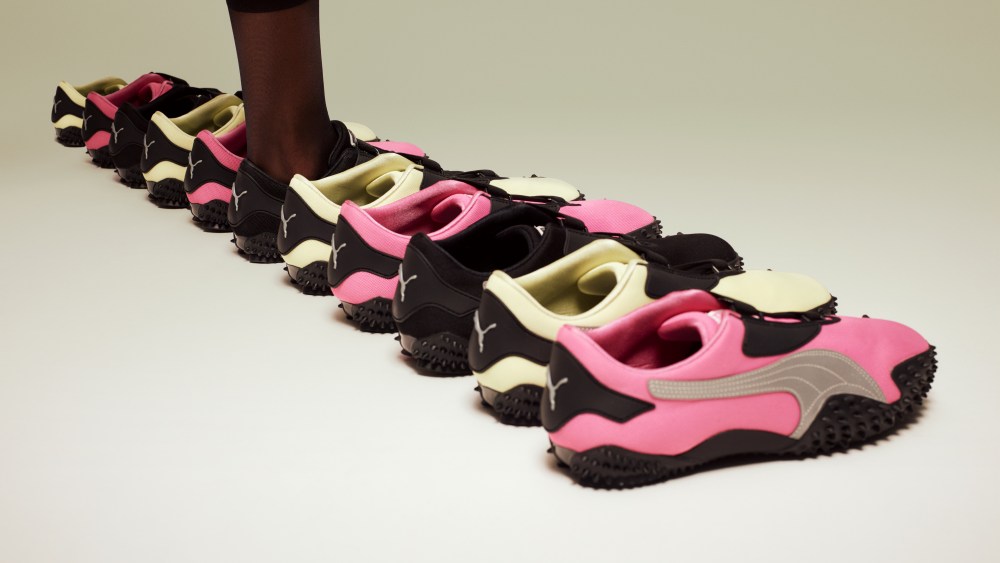
The company continues to have big hopes for the so-called “low profile” trend. This includes Puma’s lines like the Mostro and the Speedcat. The latter boasts a sort of ballerina-meets-sneaker look that’s already proving popular among trendsetters.
Low-profile looks have had a slower start in Europe, Neubrand said, but are doing particularly well in Asia. The brand expects to have sold between 4 million and 6 million Speedcat products by the end of the year.
Despite the flat sales and double-digit EBIT decline, Puma said first quarter results were “broadly in line with expectations,” and did not alter sales and profit guidance for fiscal 2025.
In fact, Neubrand noted that second-quarter sales were already looking up after February being the “worst month.” So the next three months should result in a low-single-digit sales increase. However, he pointed out that Puma’s guidance was formulated before the announcement of U.S. tariffs in early April.
Puma says it still expects currency-adjusted sales to grow in low- to mid-single digits over the course of this year and for EBIT to land somewhere between 520 million and 600 million euros.
Market analysts from the likes of Baader Bank, Jeffries, Deutsche Bank and UBS said Puma had performed as expected during the first quarter and noted the fact that, despite the sales dip, the company had confirmed guidance anyway. Some had previously expected it to be downgraded.