
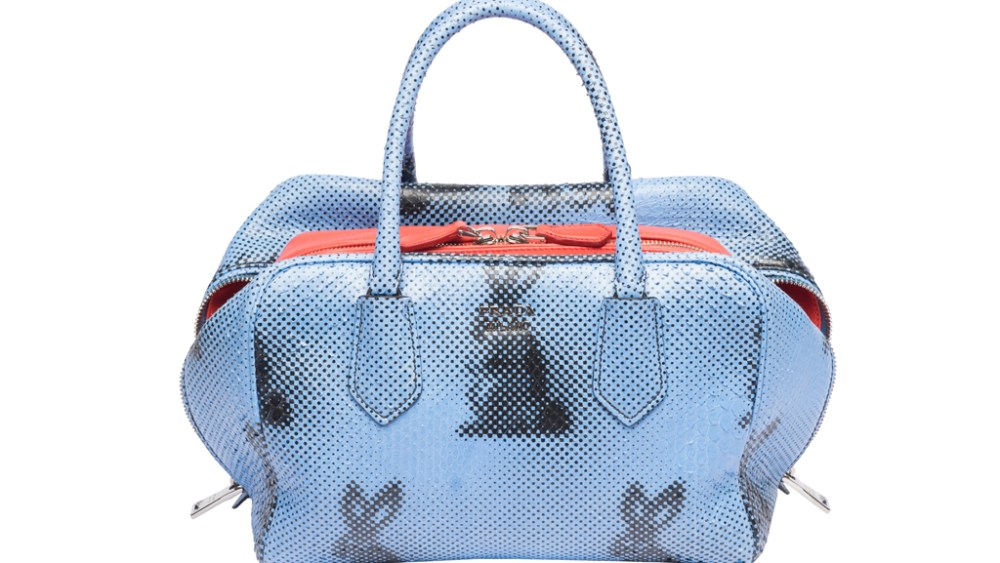
MILAN — Prada’s profits dropped 23 percent in the first half but the company is re-strategizing to get back on the growth track. The solution? Go more upmarket and raise prices.
In a move that left some analysts puzzled, Prada revealed it was continuing to streamline its operations and fine-tune its collections to push them even more toward the premium range. “We’ve moved our products to a higher range and more qualified, and changed our product mix with more homogenous prices. This has been beneficial,” claimed chief executive officer Patrizio Bertelli during a conference call with analysts Tuesday to discuss the group’s performance in the first half.
Related Articles
In the six months ended July 31, continued weakness in the Asia-Pacific region and sluggish leather goods sales hurt the group’s profitability, despite growth in Europe and Japan and strength in footwear. Prada has been struggling for the last few quarters as Far Eastern sales have declined.
You May Also Like
In the first half, net profits dropped to 188.6 million euros, or $207.4 million, compared with 244.8 million euros, or $333 million, in the same period last year.
The Hong Kong-listed company saw revenues grow 4.2 percent to 1.82 billion euros, or $2.02 billion, in the half. This confirms preliminary figures reported in August and compares with revenues of 1.75 billion euros, or $2.4 billion, in the first six months of 2014. At constant exchange rates, revenues dropped 6 percent.
Bertelli said products introduced in July and “more from today until Christmas will certainly make the difference.” He defined them as “more luxury, more detailed, more complete, very special and peculiar.” The executive also noted that, “in the last 18 months, 20 percent of sales came from bags costing more than 1,700 euros [$1,870],” and that bags “in excess of 2,000 euros [$2,200] were very successful.” He also noted that “generations change, but not the luxury market. There are new types of customers who are looking for exclusivity.”
To achieve ever-increasing quality, the company has been bringing in-house a number of steps that were outsourced before, such as cutting hides, and set up an expansive new factory for production of leather goods. “The luxury goods market is undergoing a period of significant change, which must be met with a far-reaching, long-term strategy,” said Bertelli. “Our commitment remains centered on creative dynamics and the spirit of innovation, so that we can constantly increase the levels of excellence of our products. In operational terms, we will continue with our thorough review of business processes in order to make them more efficient. The group’s primary objective remains the creation of value in the long term for shareholders, our customers and employees.”
Still, Prada’s strategy spurred skepticism among some analysts.
“We remain perplexed about Prada’s pricing approach, as it seems too skewed toward the high-end, especially in leather goods,” said Luca Solca, managing director at Exane BNP Paribas. “More product newness, nevertheless, could be of the essence in reenergizing sales momentum. Against easier comps in 2H15E, this may well be Prada’s darkest hour.”
In a breakdown of the numbers, Prada’s retail channel contributed to the bulk of sales, gaining 7.6 percent and reaching 1.55 billion euros, or $1.7 billion, driven by foreign exchange tailwinds. But at constant exchange, retail sales fell 3 percent. In a sign of how aggressive the group has been about taking more control of its distribution, Prada has opened 11 stores since February and 31 in the past 12 months – even as many of its competitors have slowed their store-opening programs. As of July, the group had 605 directly operated stores. As reported and again reiterated on Tuesday by chief financial officer Donatello Galli, the company is aiming at a few selective openings and the optimization of the existing ones.
Wholesale sales dropped 13.8 percent in the first half to 249 million euros, or $274 million, dented by a slowdown in the duty-free channel in Korea due to the MERS outbreak.
“We are taking a longer view, we see the luxury market as still positive, while undergoing major changes,” Galli said, echoing Bertelli. “In the shorter term, we are reviewing most of our critical processes, streamlining operations, adapting, working on our supply chain and better planning.”
In the first six months, sales in Europe were up 12.4 percent to 541.6 million euros, or $595.7 million, boosted by tourists flows as well as a recovery in domestic consumption.
Japan was up 11.7 percent to 194.2 million euros, or $213.6 million. “Japan is in very good shape, it’s been rebounding significantly since the beginning of April,” noted Galli.
The Asia-Pacific market was down 1 percent to 557.6 million euros, or $613.3 million. At constant exchange, sales dropped 17 percent. The area was mainly affected by Hong Kong and Macau, and offset by a positive exchange-rate effect. “There are still no signs of recovery in Hong Kong and Macau for the luxury segment,” said Galli. Greater China was down 5 percent and plummeted 23 percent at constant exchange.
Brian Buchwald, ceo of consumer intelligence company Bomoda, with offices in New York and Shanghai, said “while the slowdown in China has played a part in Prada’s sales disappointment in Asia-Pacific — what Prada ideally should account for is China’s traveling consumer, the Chinese Retail Tourist. Yes, sales in Hong Kong were down. But at Bomoda we estimate 45 percent of luxury purchases globally are transacted by the Chinese consumer and around 75 percent of that spend originates outside of China.”
Buchwald believes that Prada’s strong sales in Europe were driven by Chinese consumers traveling to the region and that “the company needs to carefully assess how they’re marketing and attracting the global Chinese consumer. They’ll need to build a more holistic and integrated relationship with these consumers if they want to see a meaningful and durable uptick in sales in the future.”
Asked by one analyst about renegotiating leases in Hong Kong, Galli said that while “there are extensive talks, these are not the easiest negotiations when leases are not expiring, but I am sure some pressure from the industry will have an effect. They [the landlords] are tough but cannot be unreasonable forever.”
Galli said more discussions will be required. “We are not negative in the long term or we would have shut down. We are confident in the market, and [landlords will lower their] expectations, they don’t want big names to shut down in the area.”
Responding to a question about a pickup in Hong Kong or Macau, Galli said he “would bet more” on the former. Macau, he said, has seen “a drop in gaming business of 40 percent piling up, it’s very difficult, and relies on the attitude of the Chinese government.”
Sales in the Americas and in the Middle East each grew 15 percent. Revenues in the Americas totaled 203.8 million euros, or $224.2 million, boosted by the stronger dollar, but resulting in less tourism and a shift of American consumers’ shopping in other destinations. “There were wobblings in August in the U.S., but the American consumer remains interesting and we remain positive in the long period,” said Galli.
In general, he admitted August had “sharp and unpredictable movements,” and that visibility was “limited.” “It will take time to see positive effects, but we constantly work on quality and innovation, selective investments in our network. We focus our efforts on enhancing the shop experience, and implemented control of discretionary expenses. We cannot expect to skip turbulence; August was volatile and we were impacted. Some fundamentals are very strong, and hopefully it will be a short-term noise.”
Galli added that the company was “waiting for the important decisions to be made this week by the Fed to see if they will raise interest rates on Thursday. It seems not the time to put up [hike rates], but this was also true two months ago.”
By brand, Prada grew 5.4 percent to 1.26 billion euros, or $1.38 billion, entirely attributable to the exchange-rate effect, and affected by the weakness in Greater China, offset by a strong performance in Europe in Japan. “Organic trends slightly improved in the second quarter, and the brand saw a positive growth in the men’s business,” said Galli.
Miu Miu sales rose 18.7 percent to 257.9 million euros, or $283.7 million, with double-digit organic growth in Mainland China in both quarters. Europe, the Middle East and the U.S. also supported the brand. Responding to an analyst, Bertelli once again trumpeted the potential of the brand to reach 700 million or 800 million euros, or $793 million to 906.2 million at current exchange.
Church’s was up 18.6 percent to 25.8 million euros, or $28.4 million. Asked by one analyst about progress on the brand’s extension into ready-to-wear revealed a few seasons ago, Bertelli said it was a project that had “not been set aside,” and that the company was “working to see elements that can be developed — we are getting ready.”
Sales at Car Shoe edged up 1 percent to 4.4 million euros, or $4.8 million.
By category, leather goods were up 2 percent to 997. 1 million euros, or $1.09 billion. At constant exchange rates, the division was down 8 percent, but Galli said there “was a slight improvement in the second quarter.”
Sales of footwear climbed 31 percent to 272.9 million euros, or $300.2 million. Bertelli said “shoes are increasingly an accessory that completes a look, while bags are more status symbols and elements of fashion.”
Ready-to-wear was up 8 percent to 248.9 million euros, or $273.8 million. At constant exchange, apparel was down 3 percent.
Operating profit decreased 21.4 percent to 293.2 million euros, or $322.5 million, representing 16 percent of revenues. In the second quarter, operating profit totaled 202 million euros, or $222.2 million, or 20 percent on sales.
Earnings before interest, taxes, depreciation and amortization decreased 10.7 percent to 440.1 million, or $484.1 million, representing 24.1 percent of consolidated sales. Margins grew in the second quarter compared with the first quarter, lifted by increased efficiency.
Capital expenditure totaled 176 million euros, or $193.6 million, of which 113 million euros, or $124.3 million, were aimed at the group’s retail network. In the same period last year, investments totaled 290 million euros, or $397.3 million, of which 174 million euros, or $238.4 million, were channeled into retail.
Dollar figures have been converted at average exchange rates for the period in question.
As of July 31, the net financial position was negative at 260 million euros, or $286 million. This was expected, said Galli, after the payment of a dividend of 285 million euros, or $313.5 million, in dividends. “We expect the position will be positive again at the end of the year,” he added.