
PARIS — As Gucci registers its sixth consecutive quarter of growth exceeding 35 percent, analysts are increasingly questioning how long the buzzy Italian brand can power parent company Kering’s exceptional growth rates.
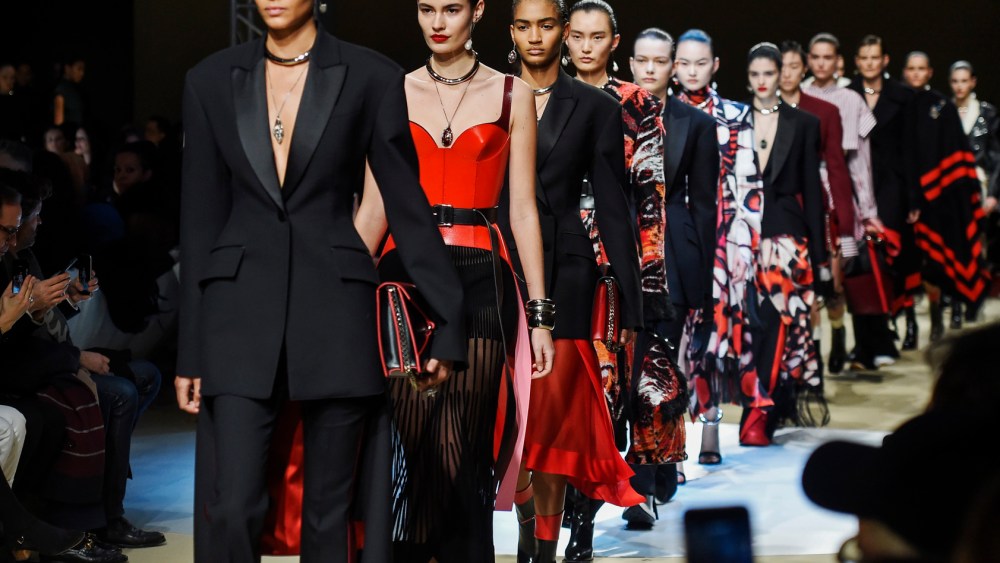
But executives at the French luxury group are not only confident their cash-cow label will keep delivering in the second half — they also have another star brand waiting in the wings: Alexander McQueen.
In recent years, Kering has relied on Gucci and Yves Saint Laurent, its biggest and most successful brands, to help close the gap with its much larger rival LVMH Moët Hennessy Louis Vuitton. Since Demna Gvasalia’s arrival at Balenciaga in 2015, that brand has also grown by leaps and bounds as consumers snap up its down jackets and Triple S sneakers, helping Kering’s revenues jump 26.4 percent in the second quarter to 3.32 billion euros.
Related Articles
Organic sales at Gucci increased 40 percent to 1.99 billion euros in the three months to June 30, accounting for the lion’s share of the group’s profits, but officials were keen to put the accent on other sources of growth.
You May Also Like
“It’s not just about Gucci,” Jean-François Palus, group managing director of Kering, said on a conference call. “Alexander McQueen is the next Kering brand to watch, following in the footsteps of Balenciaga, and its performance in the six months confirms this view. Balenciaga, of course, is doing fantastic.”
While Kering does not break out revenues for its smaller brands, its “other luxury houses” division posted a 34.7 percent increase in sales to 534 million euros in the second quarter, despite continued losses at men’s wear brand Brioni.
Kering chief financial officer Jean-Marc Duplaix said it was too soon to disclose any figures for McQueen, but he touted great potential for the brand, which has been under the leadership of chief executive officer Emmanuel Gintzburger, previously with Saint Laurent, since 2016.
“We are working to develop McQueen, which is an amazing brand with a very strong content in terms of creativity, with a very strong DNA,” he told analysts on the call. “We are building the foundations to grow that brand as we did for Saint Laurent, as we did for Balenciaga.”
Kering is focusing on organic growth as it streamlines its portfolio as part of its repositioning as a pure luxury player. The group has engaged in a flurry of house-cleaning moves this year, spinning off its stake in Puma, selling its holding in Stella McCartney and Christopher Kane back to the designers, shuttering the Tomas Maier brand and putting action sports brand Volcom on the block — though Palus said no further asset sales were on the cards.
Stripping out the impact of foreign exchange fluctuations, group revenues were up 31.5 percent in the second quarter, adding to evidence that the luxury sector is powering ahead despite currency turmoil and growing trade tensions between the United States and key partners including China. The Kering results come on the heels of an 11 percent rise in revenues at LVMH Moët Hennessy Louis Vuitton in the second quarter. Hermès International, meanwhile, reported total revenue rose 7.2 percent during the period.
“Kering achieved dazzling top-line and earnings performances in the quarter and six months. Our growth, grounded in the exclusivity and desirability of our brands, is remarkably healthy,” François-Henri Pinault, chairman and ceo of Kering, said. “While facing increasingly demanding comps and an uncertain global environment, we will once again substantially enhance our financial and operating performances in 2018,” he added.
Net profit surged 186 percent to 2.36 billion euros in the first half, boosted by a capital gain of 1.2 billion euros from the Puma divestment. Even stripping out discontinued operations, net income was up by 55 percent to 1.26 billion euros, while recurring operating profit rose 53 percent to 1.77 billion euros. The group also reported a sharp increase in profitability, with an operating margin of 27.5 percent in the first half, up 470 basis points versus the same period a year ago. Kering noted that the margin for its luxury houses topped the 30 percent mark for the first time ever.
Analysts have gradually upped their expectations to keep pace with Gucci’s explosive growth, meaning it did not beat the consensus sales forecast this time, though its operating profit margin was better than expected at 38.2 percent in the first half, noted Rogerio Fujimori, analyst at RBC Capital Markets.
“The debate on the stock will likely stay centered on the shape of Gucci’s growth normalization in the next 12 months (from current exceptional levels) as three-year stack comparatives get progressively tougher, potentially leading to some stock de-rating,” he said in a research note on Thursday.
Duplaix said despite a sharp increase in free cash flow, the group did not plan on making any acquisitions in the near term. “Short-term [mergers and acquisitions] is not on the agenda and we continue to focus on the expansion of our brands and the execution of the strategic plans of each brand,” he explained.
And while the group forecasts growth rates will come down from their recent stratospheric heights, it expects the process to be gradual.
“We are facing increasingly demanding comparisons, which should impact the rate of our growth, though not our growth itself. And in addition, it would be unwise not to make some allowances for the uncertain political and macro environment,” said Palus. “We are ready, and our determination and financial discipline are as strong as ever, so we look at the future with confidence.”
As detailed during an investor day in June, Gucci has set its sights on the next revenue milestone: 10 billion euros. Maintaining its strong momentum under ceo Marco Bizzarri and creative director Alessandro Michele, the brand posted sales of 6.2 billion euros last year.
Gucci’s sales in the first half of 2018 were roughly equivalent to its full-year revenues in 2015, Duplaix noted. “We believe that today, the desirability of Gucci has not faded at all, so we are quite confident that the second semester should be very solid in terms of sales growth,” he added.
The executive noted that although Chinese consumers were spending less in Europe as a result of a stronger euro, they were buying more in Asia. “The trends with the Chinese cluster in Q2 were still very positive and we didn’t see any deceleration compared with Q1,” Duplaix reported.
Palus credited Kering’s inclusive approach to luxury for its recent advances. The company’s share price has risen by more than 35 percent so far this year, closing at 502.80 euros on the Paris Stock Exchange on Thursday, before the results were published.
“Our brands have established new codes, new habits, a new common wisdom pertaining to luxury so what we think is that this disruption, this new approach to luxury has enhanced the desirability of our maisons, and the fact is that we think that the growth in the semester has never been more sound than it is,” said Palus. “We have constantly reinforced the exclusivity in terms of price-positioning, store network excellence and client experience, which does not mean that we exclude any customers from this journey to a new type of luxury,” he added.
Kering is opening stores for Saint Laurent and Balenciaga, and is investing in its jewelry brands, such as Boucheron and Pomellato, which are only just starting to penetrate the Chinese market. Duplaix noted the Hong Kong-based Qeelin brand was seeing “very rapid and encouraging development in China.”
Despite a disappointing performance from Bottega Veneta, which saw organic sales drop 2.3 percent in the second quarter, the group is confident of a recovery under new creative director Daniel Lee. The Céline alum arrived on July 1, succeeding Tomas Maier, who helped shape and elevate Bottega Veneta for 17 years.
“He’s been there already for a few weeks and I can assure you that we can feel the difference in terms of energy, in terms of fluidity of communication, in terms of working together with merchandising, with communication, facilitating the coordination with a full presence in Milan,” said Palus.
The brand is sitting out this season on the runway and will be back in February with Lee’s first full collection for the house. In a separate statement, Kering said Laurence Boone had resigned from her position as an independent director on the group’s board following her recent appointment as chief economist of the Organization for Economic Cooperation and Development.
In addition, Sophie Bouchillou, a Kering human resources project coordinator representing employees on the board, has reached the end of her mandate and has been replaced by Claire Lacaze.