
PARIS — Another wobble at Gucci, this time in the first quarter of 2022, overshadowed a respectable set of numbers from Kering, with luxury analysts predicting shares would weaken in trading on Friday.
Indeed, Kering shares slid 4.3 percent on the Paris Bourse to close at 529.20 euros.
Releasing its first-quarter figures after the close of trading here on Thursday, Kering reported that all its fashion and jewelry houses delivered double-digit revenue gains in the first three months of the year, while acknowledging that COVID-19 lockdowns in China since March had an impact.
Group revenues rose 21.4 percent on a comparable basis to 4.96 billion euros.
François-Henri Pinault, chairman and chief executive officer, described the quarter as “very solid” and trumpeted “spectacular performances” at Saint Laurent and its so-called “other houses,” particularly Balenciaga and Kering Eyewear.
However, he noted that “Gucci’s strong showing in North America and Europe was overshadowed by its exposure to China, where we are boosting its organization to fully capture the vitality of the market.”
As reported, Gucci recently recruited Laurent Cathala, a Tiffany & Co. executive, to become president of its Greater China fashion business, a new position. He is expected to be in place by the end of June, based in Shanghai.
During a webcast to discuss the results, Kering chief financial officer Jean-Marc Duplaix warned that “activations” to boost Gucci’s “brand perception and penetration” in China would be shifted to later in the year once lockdowns and other pandemic restrictions ease.
Revenues at the Italian house rose 13.4 percent in the first quarter on a comparable basis to 2.59 billion euros, reflecting a “mixed” performance in Asia Pacific.
Gucci’s sales have been yo-yoing lately, rising 3.8 percent in the third quarter of 2021, and then vaulting by 32 percent in the fourth quarter.
Duplaix was peppered with questions about Gucci’s performance and bristled when HSBC analyst Aurelie Husson-Dumoutier asked if there was “something broken” at the brand, given its recent underperformance versus its peers.
“I think your statement is quite brutal and unfair, there is nothing broken at Gucci,” Duplaix retorted. “The fundamentals of the brand are very strong….We are confident that intrinsically the brand has all the ingredients to perform very well in the coming years.”
He also trumpeted “a very good start to the year in China” for all Kering brands.
Barclays estimates that about one-third of Gucci’s retail sales are in China.
Claire Roblet, Kering’s director of financial communications and market intelligence, told analysts that about 40 percent of Gucci’s stores in China are located in cities impacted by coronavirus-related restrictions of varying degrees.
She further clarified that about 10 percent of the brand’s China network was closed during the last two weeks of March, with about 30 percent of locations dark in early April.
Duplaix noted that “the general mood in China because of restrictions was mixed” in the first quarter and lockdowns and other measures had an “impact on consumer sentiment generally.”
He added that “part of consumption in China is driven by intra-China tourism” and this has slowed amid new outbreaks of the virus.“ But we know what is the resilience of the Chinese consumer and underlying trends.”
Asked about early signals for the second quarter, he said “in Western Europe and North America, trends are still supportive.”
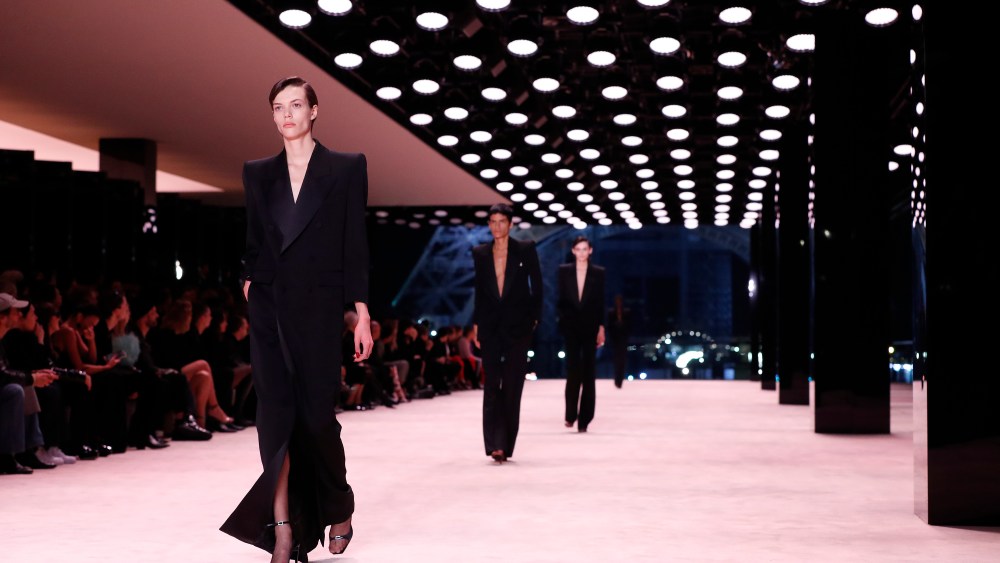
Saint Laurent reported a 37.2 percent jump in first-quarter revenues on a comparable basis to 739 million euros, the strongest performance in the group.
“All engines are working at full speed,” Duplaix said, citing strength across all product categories and flagging an acceleration of ready-to-wear sales at the French house.
Pressed to explain the brand’s momentum, he touted its “clear strategy on merchandising and distribution” and noted that “Saint Laurent is historically strong with local clients, and less reliant on tourist flows.”
Bottega Veneta sales gained 16.3 percent to 396 million euros thanks to an “iconization strategy consistently deployed,” Duplaix said.
Revenues at “other houses” — which include Balenciaga, Alexander McQueen and Brioni in fashion and Boucheron, Pomellato and Qeelin in jewelry — improved 35.1 percent to 973.4 million euros.
For the first time, Kering broke out “Kering Eyewear and Corporate,” where revenues advanced 35.1 percent on a comparable basis to 308.1 million euros.
The group highlighted a “strong contribution from Gucci and Cartier brands notably” in eyewear and its recently acquired Danish eyewear business Lindberg.
Pinault gave no specific guidance for coming quarters, noting that “while we remain attentive to economic and geopolitical conditions, we invest in all our brands, whose attractivity will continue to fuel our growth and profitability.”
The first-quarter numbers highlighted how uneven luxury growth has become in the wake of the pandemic, with retail sales in Western Europe catapulting 75 percent versus 2021, but still 1 percent below 2019.
North America grew 42 percent versus 2020 and 94 percent versus 2019. Asia Pacific was flat versus 2020, but up 31 percent versus 2019. Japan was up 20 percent versus 2020, but down 4 percent versus 2019.
Buoyant demand for luxury goods in the Middle East and Latin America underscored the 42 percent gain versus 2020 for the rest of the world, and a 62 percent advance compared to 2019.
Kering is the last of France’s big luxury players to report first-quarter results.
LVMH Moët Hennessy Louis Vuitton reported a 29 percent gain in revenues to 18 billion euros, with its linchpin fashion and leather goods division posting organic sales growth of 30 percent during the period.
Hermès International recorded a 27.1 percent rise to 2.76 billion euros, as reported.
SEE ALSO:
Gucci Improvement in Q4 Puts Kering in Bullish Mood
Gucci to Hold Show in Italy’s Apulia on May 16
Bernard Arnault Can Keep Running LVMH Until He’s 80