
This story was updated at 6.14 p.m. EST.
BERLIN – After just three years in the job, Adidas chief executive Bjorn Gulden has almost achieved the goals of his initial four-year plan — one year ahead of schedule.
When he took on the job in 2023, Adidas was suffering financially because of a canceled collaboration, the very profitable Yeezy line, with the musician formerly known as Kanye West. In 2025, Gulden said he wanted Adidas to be a “healthy company” by 2026.
On Wednesday, the German sportswear giant announced record-breaking results for the third quarter of 2025, with sales revenues growing 12 percent in currency neutral terms to 6.63 billion euros and operating profit increasing 23 percent to 736 million euros.
The sales are the highest Adidas has ever notched up in a quarter and the operating margin for the first nine months of the year is now at 10.1 percent, just slightly above the 10 percent margin Gulden was targeting. The results were in line with market expectations, as Adidas had released preliminary results last week.
The company also raised guidance for the full year. It now expects currency-neutral revenues will increase around 9 percent and operating profit will come in at about 2 billion euros. Previously, Adidas had forecast revenue growth in the high single-digits and operating profit of between 1.7 billion euros and 1.8 billion euros.
“If three years ago, we had said that at the end of 2025, we would make 2 billion profit, I don’t think you would have believed us,” Gulden told journalists during a webcast.
“It’s still a very, very volatile market — those considerations haven’t changed — but we are better than we expected after nine months [of 2025] and I think it’s fair to say, with everything we can measure, the attitude towards our brand is also better globally than we had expected,” he added.
Gulden went on to outline the tenets of the strategy that has seen Adidas significantly outpace competitors like Nike and Puma, both of which are struggling with negative sales growth and are attempting turnarounds.
The most important aspect comes down to an internal company slogan Gulden often repeats about striving to be “a global brand with a local mindset.”
Adidas has given local managers and teams around the world more resources and more decision-making power, and has established nine centers for product creation. That includes sites in Portland and Los Angeles as well as in Shanghai, Tokyo, and locations in Vietnam, Indonesia, India and Brazil.
The result is what Gulden describes as “a multidimensional matrix that moves all the time, depending on what is happening with the consumer and on the political side.”
You May Also Like
Related Articles
Adidas saw double-digit growth in almost every market in the third quarter.
In Greater China, sales rose 10 percent to 947 million euros, capitalizing on the localization drive. The product-creation center in Shanghai now designs almost 60 percent of Adidas’ goods for the Chinese market and the company sources 95 percent of Chinese product domestically.
“It’s a market where you see a lot of brands struggling, but our being a global brand with a local focus is working [best] in China,” Gulden noted.
In Europe, its largest market, sales climbed 12 percent to 2.33 billion euros. In Japan and South Korea, they rose 11 percent. In Latin America and in the Emerging Markets category, sales went up 21 percent and 13 percent, respectively.
The brand’s worst result for the third quarter was in North America, where sales rose 8 percent on a currency neutral basis to 1.3 billion euros.
This was partially due to some problems with a partner delivering accessories there, which meant the category grew just 1 percent in the third quarter. Had it not been for this glitch, accessory sales would have risen 8 percent or 9 percent globally, Gulden stated.
“It’s a combination of delivery problems and the resetting of the business, which we think will be fixed in the next few quarters,” Gulden commented.
The German company is also continuing to deal with the impact of President Donald Trump’s tariffs on imported goods. It originally calculated the direct impact of the tariffs on profit would be around 200 million euros, but has revised that estimate to 120 million euros.
Measures taken included significantly reducing exposure to Chinese sourcing early on — Adidas now sources only 3 percent to 4 percent of products bound for the U.S. from China — and the company has also worked with suppliers and retailers to decrease the tariff burden in other ways.
Prices on existing Adidas products, especially those at lower prices, have been maintained but new Adidas products coming into the U.S. — especially those featuring innovative technologies or higher price points — will be sold for more than they would have previously.
But it’s the indirect impact of tariffs on consumer behavior that Adidas is more concerned about, especially when inflation starts to hit harder.
“Consumer reactions so far were O.K. but I think it’s too early to say,” Gulden noted. “Everybody who is importing products is nervous about when new prices will come through. Retailers want to buy less up front. There’s a lot discounting in the sector too, so price increases are not visible in many categories yet.”
At the same time, Adidas still plans to grow in the U.S. and has been investing more in local sports, signing college athletes in basketball, baseball and American football.
“We need to be in college sports to be credible there and we are starting to get a pretty impressive lineup with colleges,” he noted, adding that the two latest signings were Tennessee and Penn State, with the sponsorship starting from next year.
In terms of product categories, Adidas’ apparel sales increased by 16 percent to 2.38 billion euros and footwear sales grew 11 percent to 3.75 billion euros.
Market analysts and investors have previously expressed concern about Adidas’ reliance on the wildly popular “terrace trend” in footwear, and there’s no doubt that the Samba, Gazelle and Spezial models became popular at exactly the right time, just as Adidas was struggling to get over its Yeezy issues, Gulden conceded. The last of the Yeezy range was sold by the end of 2024.
“To turn the company around, we needed heat somewhere and [the terrace trend] was our play,” he said. “We have used the time where we have been hot to actually invest in sports.”
That worked and now performance products are growing at 17 percent, a faster rate than those in the lifestyle category, with “performance being the most important leg when it gets to the credibility and authenticity of the brand,” he said.
But the terrace trend isn’t going away yet either. Adidas is investing a lot in keeping it going, the executive said, with regular launches of different colorways, materials and collaborations. In some markets, the number of Samba shoes sold is still increasing, whereas in others it has stagnated.
“I don’t think the terrace trend will die, it’s about how you manage it,” Gulden told WWD. “Plans are market by market, we’re very focused on the sell-out data and our inventory, and managing volumes going into the different markets.”
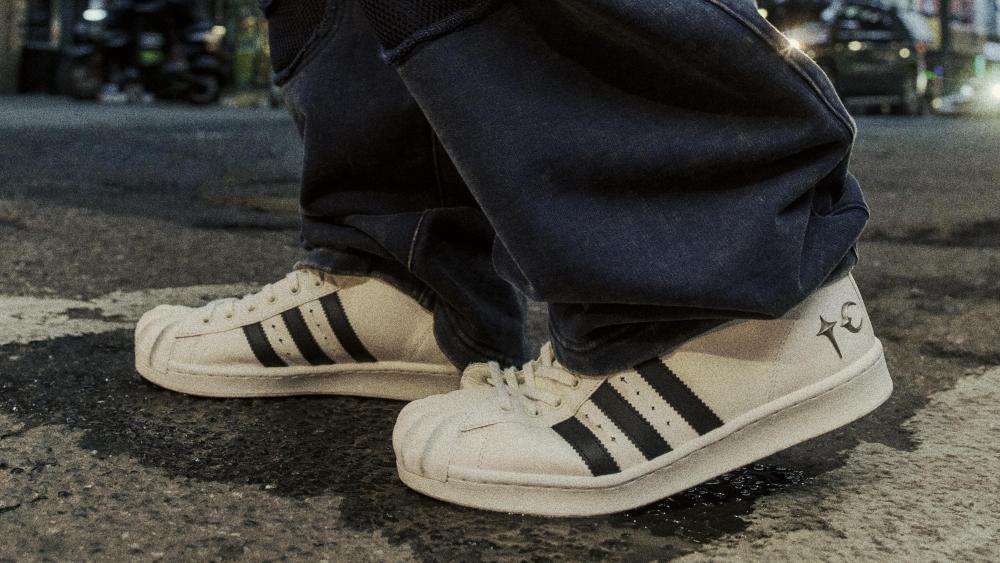
The company noted that it has also started expanding its “low profile” offerings, ostensibly the next big trend in sneakers, relaunching the classic Superstar sneaker. It’s also pushing other collaborations with creatives including Pharrell Williams, Grace Wales Bonner, Edison Chen and the British band Oasis.
Gulden is also encouraging cross-pollination of all kinds, between lifestyle and performance, and even between different sports.
For example, Adidas has used the design of one star player’s basketball shoe as the basis for another star player’s football boot. In promoting its training category, Adidas is getting its top athletes to work out in the new training looks. And by early next summer, it will launch a shoe that combines one of its most successful current training shoes and a running shoe.
The company will also launch a capsule collection of training outfits for women inspired by the aesthetic of the more retro Adidas Originals range. “The reaction to this from the trade has already been phenomenal,” Gulden enthused.
Soccer club shirts and accessories are also a streetwear trend, Gulden said, and Adidas will be trying to capitalize on that by producing lifestyle footwear that looks more like a soccer boot — even though, he conceded laughing, there’s some debate as to whether this will really be a hot trend or not.
“I feel we are on a good way to being the company that Adidas should be, even if the circumstances are a lot more difficult now than we started talking in 2023,” Gulden said.
The goal for the near future is to stabilize growth and ensure the company is able to maintain numbers like the 10 percent margin on operating profit, he said.
As for the more distant future, Gulden said that the company encourages ambitious area managers to work towards making Adidas the number one sportswear brand in that territory. Was that also his ambition globally?
“Can we be number one in all markets?,” he replied. “Of course not.” Particularly not in the U.S., where Nike has too much of a home market advantage, he added.
“But we should still have the ambition. Then we can look in a couple of years at what the score card says,” Gulden concluded.