Updated 1:05 p.m. ET Oct. 22
PARIS — Can newly appointed menswear creative director Grace Wales Bonner maintain Hermès momentum?
The news that the 35-year-old British Jamaican designer will take over from Véronique Nichanian, who has been in the post for 37 years, was announced midday Tuesday and pushed shares up 1.4 percent by market close. On Wednesday, the group reported a third-quarter sales increase of 9.6 percent at constant currency and credited the steady increase of ready-to-wear as part of that success.
Related Articles
The category has been a bit of a dark horse for the house as flashier rivals flail and saw continued momentum in the three months ended Sept. 30, with sales up 6.6 percent at constant currency.
You May Also Like
In a conference call with analysts, executive vice president of finance Eric du Halgouët said growth is split pretty equally between men’s and womenswear. So, will Wales Bonner — who is known for using cross-cultural elements, embellishments and playing with high-low mixtures, as well as collaborations with mainstream brands such as Adidas — rock the heritage house’s boat?
“Grace has got a lot of things in common with Véronique — her love of craftsmanship and her very contemporary outlook on fashion. She’ll be bringing her own signature to a new chapter for men’s ready-to-wear,” he said. Overall, du Halgouët expressed confidence her appointment will keep the category on a slow yet steady growth trajectory.

Nichanian was known for epitomizing “quiet luxury” long before it was a buzzword.
“It really is in keeping with our desire to continue on the momentum,” du Halgouët added of Wales Bonner’s appointment.
Nichanian will present her final collection for the house in January 2026, while Wales Bonner will present her first collection in January 2027, giving the new designer a long runway to ease into her new role.
Kantar BrandZ director Ellie Thorpe believes Wales Bonner’s appointment gives Hermès an opportunity to balance the brand’s heritage of timeless craftsmanship with modern cultural relevance. Her versatility — particularly through partnerships from sporty with Adidas to fine tailoring with Anderson & Sheppard — positions her to attract younger, more diverse audiences without alienating the current client. Her ability to maintain the brand’s core identity while introducing fresh cultural perspectives could strengthen Hermès’ uniqueness, which is crucial for growth, pricing power and long-term differentiation in the competitive luxury market, based on data from Kantar.
“What will be interesting to see is how Wales Bonner can bring new strands to these perceptions of craft. What we’ve seen from her so far is that her vision really aligns with that uncompromising commitment to quality and to craftsmanship,” Thorpe said. “What we may well see is that the Hermès brand becomes more meaningful to more people and more meaningful to a broader audience, and younger audiences start to pay attention.
“The cultural symbolism she employs might also appeal to new buyers too. The fact that she’s going to bring different perspectives and new points of reference will definitely open doors to fresh audiences….The worry is that you open doors to one audience, but you alienate another. I think she has the potential to balance both [and] to evolve the Hermès brand without compromising on those core associations that Hermès has built,” Thorpe said.
Bernstein analyst Luca Solca considered the performance of non-leather goods categories such as ready-to-wear “a positive surprise.”
RBC analyst Piral Dadhania said: “The backbone of Hermès’ business model is sound — with elevated and non-replicable brand positioning, absolute price leader, supply chain advantages (higher level of vertical integration and handmade products versus peers), long-term consistency in strategy, management and execution and exceptional financials.
“It is likely to suffer less than peers, given its absolute luxury brand positioning and supply constrained model for its most coveted products, although we do anticipate a second consecutive year of margin compression,” he added.
China on the Rebound, but Disappoints
With an eye on Greater China, which saw revamps of stores in Macao and Taiwan open their doors in spring, du Halgouët said that he is “optimistic” as the country is beginning to recalibrate as its real estate sector stabilizes and financial markets in Hong Kong and mainland China are on the upswing again. An increase in footfall hasn’t been the only indicator of improvement in the country; du Halgouët said they are selling bigger ticket items such as pricier jewelry items as well as watches.
The first week of October was the Chinese fall festival of Golden Week, in which the company “saw quite strong and dynamic” sales, which du Halgouët called “encouraging” following a two-year sales slump in the country.
But the market was not so positive, and the company’s shares dipped as low as 4.4 percent by midday trading, and closed down 2.7 percent. Analysts expressed concern about the leather goods sales slightly missing expectations, which erased the gains that followed Wales Bonner’s hire.
Addressing the trend for the first three weeks of the fourth quarter, Du Halgouët said it has been in line with the group’s targets. “We are confident across all regions,” heading into the final stretch of the year.
He added that they have increased stock in anticipation of the end of the year Western holiday season, and the Chinese New Year at the beginning of 2026.
Du Halgouët said that the company has seen double-digit growth in Australia, Malaysia and South Korea in the quarter, boosting the APAC region.
Sales in Europe jumped 10.3 percent, but it was mostly tourists from the U.S. and Middle East traveling to the continent to shop.
Du Halgouët said much of that was concentrated “when tensions were highest” across the Middle East regions, but they have since stabilized.
Hermès has also bucked trends in the U.S., with a “very good third quarter driven by all product lines” in the country, despite tariff-related price increases. Sale were up 14.1 percent at constant currency, aided by increased footfall driving up purchases of volume goods, like silk scarves, as well as jewelry and shoes.
But with the dollar at a low against the euro, the company was hit by currency fluctuations, which delivered a 254 million euro hit to revenues.
While price increases can again be expected — as they are each year — du Halgouët noted they “will be below the price increases of this year,” in which prices climbed 6 to 7 percent worldwide at the start of the year, with an additional 4 to 5 percent tariff offset for the U.S. in May.
While sales in leather goods were up 13.3 percent at constant currency in the third quarter, it was a slight miss from analysts’ expectations that pegged the category at a full point higher.
“The leather goods miss could be signaling that they are holding back inventory for the year-end — when they have difficult comps in America,” Solca said.
Du Halgouët added that stocks have been increased in anticipation of the upcoming Western holiday season in December, and Chinese New Year in February.
Elsewhere the company missed in its fledgling perfume and beauty sector, a category that has seen overall explosive growth for brands across the board. Sales were down 7.2 percent at constant currency. Du Halgouët dismissed concerns and chalked it up to high comps to the same period last year when it launched Barénia, and the strong sales of that new fragrance subsequently led to reduced stocks that dragged sales down in the third quarter. Now that they are replenished “sales continue to increase” especially in Europe.
The group continues to explore skin care, but don’t expect any moves on that before 2028, he said.
Addressing the recent controversy over Western brands retaining real estate in Russia, despite declarations of exiting the country and signaling plans to return, du Halgouët said it “has no business” in Russia and is currently exiting its leases bar what is required by law.
However Hermès Could Signal Rebound for Sector
“Hermès is the third luxury company during this reporting season to deliver year-over-year sequential revenue improvement, suggesting a potential inflection point,” said Citi analyst Thomas Chauvet.
“We think the luxury sector may be entering in a more favorable demand and earnings cycle, supported by stabilizing macro conditions in key geographies, significant wealth effects, improved traffic/volume, supply-side initiatives (creative change/newness, renewed marketing efforts, distribution innovations/new store concepts, category expansion),” he wrote in a note following the release.
Also looking at 2026, the company will continue to increase its retail footprint in key markets, upsizing to stores more than 5,000 square feet.
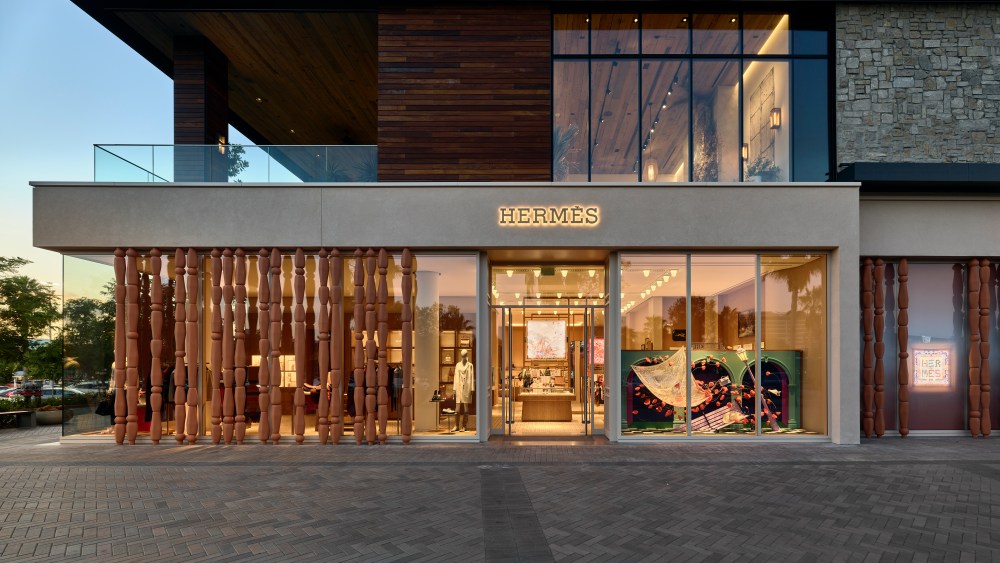
The current store in Geneva will expand, and Hermès will open a new outpost on Bond Street in London, targeting the second quarter of 2026. There will also be another China project later in the year, as well as “a lot” of investment in the U.S. store network, where it opened a Nashville flagship on Oct. 13.
Third Bridge analyst Yanmei Tang said Hermès has expanded its store network with restraint. “Unlike peers that overextended during the post-pandemic boom, Hermès has grown carefully, opening boutiques in strategic locations while maintaining consistent standards of service and presentation. Its refusal to enter the wholesale or resale markets underlines its commitment to scarcity and full-price integrity.”