
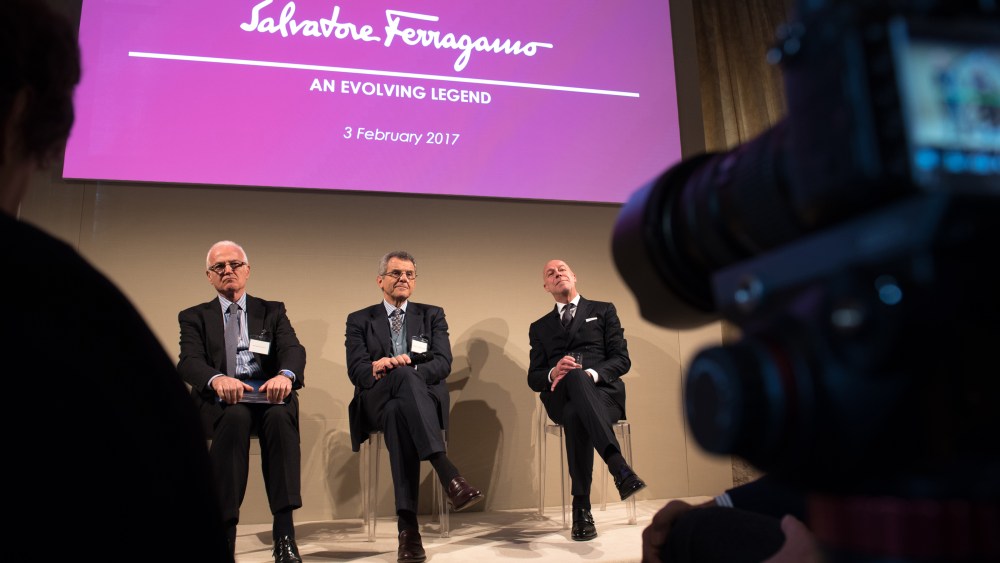
FLORENCE — Salvatore Ferragamo SpA quashed speculation about a possible sale of the company at its investors’ day here with family members showing a united front behind Eraldo Poletto, who joined as chief executive officer last August.
“We are not even thinking about it,” chairman Ferruccio Ferragamo told a packed, frescoed room at the brand’s headquarters in Palazzo Spini Feroni on Friday.
Ferragamo reiterated his belief in tapping outside management. “We should have done it even before 2006. It’s very healthy to have an independent manager,” he said. The sheer number of family members was a reason for the listing, including 23 grandchildren and 40 great-grandchildren.
Related Articles
Also present at the event were the chairman’s siblings Leonardo, Fulvia and Giovanna, their mother Wanda, and the three members of the third generation active in the firm: James, Angelica and Diego Ferragamo.
You May Also Like
“We are solid; we have our feet on the ground, preferably shod in Ferragamo,” Ferruccio Ferragamo said to a round of chuckles. “We have built a good structure, we have a nice market position, but there are many opportunities. We are not satisfied; we can improve our stores’ performance.”
Ferragamo noted that the day had a “significant” meaning. “It makes me think of our road show in 2011, maybe some of you thought it was weird. We were the only company listing, we made many promises, we accomplished them and maybe even [surpassed] some,” said Ferragamo, taking the opportunity to thank former ceo Michele Norsa, who took the company public, and Poletto for his “passion and energy” in building the company.
While leveraging Ferragamo’s strong brand awareness, cautious brand extension and global growth over the past years, Poletto characterized the brand as a “sleeping beauty.”
The goal, he said, is to expand the company at “twice the rate of market growth” in the medium term, or three to four years by improving like-for-like sales, product assortments, gross margin and earnings before interest, taxes, depreciation and amortization with tight control of operating expenses.
Poletto repeatedly paid tribute to the company’s 4,000 employees, comprising more than 65 nationalities, and the customer service he sees as a priority. “Taking a quote from someone else [Peter Drucker], ‘Culture eats strategy for lunch.’ We must empower our people and unveil the strength of the brand, become louder and raise our tone of voice, we’ve been a bit shy in the past.” To this end, the company will unveil a new web site in mid-2017 — part of a “big push in marketing.” Ferragamo opened its online store in China in December and plans to go omnichannel worldwide in 2017.
In general, Poletto said the brand needs “fewer, bigger and better messages. Be true to yourself.”
While the company plans to slow down store openings, with 15 to 20 new units per year, Poletto explained that the goal is to refresh existing stores with a “very strong merchandising approach.” It’s less about seasonality and more about evolution, he said.
Chief financial officer Ernesto Greco said the company had invested 140 million euros, or $151 million at current exchange rate, since the initial public offering on store renovations, but that capital expenditures were now “under control because of this soft refurbishment.” In the next three to four years, the company plans to spend 85 million euros, or $91.6 million, in capital expenditures.
Poletto defended the decision to forgo a single creative director, following the exit of Massimiliano Giornetti last March, in favor of appointing Paul Andrew, Fulvio Rigoni and Guillaume Meilland in charge of women’s shoes, women’s ready-to-wear and men’s rtw, respectively. “The brand is the creative director, and it relies on the strong expertise of each designer under a very unified aesthetic.”
Poletto characterized shoes as “one of the biggest opportunities in leather goods.” He praised Andrew’s “contemporary and modern twist” to the brand, while staying true to Salvatore Ferragamo’s legacy.
Poletto highlighted the lingering influence of the late Salvatore Ferragamo. “He is the living soul in the organization, we talk to him like he’s here, and he is watching us and what we do next. But it’s not about nostalgia, it’s about looking forward. He was very modern. He invented shoes, they were not fashion before him, they were just comfortable and useful.” Andrew is bringing back the brand’s colors, shapes and fun, he added.
He also plans to expand rtw with “wardrobe essentials” and textile accessories. “I am a retailer and think of a pull merchandising approach,” he noted. “We don’t want to talk about seasons anymore, we want to continuously create excitement in stores, simplifying the collections,” said Poletto, adding that the company has cut 36 percent of stockkeeping units with the spring collection and 30 percent of sku’s for the following season. “We must create demand and excitement, and not follow the market.”
The executive said the company does not plan to raise its prices and emphasized “price integrity and impeccable customer experience. Sometimes luxury lost this, but there’s a scientific way to it.” He said Ferragamo is “strong on entry price and that it can be stronger in the medium and high-range, too.”
The company did not disclose additional figures to those released earlier this week, when it said that sales in 2016 rose 1 percent to 1.44 billion euros, or $1.58 billion at average exchange.
Poletto noted women’s products account for 60 percent of revenues. By category, footwear represented 42 percent followed by leather goods with 37 percent. Retail generated 65 percent of total, and by region, Asia-Pacific represents 36 percent of sales and the U.S. 24 percent.
Poletto said Ferragamo must be “very agile,” continuously evolving, mapping out strategies on a weekly basis. “It’s a new era, there are no more tailwind. The winners are those that brought the product back.” He emphasized merchandising “by category and not by assortment. There was a disconnection before between different categories.”
Greco emphasized how the Patent Box, a tax reduction approved in Italy for intellectual property holders, will allow a “quantum leap” in profitability. The consensus is that in the 2015-20 period it will allow profitability to grow by 100 million euros. Last year the tax rate was 31 percent and starting in 2018 it is expected to be 24 percent.
The company is investing in a new distribution center in Osmannoro, near Florence, due to open in August 2018.