
New product life cycle management software from UGS helped Marimekko grow its export sales by 35 percent last year.
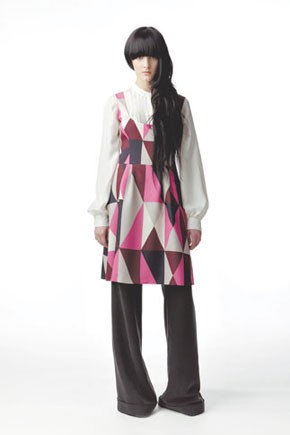
The growth shows in the recent appearances the company’s iconic prints have made at fashion companies such as Rebecca Taylor and Anthropologie. Founded in 1951, Marimekko, based in Helsinki, Finland, makes textiles, home products and apparel.
The Teamcenter software, which stores product information in one place, where it can be accessed by anyone in the company, has helped Marimekko create a greater number of apparel collections and sales catalogues, and at a faster rate. The product development time has been halved, from three months to six weeks, and some extra collections are turned around in only two weeks.
For example, one of the company’s new designers, Samu-Jussi Koski, recently created a group of 30 items for fall 2007 in two weeks. “It was a very difficult project because it used three new materials — silk, viscose velvet and wool,” said Helina Uotila, Marimekko’s supply chain manager. In that brief period, starting just before Christmas and finishing in early January in time to begin the sales process, the Marimekko team designed the 30 items and created 20 sale samples for each piece to send around the world.
“Often, it happens that we had good ideas and prototypes, but the product development process took so much time, so very often they would drop out of the collection because of lack of time,” she said.
Before installing Teamcenter two years ago, Marimekko made one or two catalogues for each collection, and the catalogues did not have photographs of the products. Now the company can make 10 or 20 catalogues for each collection, and target various ones to different countries and markets. It is easy for the company to quickly put together the catalogues using the artwork that is already in the shared UGS system.
Previously, Marimekko was using product data management software from another vendor that did not support photographs or drawings. Now, the company has images to accompany nearly every product it makes.
The vendor of Marimekko’s previous software could not keep up with the growing company’s needs. In 2004, Marimekko evaluated three programs and chose Teamcenter. Although UGS’s software was created to design airplanes, it is also appropriate for companies such as Marimekko that have many products with data specifications that change frequently, said Uotila. Another company, Ideal of Espoo, Finland, helped Marimekko choose the Teamcenter modules it needed and configure them for its business.
Related Articles
You May Also Like
“For us, [fashion] was a new industry in the beginning, but when we did the work, we realized it is quite similar to other industries,” said Markus Ranta, who handles professional services for Teamcenter at Ideal. “The language is different, but the needs are the same in all manufacturing.”
Marimekko is using Teamcenter’s workflow capabilities to manage its time and tasks. Each product can be defined by colors and sizes, and the length of material needed can be specified for each size. Accessories can be related to garments and defined by size. Other capabilities include translating technical drawings into a variety of formats so they can be viewed on the Web, for example. And what-if analysis makes it possible to see what a garment would cost to make in different factories.
Espoo received its assignment in August 2004, and by January 2005, Marimekko was able to start using the new software in its apparel division. Next to get the new system was interiors at the beginning of 2006. At the end of 2006, the handbag department was up and running on Teamcenter.
Now several dozen people use the system throughout the company, from product development to production, sales and financial. Some suppliers are also on the system, to see drawings and photographs, so fewer specifications need to be translated from Finnish into other languages.
Sales results recently came in for an additional collection designed by Koski for summer 2007. The line was made up of 16 products, and was designed, developed and presented to customers in only two weeks. Sales totaled 8 percent of all of Marimekko’s summer styles.
“The schedule was very tight,” said Uotila. “With the old PDM system, this would not have been possible, and we would have missed the sales.”