
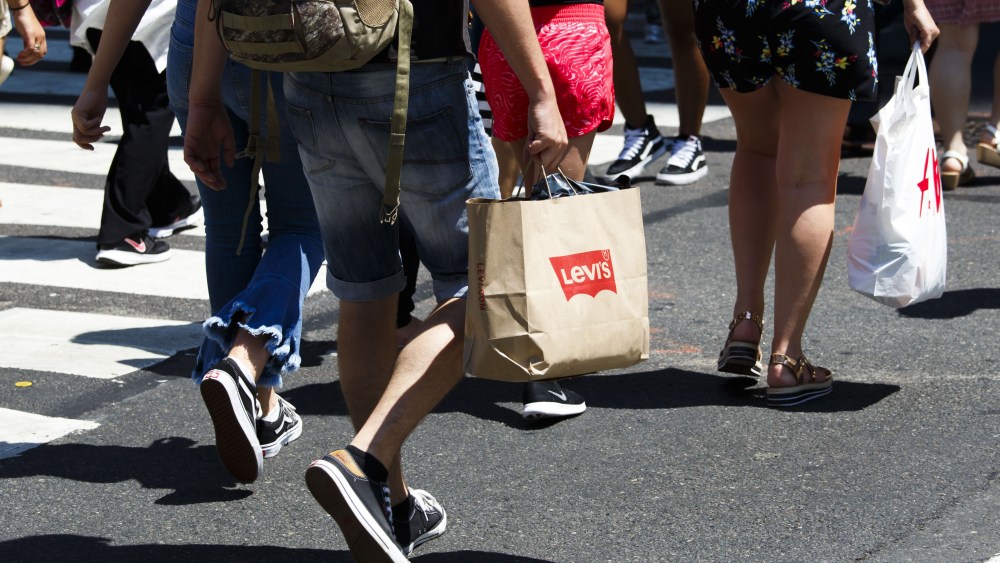
If shoppers updated their summer wardrobes last month they didn’t do it in store.
New figures from the Commerce Department showed consumers shunned traditional brick-and-mortar clothing and accessories stores between May and June, with sales sliding 2.5 percent, making it the second worst-performing category in the retail sector.
Department stores didn’t fare much better as sales fell 1.8 percent on a monthly basis, the biggest decline in over two years and reversing May’s strong performance.
In contrast, non-store retail sales increased by 1.3 percent, its largest gain this year, leading some analysts to speculate that consumers were more active online last month in a number of categories — just not fashion.
Related Articles
“It may not be a coincidence that sales in the traditional bricks-and-mortar categories of electronics, sporting goods and general merchandise all posted fairly large declines last month,” said Andrew Hunter, U.S. Economist at Capital Economics.
You May Also Like
Chris G. Christopher Jr., executive director at IHS Markit, brushed off concerns for both brick-and-mortar clothing and accessories stores and department stores, arguing that it was just “payback” for “extremely strong growth in the two months prior.”
Nevertheless, overall retail sales managed to end the month in positive territory, rising 0.5 percent in June, driven by higher vehicle sales and gas prices.
At the same time, May’s figure was upwardly revised from 0.8 percent to 1.3 percent, fueling hopes that consumer spending boosted second-quarter growth.
“Based on today’s report, we raised our estimate for Q2 GDP growth three-tenths to 5.2 percent and Q3 GDP growth one-tenth to 2.7 percent,” Christopher said.
Risks remain though, namely the escalating trade war between the U.S. and China. Consumers were largely protected at the beginning, but after the U.S. named a raft of consumer-facing Chinese imports it will hit with 10 percent tariffs in September, that may not last for long.
A weaker yuan might help some retailers to partially offset these levies in the short term, but the fear among industry watchers is that if the trade war keeps engulfing more products, retailers will be left with little choice but to pass on the higher costs to consumers, who are already starting to be squeezed by rising oil prices.
“The big question is whether households can continue this spending pace, which is helping drive the current economic cycle,” said National Retail Federation chief economist Jack Kleinhenz. “We think they can, but the big risk to the outlook is the trade war, which could raise prices while reducing consumer confidence and household buying power.”
For now, retailers will be hoping for a strong back-to-school season when consumers traditionally shop for books, school supplies, clothing, footwear, computers, computer software, smartphones and other electronics.
IHS Markit believes they may be in luck and is forecasting BTS retail sales will rise 4.9 percent compared with last year. If this materializes, it would be the strongest growth since 2014.