
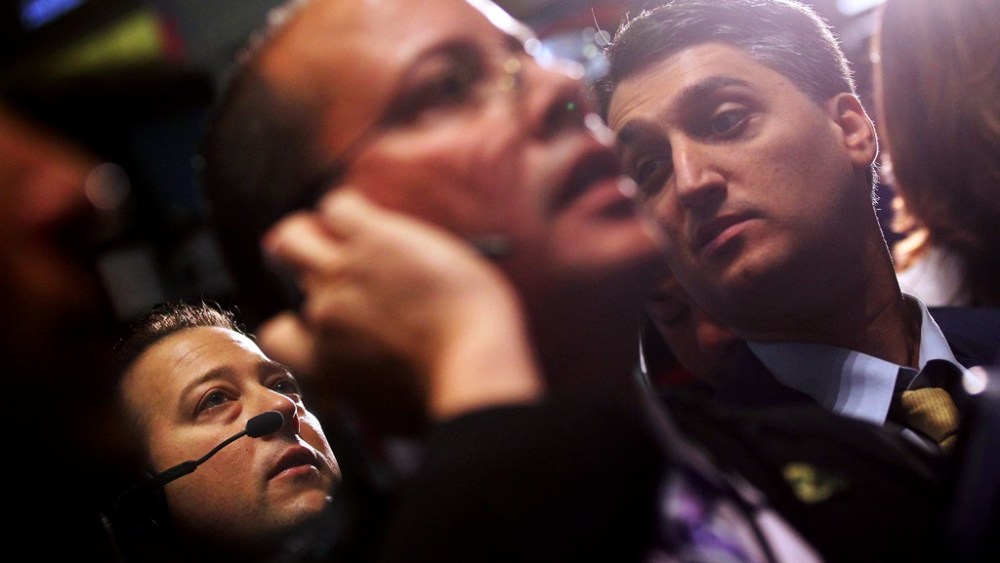
Crude oil dropping to $30 a barrel along with mounting evidence of a slowed global economy sent U.S. stocks down sharply, with tech stocks taking a serious beating that sent the Nasdaq down 1.8 percent to 4,283.
The Dow Jones Industrial Average lost footing and after falling nearly 400 points during the afternoon session, closed the day down 177 points, or 1.1 percent, to 16,027. The S&P 500 closed the day down 1.4 percent to 1,853. But the S&P Retailing Industry Index fared worse, and staggered to the finish with a 2.3 percent drop to 1,067.
If there was any good news on Wall Street — if it can be called that — the Nasdaq-100 Volatility Target Index closed down 0.07 percent 1,689. The slight decline was similar to recent decreases in other volatility measures, which suggests investors are getting acclimated to massive stock sell-offs.
Related Articles
In the U.S. retail, fashion and apparel segment, traders took profits on some big names.
You May Also Like
The top decliners included Kate Spade & Co.’s 7 percent drop to $16.21; Under Armour Inc.’s 6.2 percent to drop to $72.56, and Lululemon Athletica Inc.’s 4.6 percent decline to $57.96. Victoria’s Secret parent L Brands Inc. closed down 4.6 percent to $81.11, while Sears Holdings Corp. finished down 3.9 percent to $16.73. Nike Inc. ended the day down 3.7 percent to $55.04.
Among the gainers were Nordstrom Inc. with a 5.5 percent jump to $50.85; American Eagle Outfitters Inc.’s 2.7 percent gain to $13.48 and Vera Bradley Inc.’s 2.3 percent increase to $14.57. Express Inc. close the day up 3 percent to $16.27 while Chico’s FAS Inc. rose 2.7 percent to $9.99 and Bebe Stores Inc. gained 5.3 percent to 37 cents.
Regarding economic conditions, IHS chief economist Nariman Behravesh noted that while the “pace of the U.S. recovery fell sharply in the fourth quarter of 2015,” the results were in line with expectations. Dragging down economic growth were net exports and inventories. But Behravesh said “consumer spending and housing investment remained the bulwarks of the economy – contributing 1.5 and 0.3 percentage points to growth, respectively.”
The spending was on big-ticket items such as furniture and cars as well as on eating dinner out. Meanwhile, employment is on a steady footing, the economist added.
“While there are clearly some weak spots in the economy – such as energy and parts of manufacturing – there are also many sectors where employment growth remains robust – including retail sales, healthcare and most of the services sectors,” Behravesh said, adding that his firm “still expects employment gains in the 200,000 to 220,000 range in the coming months, but likely cooling later in the year. This means the unemployment rate should drift a little lower as the year progresses and then level off.”
Behravesh expects the Federal Reserve to keep “raising interest rates, but at a much slower pace than was previously expected.”
In the meantime, analysts are keeping a close eye on retail and fashion apparel company earnings and sales. Wall Street is also scrutinizing balance sheets for signs of weakness.