Burberry chief executive officer Jonathan Akeroyd made his first post-pandemic trip to China in March, visiting about 30 stores in Chengdu, Beijing and Shanghai. He returned to London “very encouraged.”
“The customers there are very, very excited about what’s to come,” Akeroyd said, referring to the overhaul of the British brand by creative director Daniel Lee and his color-drenched debut collection for fall 2023, expected to land in stores and online in late September.
“China will be a key part of our growth ambitions. Hopefully we will soon see a recovery of Chinese tourism into EMEA,” he told a media call Thursday after Burberry reported comparable-store sales advanced 16 percent in its fourth quarter ended April 1, aided by a strong rebound in China.
Related Articles
Retail sales in mainland China, where Burberry’s store refurbishment program is more advanced than in other regions, increased 13 percent in the fourth quarter, while sales to Chinese nationals bounded 23 percent. Overall, China now accounts for 30 percent of Burberry’s business.
You May Also Like

However, the Americas have been a drag on the numbers, with retail sales there down 7 percent in the fourth quarter, marking a further deterioration from a decline of 3 percent for fiscal 2023.
Burberry highlighted “pressure on entry-level items” in the Americas, providing further evidence that occasional and first-time luxury buyers in the U.S. are keeping pocketbooks closed.
“In America, we are more challenged mainly to do with the macro environment,” Akeroyd told a media call, citing a “softening” in sales of sneakers, hats, belts and jersey to younger clients especially.
Pressed for indications for the past six weeks of trading in the U.S., he said “it continues to be difficult.”
By contrast, he flagged better engagement with elite customers buying leather goods and outerwear.
Burberry will encounter easier comps in the Americas as 2023 unfurls, and Akeroyd asserted that the brand is “well positioned” in the market, with an “elevated” offer in the wholesale channel and its New York City and Los Angeles boutiques, located on 57th Street and Rodeo Drive respectively, slated for refurbishment this year.
Comparable store sales improved 19 percent in Asia-Pacific and 27 percent in Europe, the Middle East and Africa region, the latter boosted by robust tourist spending in Continental Europe.
Akeroyd cited triple-digit increases in tourist spending in Paris and a 43 percent gain in Milan versus only 19 percent in the U.K.
“We’ve seen a big surge in British consumer spending in mainland Europe,” he said, pointing a finger of blame at the U.K. government for scrapping its tax-free shopping scheme, putting Britain at a competitive disadvantage for the international tourist trade.
“When tourists come to the U.K., we’re the first calling point in terms of luxury,” he said, listing Burberry boutiques as a top London tourist attraction along side Buckingham Palace and Harrods.
The tallies for the quarter mark an improvement over the third quarter for Burberry, when retail revenues were flat at constant exchange rates, dented by COVID-19 disruptions in China during the key holiday trading period.
In a research note, Bernstein analysts calculated Burberry’s reported growth in the first quarter of the calendar year at 12.9 percent, which puts it somewhere in between the best and worst performing of its luxury peers. First-quarter sales rose 2 percent at Kering, 17 percent at LVMH Moët Hennessy Louis Vuitton, 22 percent at Hermès International and 23 percent at Richemont.
Investors weren’t impressed by the numbers, sending shares down by as much as 6 percent.
Carole Madjo, equity analyst at Barclays, flagged concerns about the U.S. slowdown and that the wholesale order book in the first half “will be down by low single-digit driven by de-stocking of U.S. based wholesalers.”
She attributed the weakness in the share price to “high market expectation following a round of strong beats at luxury peers.”
Burberry reported adjusted operating profits rose 8 percent at constant exchange to 634 million pounds, with margins at 21.2 percent at the reported level.
The British company said it maintained its full-year 2024 guidance of high-single-digit revenue, and its midterm targets despite the rocky macroeconomic and geopolitical environment.
The company has a medium-term ambition to reach sales of 4 billion pounds.
Full-year revenue rose 5 percent at constant exchange to 3.09 billion euros, with comparable-store sales increasing 7 percent.
Business in the quarter was driven by outerwear and leather goods, with sales of heritage rainwear doubling, and demand robust for its Lola and Frances handbags, as well as its new Vintage Burberry Check line.
For the full year, outerwear sales advanced 7 percent and leather goods 12 percent.
Akeroyd credited an advertising campaign featuring actress Vanessa Redgrave, singer Shygirl and footballer Raheem Sterling wearing beige trenchcoats for helping stoke demand, touting the “sharper, more coherent brand image” ushered in by Lee.
The designer revived an equestrian knight logo from 1901, further extolling the brand’s Britishness.
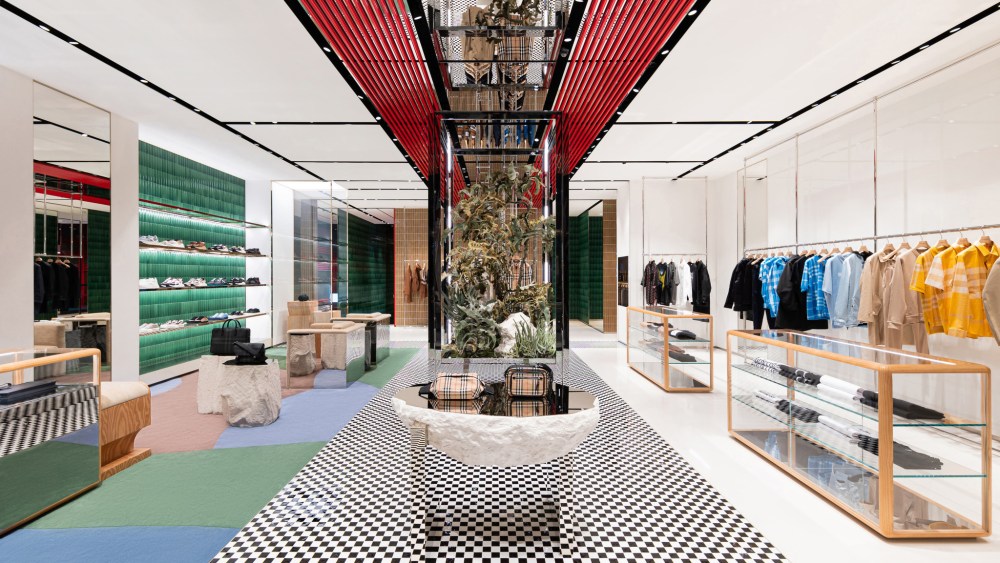
Burberry plans to invest about 120 million pounds in fiscal 2024 to accelerate its store refurbishment program, angling to update half the network from the current 30 percent.
It has a mid-term target to reduce the wholesale share of revenues to 15 percent, a higher quotient than many of its luxury peers.