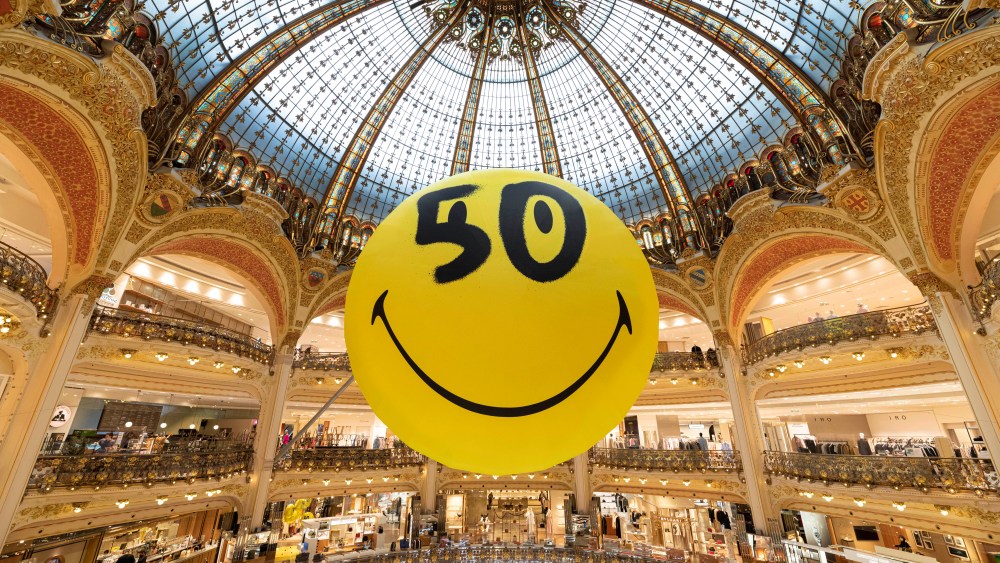
Over the course of the last 50 years, the Smiley Company has made it its mission to make the world a happier, kinder, more conscious place.
Humbly created to spread feel-good news in 1972 by French journalist Franklin Loufrani, Smiley started out commercially as a traditional licensing company. Under the leadership of Franklin’s son Nicolas Loufrani, it has grown into a global lifestyle brand with a presence across a myriad of market segments. Today, Smiley generates an annual turnover of $573 million and sells over 68 million units per year.
According to Loufrani, the Smiley Company’s unique evolution has required Smiley to continuously “push the boundaries of innovation by finding unexpected ways to continue our global mission of spreading positivity and happiness.” Soon after joining his father’s company in 1996, Loufrani brought a new vision to The Smiley Company, certain that the opportunity to expand was endless.
Related Articles
Ahead of its time, in 1997 the company began integrating digital technology into its business model and introduced the first 3D Smiley. Just two years later the Smiley was also introduced as the first graphic emoticon, modernizing the Smiley logo and bringing it into the digital world.
“At a time when the world was not digital-first as it is now, we felt that a company simply cannot prioritize innovation without having a strong tech-driven strategy,” said Loufrani. “We saw an opportunity to bring the feelings and emotions that Smiley brought in real life into the digital world and we developed the concept of the first 3D smileys, allowing people to communicate emotional intelligence electronically. This concept has continued to expand in ways we never had imagined, with billions of emoticons shared every day, becoming a key part of our digital vocabulary.”
Soon after, the iconic Smiley logo made its way to the runways, partnering with prestigious brands including Moschino, Loewe, Fendi and more. At the same time, the Smiley brand was being introduced to a mass, global market as it began appearing in more industry sectors like home and design as well as food and beverage.

“We grew the Smiley into a lifestyle brand by strategically identifying the right partners and opportunities that aligned with our overall goal of spreading positivity and happiness,” said Loufrani. “For the first ten years as CEO, I was focused on developing a mass-market merchandising program focused around the emotions that Smiley evokes. However in 2007, we expanded Smiley into a true lifestyle brand by creating
the first fashion collection, where we started designing products directly for brands, rather than allowing brands to design for us.”
This strategy, he told WWD, opened up an entirely new market for the Smiley Company that facilitated further momentum into the lifestyle world across all categories and seal even more partnerships.
Recently, Smiley redeveloped its brand positioning to ensure it holds prominent visibility within the streetwear sector to continue growing its global impact. The success this has experienced is partly thanks to the long term collaboration with LA-based brand Ma(R)ket and all the unique products they develop. For example, the Ma(R)ket Smiley Basketball collaboration has become a street culture icon!
“As we saw the growth potential of Smiley, we created a 360 degree strategy that allowed us to take great care in every detail of our partnerships, including structuring the distribution and marketing of each collaboration,” said Loufrani. “The notion of working closely with designers who want to license the original Smiley brand is something we still embrace today.”
Notably, each season Smiley develops over 30 bespoke style guides and product presentations for partners to utilize based on the latest trends, market segments and consumer insights. In 2021 alone the company launched 15,000 products with 400 partners and has grown by 70 percent in the past two years.
Still, Loufrani said, the brand needs to maintain its sense of exclusivity in its storytelling to ensure each campaign is unique.
“The thing that sets Smiley apart from other traditional licensing models is that while we want to ensure that Smiley is accessible to a global market, we also do not want it to become an over-licensed or over-produced symbol, as we felt that it would take away from the power of the brand,” said Loufrani. “With every partnership, we create a custom approach to working together.”
Over the course of its 50 years, Smiley has always approached partnerships in a way that is different from most licensing brands – a strategy that Loufrani said speaks to the company’s goal of not being in mass licensing and production, but rather to ensure that Smiley remains at the forefront of culture in the most strategic and positive way.
The Smiley Company ethos always remains of utmost importance with its goal to spread positivity through smiles in order to make the world a happier, kinder place.
For example, when assessing a potential partner, Loufrani said, he looks at how that brand’s ethos aligns with Smiley’s. In addition to looking at distribution strategy to ensure mass production and distribution is not being prioritized, the company asks questions such as: Will they use the Smiley to spread happiness and positivity or just to sell products? Does this partner want to bring Smiley to life in a unique way? Is the brand’s product and culture like Smiley’s?
Throughout the last five decades, Loufrani said, every one of Smiley’s collaborations, partnerships and experiences have laddered up to the company’s ethos.
“It goes without saying that the last few years have been particularly challenging for everyone,” said Loufrani. “In fact, in honor of our 50th anniversary this year, we declared 2022 to be ‘the
year of the smiles’ because we found that while 40 percent of Americans admit
they smiled less in 2020 and 2021 than in previous years, 70 percent of Americans agree they want to see more smiles in 2022. These findings show that now more than ever, the world needs more smiles.”
In 2017 the company also took its mission beyond licensing and brand collaboration when it created the Smiley Movement – a non-profit social enterprise that aims to spread positive news about the third sector and help charities connect with the public.
“As a multimedia platform, Smiley Movement shares inspirational news and stories to highlight the good in the world. We also work with communities to bring smiles to life through charitable donations, volunteering, events and more,” said Loufrani. “Smiley runs a number of programs specifically aimed at improving the opportunities for children across the world such as ‘Happier Schools Project’ which provides activity based learning around emotional intelligence for elementary school years for teachers, which parents and caregivers can actively participate. We believe that as children are the future adults of the world it is important to make an effort to provide them with the best opportunities regardless of their socio-economic background.”
Marking its 50-year milestone of “flashing defiant optimism in the world’s face,” the Smiley Company is celebrating with a special Collector’s Edition range, where the company will pay homage to its many collaborations with brands and designers who have helped spread positivity. With the help of Sarah Andelman, the Creative Director of Colette, and renowned graffiti-artist André Saraiva, they created a style guide, from which designers were challenged to create unique iterations that will pay homage to some of the most iconic partnerships the brand has had.
The Collector’s Edition features global iconic brands, such as a sneaker with Reebok, a bomber jacket with Schott, caps with New Era, jerseys with Champion, a backpack with Eastpak, denim with Lee, women’s streetwear collection with By Sami Ryan, and kids sportswear with Puma, to name a few.
“We are so thrilled with the products featured in the Collector’s Edition, and this is just one example of how we strategically, and uniquely, work with brands and designers. These include Raf Simons, Karl Lagerfeld, Caroline Herrera, Dsquared, Alice and Olivia, Armani X, but also beauty, home and gift designers” said Loufrani.
Around the globe, department stores will be curating pop-up shops and activations to celebrate 50 Years of Smiley, including featuring limited-edition pieces from the collection. Partners include Nordstrom in the United States, Galeries Lafayette stores globally, Hanhwa Galleria in Korea, Palacio del Hierro, Mexico, Ciudade Jardim in Brazil and Urban Outfitters in Europe.
We were also inspired by our strong community of streetwear followers to leverage our partnership with street artist André Saraiva to develop the global street art manifesto for positivity campaign to spread smiles throughout the streets of major cities around the world through art.
“This year is Smiley’s 50th anniversary and as we look to the next 50 years and beyond, we’re constantly finding ways to show people why smiling back at the world – together – is exactly how we reclaim what comes next,” said Loufrani. “Smiley will continue innovating, forging new and unexpected partnerships and always finding more impactful ways to spread positivity and happiness through the power of a smile.”