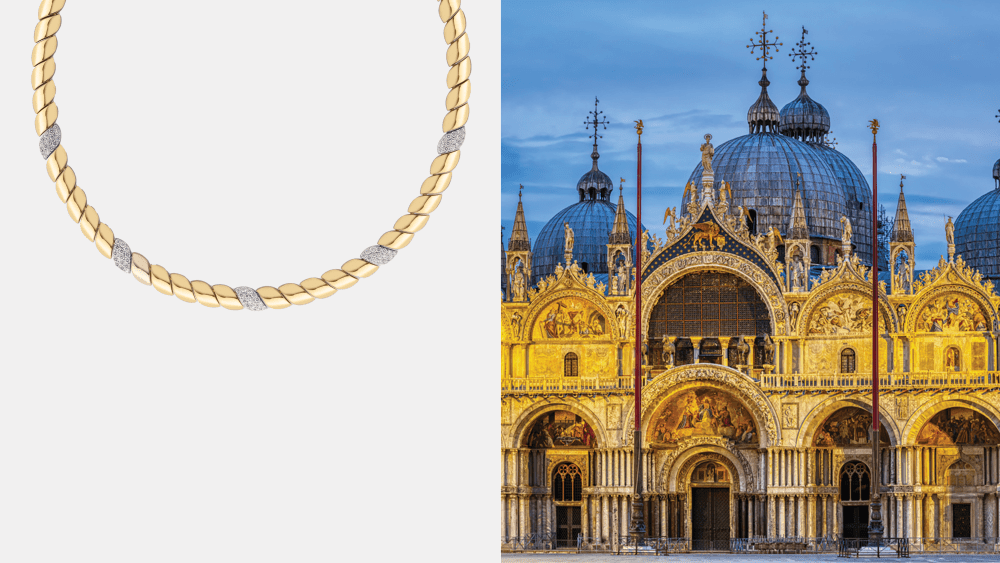
Roberto Coin’s roots are intrinsically intertwined with the city of Venice — it’s where the jewelry designer was born and raised, and in 1996, he founded his eponymous brand. Coin’s notable collections take a tour across Italy, with Portofino, Capri, Rome and Verona serving as inspiration — but Venice is the crowning jewel of his influences.
“It is the city of mirrors, the city of mirages — at once solid and liquid, at once air and stone,” said Coin.
With its rich heritage, Venice’s history spans across medieval, Renaissance and contemporary time periods — and has decades of culture to draw from. Palazzos emerge from the city’s dazzling waters. Driven by his love of beauty, Coin seeks out innovative techniques for his creations; each piece draws on the artistry of Venetian culture.
Related Articles
Venice also served as the backdrop for the brand’s new jewelry campaign with actress Dakota Johnson, who was named a global brand ambassador in June 2025. Johnson wore the Love in Verona, Venetian Princess, Navarra, Obelisco, Tiaré and Cobra collections across Roberto Coin’s campaign imagery and videos.
You May Also Like
Colonna di San Marco

In St. Mark’s Square, two columns were constructed in the 12th century for the Colonna di San Marco (the Winged Lions) on top. Atop each column is a winged lion, a symbol of grandeur and power in Venice, and the first patron saint of Venice, San Teodoro.
In the Animalier collection, the limited-edition pieces are handmade in Italy and feature the lion motif in the jewels. Animalier pays homage to the craft of Venetian goldsmithing artistry, passed down through generations. Most notably, Coin’s astrological sign is a Leo and his middle name is Leone, lion in Italian — the collection reflects Coin’s love of creations and indulgence in unique pieces.
Palazzo Ducale
On the banks of the Grand Canal sits the Palazzo Ducale (Doge’s Palace). The palace building is a symbol of Venetian wealth and influence, originally dating back to the 10th century, with its design grandeur achieved during the 14th and 15th centuries. Previously the residence of the ruler of Venice, the residence and the Venetian governmental and judicial center, the palace is now a museum and a masterpiece of Gothic architecture.
With its opulent decoration, arcades and carvings, the famous palazzo serves as inspiration for Roberto Coin’s Love in Verona collection. Known as the city of lovers, Verona has been immortalized by Shakespeare’s “Romeo and Juliet.” The four-petal diamond flower in the collection can be seen across the palace. Appearing to be detached, the illusion stems from a 3D micro architectural support and invisible bezels to enhance the diamond’s light.
Basilica di San Marco
Dating back to 828, the Basilica di San Marco (Saint Mark’s Basilica) was originally designed to be the Doge’s private chapel — it also hosts the relics of St. Mark. Today, the church in the square dates back to 1063, after a fire destroyed the previous one. The elaborate church combines a myriad of styles included in the Byzantine Empire — and continues to showcase the wealth, influence and the might of Venice across the Mediterranean.
Also known as the “Church of Gold,” its entire interior of more than 85,000 square feet is adorned with mosaics. The floor also boasts more than 2 million rare marble tiles to create a polychrome decoration complete with geometric swirls and wheels to symbolize cosmic harmony.
Swirls and byzantine circles of mosaics are woven throughout the San Marco collection. Drawing on the opulence of the church’s iconography, the collection is a contemporary reimagining of the richness of its decoration.
Torre dell’Orologio
As one of Venice’s most famous landmarks, the Torre dell’Orologio (Astrological Clock Tower) is an architectural triumph and boasts to visitors the wealth and power of the city — particularly to those arriving by sea. The clock tower also serves as the main connection from the square to the commercial sector of the city and onto the Rialto Bridge.
Its gold and blue enamel dial is a masterclass feat with its technology and engineering prowess — it marks time, day and moon phases with zodiac signs. It’s also equipped with a carillon mechanism that is activated on the Epiphany and Ascension days; the compartment opens to core people from Nativity scenes and adds a theatrical element to its function.
The Obelisco collection pays homage to the obelisks originally built at the entrances of Egyptian temples at the top of pyramids to evoke the sun’s rays to honor the Sun God Ra. This motif is central to the collection alongside its striking blue hues found on the Venetian clock tower.
Corte del Milion
“Patere” is a Venetian architectural element found throughout the city, with ornamental medallions made of stone recurring on Venetian palazzo façades. The Polo family, with its legacy of long-distance travel and Marco Polo’s travel diary to China, displays a set of five patere at its house, Il Milion. The motif showcases the stories of the family that previously lived at the palace — often reproducing animals such as eagles, lions, dogs, peacocks and griffins.
The Venetian Medallions are adjustable, versatile and colorful to create accessible luxury by their variety of materials such as mother of pearl, black jade, turquoise, lapis, red agate and the newly released pink opal. The stone disks enclosed in a twisted wire structure are held in place by leaf designs with similar petals to the Love in Verona collections.
Ca D’Oro
Originally built in the 15th century, Ca D’Oro (House of Gold) references the building’s original façade, which was covered in gold leaves and polychrome decoration — blending Gothic and Renaissance architecture. With its intricate designs, the Ca D’Oro is both opulent and powerful with its Arab influences, Gothic motifs of centerpiece lace decoration and Renaissance design elements with its colonnade and right wing.
The Venetian Princess is one of the most prominent examples of how Roberto Coin has transposed Venetian architecture into its jewelry designs. Coin studied and transformed the grandiose palazzo designs into wearable works of art. At the heart of the collection is a delicate flower design.
For the Princess Flower, the floral jewel is part of the creative bouquet of the Princess collection, with the same twisted wire craftsmanship, with its smooth and satin surfaces alternating. The shape of the petals was inspired by the “rosoni” (rose windows) adorning the Palazzo Ducale and other façades across the city.
Secret Gardens
Venice is home to at least 500 gardens. As secluded, hidden oases throughout the city, the secret spots are surrounded by walls that create large flowerpots, and which are filled with soil that won’t kill the plants, unlike the salt-rich Venetian dirt.
Wisteria, ivy, palm trees, magnolia trees, jasmine and gardenias are the most popular trees and plants found throughout the city. Coin’s love of flowers can be seen throughout his floral-forward designs.
With its regal and feminine design, the Tiarè collection is set with rubellite, mother of pearl and diamond details. The Tiarè is a tropical flower from Polynesia; it was intended for the ruling class of nobles and as a symbol of purity and divine power.
The Jasmine collection draws on the flower’s delicate appearance but formidable presence in nature. With its climbing-vine flower that blooms in both the summer and winter, it goes beyond its own limits to create a collection of lightheartedness and luminosity.
To learn more, visit robertocoin.com.