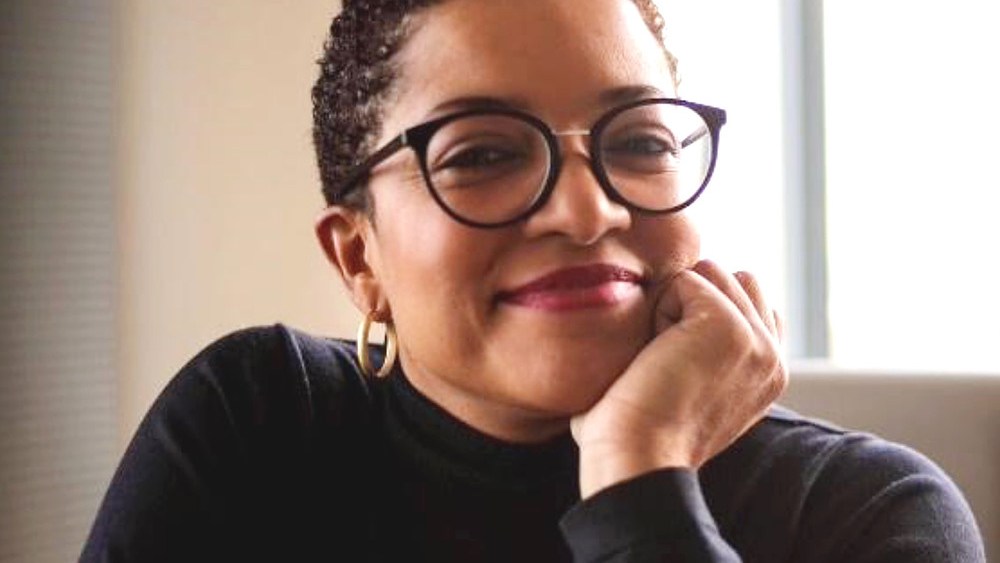
Pamela Culpepper is bringing some color to Prada Group’s board.
Her January appointment to the luxury fashion house board makes Culpepper the first Black female board member Prada has had in its history.
The move, according to Culpepper, who is the cofounder of Have Her Back, a female-owned and -led consultancy focused on tackling equality for all — which, on Tuesday, was named to Fast Company’s list of the World’s Most Innovative Companies for 2022 — means “An opportunity to bring silent and muted voices to the table in spaces where they’re often left out.”
The news leads to the question: what took so long? Culpepper is realistic about luxury fashion’s realities and focused on the bigger meaning of her new role and what she can do with it.
Related Articles
“For most of the luxury goods organizations, they are family-owned and unless your family is diverse, you generally don’t bring in people that you don’t think understand your industry. And so I think it’s predominantly that it’s been made up of people that they thought understood the industry, understood the consumer better than anyone else. The consumer has changed and the demographics have changed and now they don’t have enough people representing the broadness of their consumer,” she told WWD over Zoom from her home in Scottsdale, Ariz.
You May Also Like
Prada’s answer?
“We are extremely fortunate that Pamela Culpepper has joined Prada Group’s board of directors,” said Lorenzo Bertelli, Prada Group’s head of corporate social responsibility. “Her diverse experience — which spans senior positions in human resources and people management, sustainability, as well as change management and culture building — will make her instrumental as we continue to strengthen Prada Group and further advance upon our ESG strategy.”
Already, there are synergies between Prada and HHB, according to Culpepper.
“HHB focuses on influencing the integration of DEI into a company’s business strategy and it also focuses on the application of those ideas into the mainstream operations,” she said. “So, I’m really excited to continue that with Prada because I think they’ve already begun the work of both integration and application, so there’s already momentum and I’m excited about being a part of that.”
Culpepper’s message to the fashion industry at large — and really, all industries doing work to diversify — is a simple, but thoughtful one.
“Stop hiding behind equality to avoid the hard work of equity,” she said. “I think equitable solutions are in service to equality, not the other way around. Treating everyone, in my opinion, the same, which is equality, before you close the equity gaps is only perpetuating the gap.”
Here, in WWD’s latest “10 Questions With,” find out what Culpepper thinks is the single thing keeping companies from diversity progress, what people assume about her that isn’t true and what she would consider successful impact with the seat she now has at Prada’s table.

1. Where do you think fashion sits in terms of its influence on life and culture — and is it wielding that influence well?
Pamela Culpepper: I think there’s still work to be done. I think that people make decisions about what they like irrespective of price points and quality sometimes. And part of the fashion industry’s responsibility is to cater to relevance and value and I think it has to do with across-the-board stakeholders. We need to listen to everyone and we need to understand how relevant we are, we need to push the boundaries on what fashion could and should look like. But I think it’s critically important that the industry keeps a balance on whether or not it’s supporting all aspects, the environment, the societal, the community opportunities, all of those things have to be in balance because I think the consumers are demanding it. They’re demanding a much more conscious organization than they have in the past.
2. In a word, what’s keeping the world back from embracing diversity?
P.C.: Fear.
It’s fear of loss, whether that’s loss of control, loss of power, loss of status. It’s fear of scarcity, so if you have more that means I have less of all those things I just mentioned. It’s fear of being exposed. Once you give a group of people or a person equal footing and leverage, the exposure becomes, wow, they are as smart and as thoughtful and as fill-in-the-blank as I am and I lose leverage because I now have started to share a platform that I’ve never had to share before.
3. If you could go back in time to change one thing, what would it be?
P.C.: There’s one thing that I think about a lot and I believe that it impacts us even to this day. In slavery, the idea was to preserve the body and destroy the mind, so keep people from being able to communicate, keep them from feeling like they were superior. Let’s take the kings and queens out of people but preserve the body because we need the productivity.
When you fast-forward, we still have some of the same mindset challenges of shaking off this feeling of inferiority, shaking off the feeling of not being ready, shaking off the feeling of lesser value to some degree, and all of that, to me, started back in those days and has been perpetuated. So, if I could change this notion [and] that the mind can be preserved, that the feelings of worth can be preserved, man I just think we would be so much further as underserved communities than we are right now.
4. Corporate boards still have a long way to go when it comes to diversity. What do you think it is that companies don’t get about the benefit of having various voices to consult on your business?
P.C.: I am convinced that there’s enough out there to help people get it. I think the moment you know better you should do better, so if I abstain from bringing in new information I get to continue to operate on the old information. Once you open up your boardroom to people who are different, with the expectation that they’re going to come with new thinking and new experiences and new ideas, the question is, ‘do I really want that, are we ready for it as a board, will we do something with what we hear?’ And if the answers to those questions are, ‘I’m not sure and no,’ then I think people will continue to push around the idea of ‘we can’t find them’ until they can’t use that excuse anymore.
5. What do you think people automatically assume when they look at you — and what’s the truth?
P.C.: I think they assume that I am an extrovert and that I’m a fan of the camera and limelight and that’s the complete opposite.
They [also] wonder if I’m of mixed race and the answer is “yes,” but not for the reasons that most would think. I have two African American parents, but my lineage includes a multitude of races. But I think that there’s always the question of: is one parent nondiverse and the other one diverse? But they’re both diverse. My lineage includes sharecroppers, slave owners, my lineage includes all of that. So, on its face that’s the surface question, but the depth of it is we’re all mixed to a great degree and that can be controversial for some people to handle as a conversation.
6. Do you think companies are making lasting impact on diversity and inclusion yet?
P.C.: No. I think the most progress some companies have made has been against transparency. I think that there are some companies that are trying to go beyond the rhetoric because their employees are calling them out, their consumers are calling them out, so they really do want to do more than just talk the talk. But there’s so much more that I think they should be doing that it’s hard to do. It’s hard to do it because we’re talking about impacting systemic change and systemic change requires you to unravel all that’s been done for a number of years and create something different. And that’s the part that most organizations are having a challenge to do.
7. What’s something people really need to chill out about?
P.C.: Critical race theory.
8. What’s something you wish you had more time for?
P.C.: Professionally, I wish I had more time to pour into people that all they need is a little bit of an edge to get them over whatever their top is. There are so many people on the precipice of greatness and all they need is just a little bit more information, a little bit more motivation, a little bit more of their own confidence. I just wish I had more time to pour into everyone who is showing effort [but] just don’t have all of the support that they need.
9. What would make you really feel successful in the Prada board role?
P.C.: There’s two things, really. If I can help them create demonstrable ways for an organization to create equity with their employees, with their consumers, with their store leaders, if I could help them create some demonstrable actions in that way, so much so that other organizations are looking to us as the leader in that space. Prada has been the only organization that I’ve seen where they’ve dedicated an actual board committee to this work [of ESG and diversity] and all board committees, for all intents and purposes, they get equal time and space, there’s an expectation that they’re delivering, and so I would like for Prada to be able to influence not just the fashion industry, but other industries. There is something to giving the time and space to this work.
I would also love to see the employees — not just the consumers but the employees — say, ‘wow, I’m proud to work for a company that is putting this kind of work into something that affects me personally as a part of this community.’
If I could get those two things, that would make me feel successful.
10. What’s one dream you have yet to accomplish?
P.C.: Gosh, that’s a hard one because I literally am living my best life. My son graduates from graduate school as a productive citizen in May, I’m done, I’m getting my purse back! No but honestly, I think the dream work is making a difference on the ESG side. I think being on a board has been a goal — not a dream but a goal — because I think…there’s going to be a reciprocal feeling of getting and giving [between Prada and I]. I think there’s going to be lots of value to me being on that board, as much as there’s going to be value to me to serve in this capacity. So I need to come up with a new dream because I’m doing alright!