Despite a recent survey that quantified the continued dearth of office workers in New York City, some Business Improvement District leaders reported upticks in foot traffic, improved retail sales and optimism about the coming months.
On Wednesday, the Partnership for New York City released a survey of 188 major companies that indicated only 28 percent of Manhattan office workers have returned to their desks. In addition, office vacancy rates are at a 30-year high of 18.6 percent, and by January, only 13 percent of office workers are expected to be back in their Manhattan offices five days a week.
Just this week, union workers at Hearst balked at the plan to soon return to the office once a week. As they and others grapple for more flexible schedules, the city’s ecosystem is feeling their absence not just in fast casual lunch sales but also in property tax revenues. Forty-nine percent of office workers are expected to return on average during the workweek by January, according to the new survey.
Related Articles
Despite those daunting numbers, BID leaders presented a rosier outlook Thursday.
You May Also Like
Dan Biederman, president of the 34th Street Partnership and executive director of Bryant Park, expects turnstile counts to hit 80 percent right after the new year. Small buildings are already at 80 percent and large ones are at 40 percent, he said, adding that TJX just brought back workers in his office building at 5 Bryant Park, where the retailer occupies a few floors.
Some of their confidence comes from observational cues, like the increased influx of people between 7 and 8 a.m. at 9 West 57th Street, which houses some “big shot law and financial firms,” according to Biederman, who lives across the street. People are dressed better than they were a year ago, with many wearing suits again, he said. Neither Mayor Bill de Blasio nor Mayor-elect Eric Adams may have to do anything encourage a return to the office, he said. “It seems to be coming back. People got tired of WFH.”
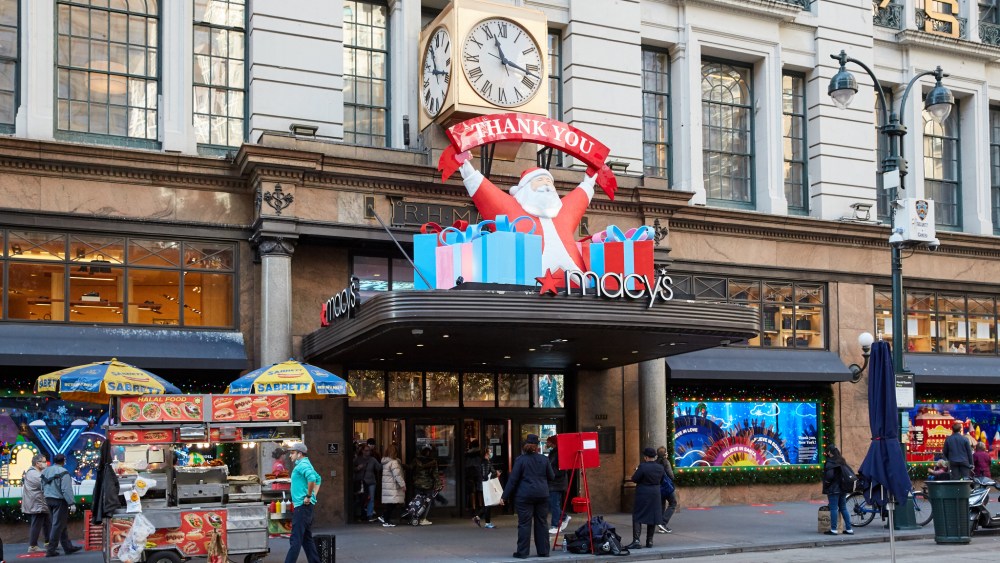
Dan Pisark, vice president of retail services and special projects at the 34th Street Partnership, said Penn Station is busier with travelers on Long Island Railroad and New Jersey Transit, as well as Amtrak to a certain degree. Subway stations near 34th Street are increasingly busier. More people are walking around with shopping bags, too, especially from Macy’s and H&M, he said. Making the point that coronavirus cases have declined substantially, vaccination rates are significant, mask wearing is prevalent outdoors and vaccinated foreign travelers can return, Biederman and Pisark are “positive” about continued improvement.
Madison Avenue has seen a spate of store openings and expansion in existing stores of late.
Spanning from 57th Street to 86th Street, the Madison Avenue BID has the advantage of resting in a largely residential area as opposed to relying on office workers, said executive director Matt Bauer. Art House, a fine art hub, will take over Barneys New York’s former space on Madison Avenue. AG Jeans and Studs, Sleepy Jones and Christophe opened new stores; Bogner has unveiled an outpost, and Brunello Cucinelli recently expanded. Giorgio Armani is in a temporary space as it renovates another building. Hermès is building a new flagship at 702 Madison Avenue.
William Greenberg Desserts stretched into what used to be the Alexis Bittar store. The latter relocated to another Madison Avenue location. Bauer noted that a few pop-ups have turned into permanent stores such as Mackage and Lizzie Tisch’s LTDxNYC. Seaman Schepps will be opening a new store. With a current vacancy rate of 16 percent, that figure was about 19 percent a year ago.
Encouraged by international travelers returning, Bauer expects there will be “some kind of bump” over the holidays but that more people will visit the city in the coming spring. Corinthia Hotels will also open their first U.S. location at what used to be the Surrey in 2023.
Noting how New York Social Diary is increasingly covering events and galas, Bauer said the return of such events is a sign of things coming back to normal.
“Not only are many of the events happening in the community here, they are for charities that are often based here,” he said. “The planning of these events are often taking place in the restaurants and hotels here. And people are buying clothes to wear [to the galas on Madison Avenue stores].”
The return to in-person learning in public and private schools has brought families back to the neighborhood, too, he added.
With a few hundred stores, the Hudson Yards/Hell’s Kitchen Alliance has only lost one retailer — Neiman Marcus — during the pandemic, said the group’s president Robert J. Benfatto. “We did better than I expected. Most of the places stayed. Any restaurant that I lost, a new one has opened or one is in the works.”
Restaurants continue to be the strongest sector due to the amount of tourists in the area, and the return of some office workers, he said. “Traffic is worse than it has ever been,” Benfatto said, adding that many hybrid workers are more inclined to drive in for their two in-office workdays each week.
Two new office buildings are scheduled to open next summer with one that will have Facebook, or Meta, and Blackstone as the anchor tenants, and the other will have Pfizer as the primary occupant. Meta and Pfizer signed on before the pandemic. Combined, the buildings have about 1 million square feet of space. One is almost entirely leased and the other is approximately 60 percent leased, Benfatto said. That should bode well for area retailers and will translate to thousands of more workers in the area, he added.
In NoHo, pedestrian traffic is improving during the day and it builds as the week progresses, according to NoHo BID executive director Cordelia Persen. Unlike in Midtown, where many office towers remain largely vacant, some workers in NoHo have returned to their offices, which tend to be smaller with high ceilings and windows that open. The liability of bringing back five employees versus thousands is vastly different, she noted. In turn, area restaurants have started serving lunch again, Persen said.
“We mostly have a lot of small companies. When I get in the elevator in my 12-floor building, we stop at four floors now. The elevator is full again. Maybe not at 100 percent like before.” she said.
Despite that, one major local tenant, Meta, has not brought its NoHo workers back, nor has Snap. “Also, tech [companies] feed their employees in the office so they don’t have a food imprint on our neighborhood,” Persen said. She raised concern about how the lack of workers had impacted restaurants at lunchtime, but noted that several area restaurants have recently reopened for lunch.
Sneaker resellers Laced Up and Sneaker City each have opened their first stores in Manhattan. Seemingly “very successful,” they are “adding a lot of life to Broadway,” according to Persen. Another direct-to-consumer brand, Lalo, which specializes in elevated children’s and baby goods, just opened a 4,700-square-foot Bond Street flagship that also houses a café.

“Mondays and Tuesdays are very slow. It builds to the weekend. It gets much louder. The streets are much busier after 1 p.m. Stores are telling us their numbers are up again. It’s just a different pattern of shopping,” Persen said, adding that Hatch and Ulla Johnson have reported strong sales.
Anticipating a busy holiday shopping season, Showfields, a three-story location that provides digitally native brands with brick-and-mortar outposts, is setting up gift wrapping tables to encourage shoppers to buy lots of smaller gifts “for everybody you ever cared about in the newfound post-Covid happiness,” Persen said. “They anticipate that people will want to buy more Christmas gifts. They [feel] that there is more wealth, more anticipation and people are spending more. Other people have told me the same thing.”
The NoHo BID has about 140 ground-floor spaces, with fashion accounting for roughly 35 percent. The executive director said she noticed an uptick in traffic in September even though concerns were rising about the Delta variant. Children returned to classrooms and street traffic became more vibrant as a result. Construction is happening again and “For Rent” signs are coming down in the area. The return of New York University students also helped some local businesses staff up.
“I do hear from high-end brands that foot traffic is coming back,” she said.
The Flatiron/23rd Street Partnership’s executive director James Mettham said Gap will be returning to lower Fifth Avenue with a store opening. Harry Potter New York opened in the district. The current BID has 500-plus ground floor businesses, but that will expand to 700 or 800 since the broadened boundaries will go into effect next year. The area’s current vacancy rate varies block-by-block with some having 10 percent vacancies and others having 15 percent to 20 percent — particularly those closer to Union Square.
All in all, foot traffic in the area has improved month by month. There is around 75 percent of the foot traffic there was in 2019, which is “really promising,” Mettham said. Still impacted by the downturn in international travelers, the BID leader enthused that there have been many domestic and regional tourists shopping. And the recent easing of travel restrictions to the U.S. is “really terrific,” he said.
Looking ahead to the next few months, winter is generally a little tougher on retail compared to the holiday season, which area businesses are feeling really good about, Mettham said. But the rollout of booster shots and vaccines for children could help to bring a larger number of office workers back, he added. In response to the Delta variant, some area offices are looking at an early 2022 return and/or hybrid.
Considering Adams taking on his new role, Mettham said, “He understands the importance of what the central business districts and community in general means to the city of New York’s economy and the quality of life of people in every corner — whether it’s in Midtown, Midtown south or any borough or main streets. We’re looking forward to working with his administration. He announced his transition just the other day. He has a great perspective on all sorts of facets that make the city move.”