LONDON — The Chinese luxury slowdown seen from the second half of 2023 across all major players is likely to continue in 2024, but local experts believe those who can go the extra mile to deliver buzzy initiatives, exclusive shopping experiences and desirable products will be able to sustain growth in a bearish market.
Jacob Cooke, chief executive officer of WPIC, a Beijing-based e-commerce consulting firm, observed that with flat private investment, flagging consumer confidence, and high youth unemployment persisting into the new year — although there was a hopeful sign of recovery in the last quarter of 2023 as November logged a 22 percent uptick in apparel retailing year-over-year, according to data from the National Bureau of Statistics — he expects luxury players will achieve similar levels of growth in the first half of 2024.
You May Also Like
Related Articles
A recent Altagamma and Bain study forecast global luxury sales will grow 8 percent in 2024. Bernstein‘s Luca Solca believes that Chinese luxury consumption will grow 15 percent in 2024, while Carole Madjo, head of European luxury goods research at Barclays Equities Research, predicted the China market will register “at best mid-single-digit growth” this year, citing “all signs are going toward the negative spectrum.”
The World Bank forecast that China’s economy’s 5.2 percent annual growth in 2023 will slow to 4.5 percent this year and to 4.3 percent in 2025.

James Macdonald, head of Savills Research China, agreed that “while initially coming out of COVID-19 restrictions the luxury sector was one of the best-performing sectors, the pace of growth and future expectations shifted in the second half of the year as the economy and the property market haven’t experienced the rebound many were expecting.”
A silver lining is that high-end consumers in China seem relatively immune to macro pressures, Cooke said.
With the success of Chanel’s VIP salons, or Chanel Les Salons Privés, and the considerable buzz they generated on social media, it’s understood that brands including Louis Vuitton, Dior, Hermès, Prada and Valentino have been expanding their VIP areas in China with store renovations — like Dior’s latest and largest expansion in China with its Plaza 66 store in Shanghai — or taking up additional spaces for freestanding private stores in the same developments.
A slew of mega flagship store and shopping complex openings across China is set to safeguard top players’ prospects as well, with key projects such as the redevelopment of Taikoo Li Sanlitun, IFS Nanjing, ITC Shanghai, SKP Wuhan, WS Mall Nanchang and The MixC Lanzhou fueling luxury growth in 2024.
Mega glocal events, where Chinese shoppers are treated with the highest priority with a nod to local culture and customs, can help boost sales and brand awareness significantly as well.
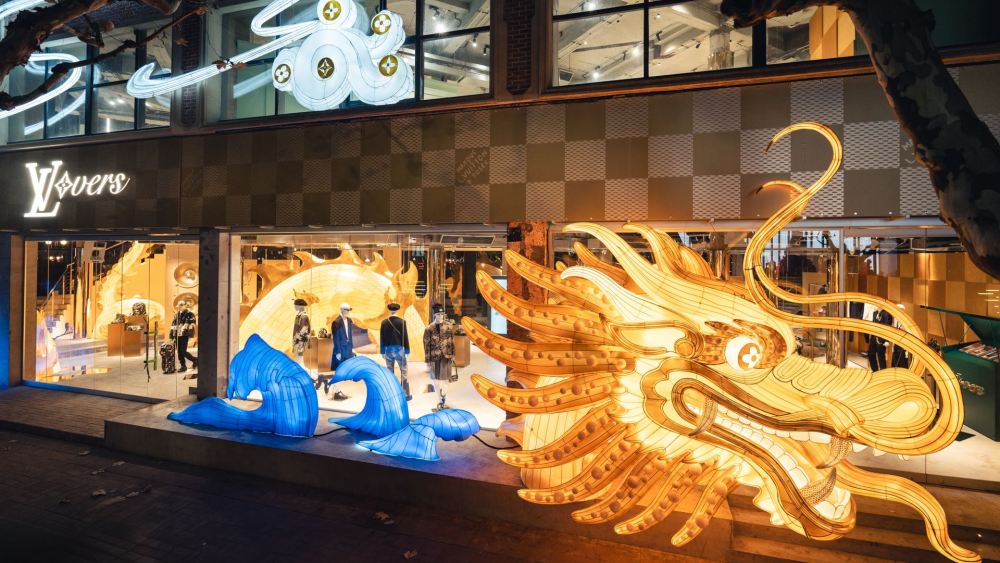
Following a successful experiment of integrating street food and local artisans into the opening event of books and gifts pop-up by the Suzhou Creek in Shanghai, Louis Vuitton surprised VIPs and onlookers with a series of pop-ups that featured oversized dragons ahead of the Chinese New Year; 2024 will be the Year of the Dragon. The festive initiative coincided with the launch of Louis Vuitton‘s menswear creative director Pharrell Williams’ first collection in store.
Making sure 2024 starts with a bang, Williams had already embarked on a whirlwind trip to Chengdu, Shanghai and Beijing last December to interact with local VIPs after bidding farewell to Hong Kong, where the brand hosted its first pre-fall fashion show at the Victoria Dockside. It’s said that only the biggest spenders in these cities were invited to meet with Williams.
A similar spending frenzy could be observed on Chinese social media before and after Chanel reprised its cruise 2024 show in Shenzhen; Miuccia Prada and Raf Simons inaugurated the Second Pradasphere in Shanghai last month, and Cartier entertained its guests on the Great Wall to celebrate its Le Voyage Recommencé exhibition at Beijing’s Prince Jun’s Mansion.
There is little doubt that this formula will be carried well into 2024.
Louis Vuitton has revealed that it will hold its pre-fall 2024 show, a first under the “Voyager Show” concept, at the Long Museum West Bund on April 18 in Shanghai. Dior, meanwhile, will stage its men’s pre-fall show in Hong Kong in the first half of 2024.
The downside of entertaining VIPs at home is the slower-than-expected recovery of travel retail.
According to Global Blue, last month Chinese tourism spending on luxury goods recovered to 82 percent of November 2019 levels.
Cooke added that the rapid development of the Hainan duty-free zone — where DFS, the LVMH Moët Hennessy Louis Vuitton-owned travel retail operator will open its first “seven-star” luxury retail and entertainment destination, DFS Yalong Bay — and the fact that consumers can enjoy a better experience interacting with local sales representatives at mainland Chinese stores designed specifically for them, is offsetting the impact of the price gap between mainland China and popular travel destinations.
Macdonald also anticipated that due to a weaker renminbi and lower inflation rates compared to overseas markets, making domestic travel and purchases more affordable, the travel retail market is unlikely to return to the pre-pandemic level in 2024.
On the other side of the spectrum, Chinese fashion consumers are looking for good value and great design, according to Sherry Huang, founder of the local fashion concept store chain ENG.
“In a polarizing market, our customers are looking for brands with unique design languages that speak to very specific communities like Blumarine, Didu, Greg Ross and Thug Club, or those that can offer unique and affordable designs such as Office Kiko and Anomalies Department,” said Huang, adding that curating a cohesive online and offline presence is key to retaining China’s bold and experimental fashion lovers.
Zhu Chongyun, founder of 30-year-old Marisfrolg Fashion Group, which owns the Italian fashion brand Krizia, said Chinese fashion consumers will only get more rational in 2024.
“No one is going to buy clothes because you are short of that piece of clothing. More often, people buy clothes because they are emotionally impressed and connected to the design. I think no matter how tough the market is, the key is that you create something truly desirable,” Zhu added.