Athletes are chasing the runner’s high…literally.
Cannabis has made its way into running culture, and athletes are opting for THC-infused gummies, tinctures and drinks pre-workout. The goal: to get in the zone and recover post-run.
While the conversation around cannabis and running has been relatively quiet, a 2021 book by journalist Josiah Hesse titled “Runner’s High” brought light to the movement. It explores the cannabis-centric running subculture and argues against the stereotype that marijuana users are lazy.
Related Articles
Now, more athletes are beginning to talk publicly about their experience using THC. Kate Glavan, who recently participated in the New York City marathon, is one of them.
“I first noticed like, ‘Wow, my brain is finally shutting off,’” she says of the first time she used weed before a run.
Now, it’s become a consistent part of her running routine.
“I pretty much used it [for] 99 percent of my runs up until the marathon and I did use weed on race day,” she says.

Glavan isn’t alone — weed-positive run clubs have even emerged, such as New York-based Rage and Release.
“Understanding that cannabis has always been a community tool is [a] reason why I love it so much,” says Rage and Release founder Thai Richards. “You think about high school, you think about college, and when you think about stoners, you think about a group of people. You never think about, ‘Oh that one stoner is always by himself.’ No, there’s always a group of people that smoke together.”
Richards attributes Rage and Release’s success to that community element.
For Richards, cannabis and movement just make sense.
“The first time I ever smoked, we smoked and rode bikes on the lake and climbed trees,” he says. “Cannabis was always an active thing.”
The athletes who show up for Rage and Release’s weekly group runs feel the same way, he says.
“We get people that fly in from different parts of the world,” Richards says. “It’s a beautiful thing to be able to see.”
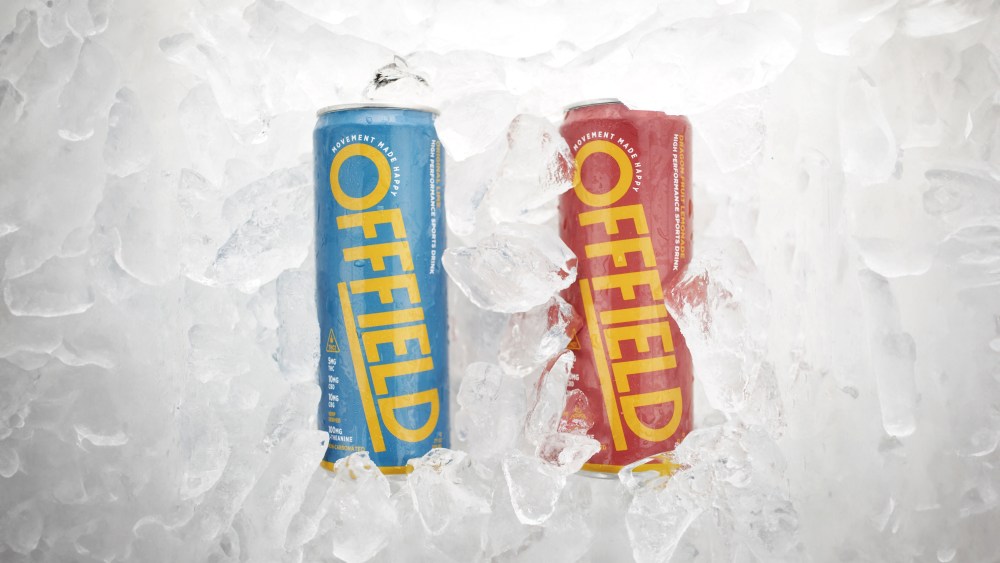
Although THC offerings are numerous, there are a few brands that specifically focus on the athletic experience. Offfield, a favorite of Glavan’s, sells a High Performance Sports Drink ($55 for eight cans), that is infused with 5 milligrams of hemp-derived THC, 10 milligrams of CBD and 10 milligrams of CBG.
“The overall experience is getting out of your head and into your run and actually finding that enjoyment in the occasion,” says Offfield cofounder and chief executive officer Tony Fur. “We’re really trying to define our formula for that occasion.”
The product, which took two years to formulate, was tested by 300 athletes through the brand’s incubator program, Offfield Labs.
Fur suggests that zoning out during a workout can be beneficial. “What you’re doing is allowing your brain to check out,” he says. “Your energy balance is switching. Your brain is taking less energy, which means less calories. It’s applying it to your body that needs it most, so you’re going to be performing better for longer that way.”
Additionally, brands that offer microdosable formulas, like Rose Los Angeles, provide an option for runners looking to customize their highs around the length of their runs.
“I definitely did a lot of experimentation of what physically felt good,” Glavan says, adding that on race day, she drank an Offfield before and cut up Rose Los Angeles edibles into 2.5 milligram pieces to take as needed. “You don’t want to have it where you feel like you can’t feel your body.”
While the ongoing marijuana legalization has led to a more open conversation, there is still a large stigma around using the drug.
“I have a social media following and a platform and [there are] mass incarceration and racial disparities that come up with weed, like, if I can use it as a white woman that’s living in New York City, I sure as hell should be open about it because I know that I am in a very privileged position to be able to destigmatize this thing,” Glavan says.
Richards, who was featured on the cover of “Runner’s World” and has collaborated with brands like Nike and Hoka, says there’s a lot of work to be done, especially for athletes.
“There’s still a lot of stigmas that I even right now am combating,” he says. “The trend that is happening right now, it’s helpful but it’s not helpful because there are a lot of people who haven’t been cannabis advocates or cannabis users long enough to even speak on the culture.”
According to Richards, the true turning point will be when brands are willing to fund cannabis-centric runners and groups to help them grow.
“There’s very few runners that want to openly admit that they use. There is this stigma that sponsorships are going to be revoked,” says Glavan, who is a Hoka ambassador. “As more and more runners talk about it, it’ll be a ripple effect where other runners feel like they can talk about it.”